Water Rescue Boots Wholesale Supplier for Flood and Swift Water Rescue
Equipping a rescue team, fire department or disaster-relief program? As a water rescue boots supplier, safety boots supplier and rubber boots supplier, YIROUFANG supplies neoprene water safety boots built on a double-layer insulating upper with synthetic leather reinforcement. We sell wholesale and bulk, support OEM, and ship worldwide from China with 20+ years behind us.
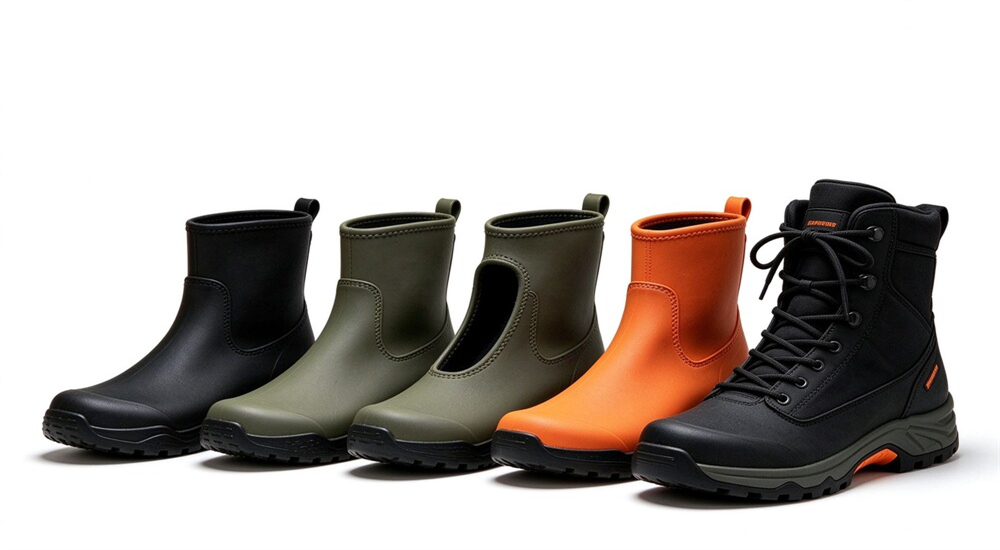
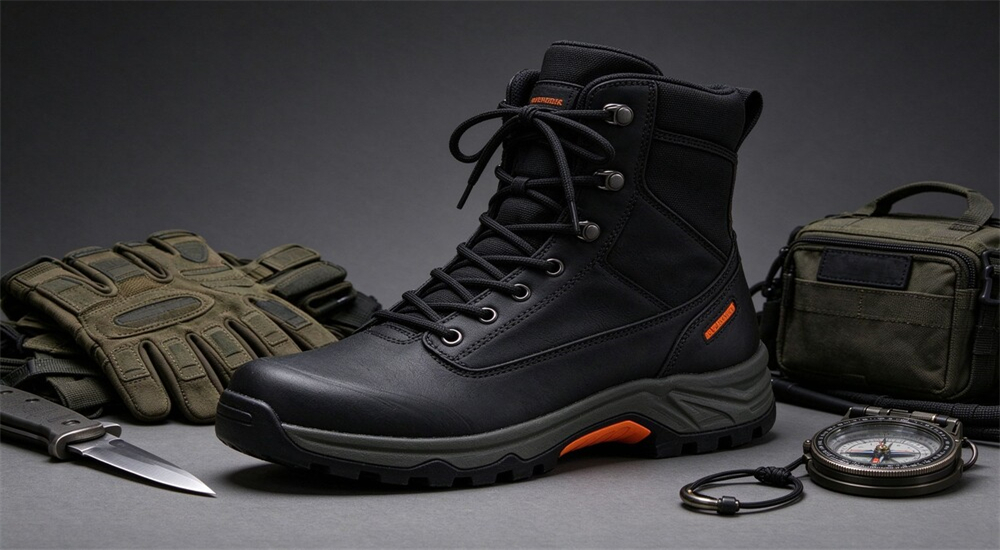
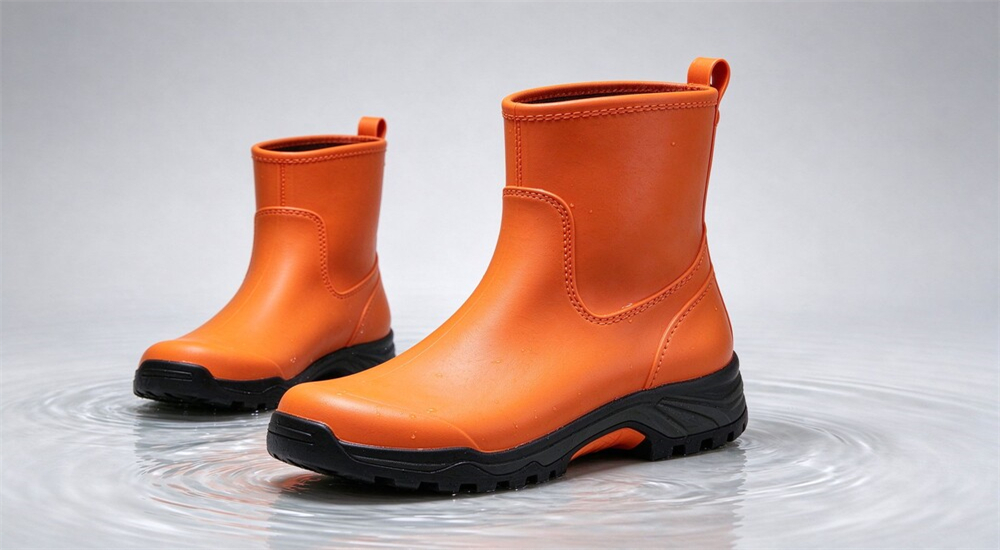
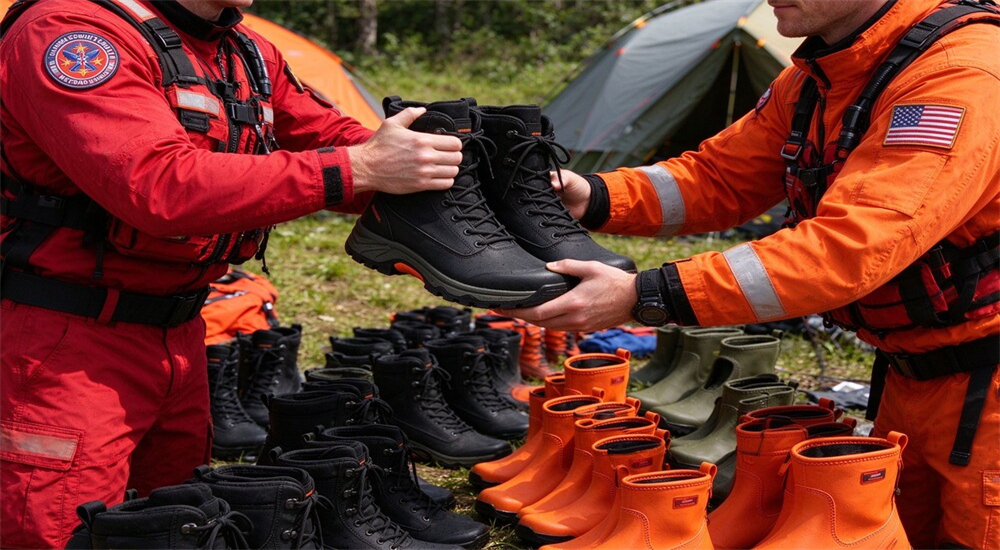
One hazard does not fit one boot. As a fire service boots supplier, the range you see above covers mid-cut and high-cut shafts, rubber and felt outsoles, lace-up and BOA closures, and black or orange uppers. That is why distributors and fire departments mix models in one order: a city flood team runs a different spec than a swift water rope team. Send us your scene and we will suggest the model mix that fits.
City flood is where most buyers first feel the problem. Ordinary rain boots fill up with cold water, slip on submerged tiles, and fall apart after a dozen wades. These flood response boots carry an insulating neoprene upper and a non slip rubber outsole that keeps the rescuer upright on covered asphalt and submerged steps. The difference shows after two hours in, not after ten minutes.
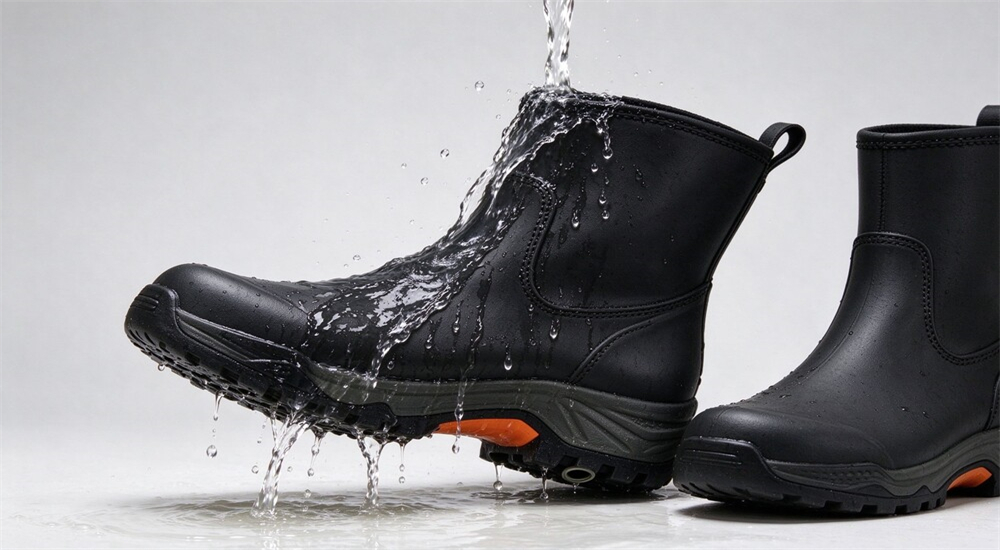
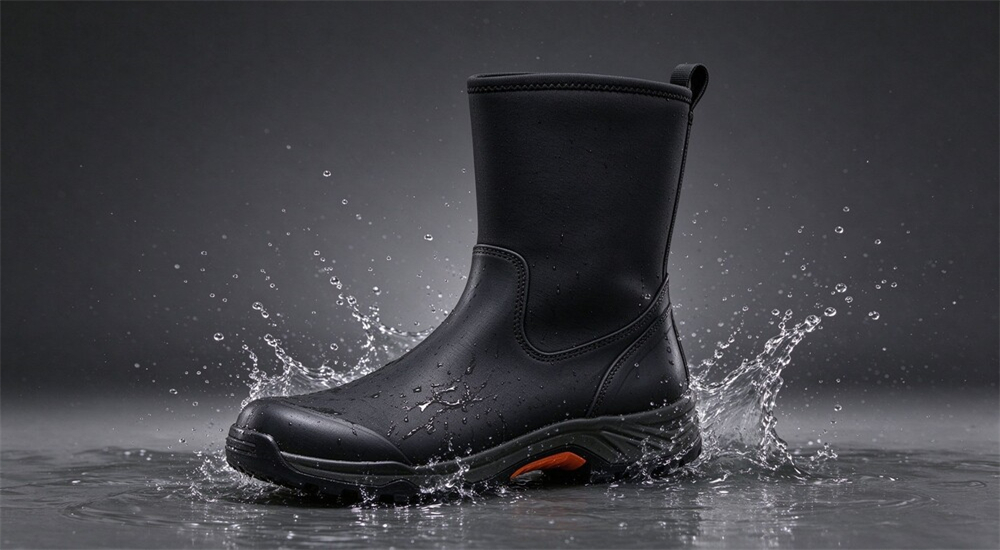
A sealed boot is a heavy boot. Water that gets in has to get out, or every step sloshes and adds weight. These waterproof rescue boots use small side and heel drain holes so trapped water leaves as soon as the wearer steps out. The boot stays light, dries between shifts, and does not turn ankle fatigue into a fall late in a long flood response.
Half of real flood response happens after dark. A rescuer in dark boots disappears against black water and wet asphalt, which is why we offer orange and hi-vis options. The reflective and fluorescent panels on these swift water rescue boots keep each crew member visible to the rest of the team and to boat drivers in low light.
Broken glass, nails, rebar and brick under murky water are not a worry you notice on dry land. Reinforced toe caps and molded rubber bumpers take those kicks so a single hidden nail does not end a shift. These non slip rescue boots are built for rubble-strewn urban flood ground where a smooth-soled rain boot would slide and a thin upper would puncture.
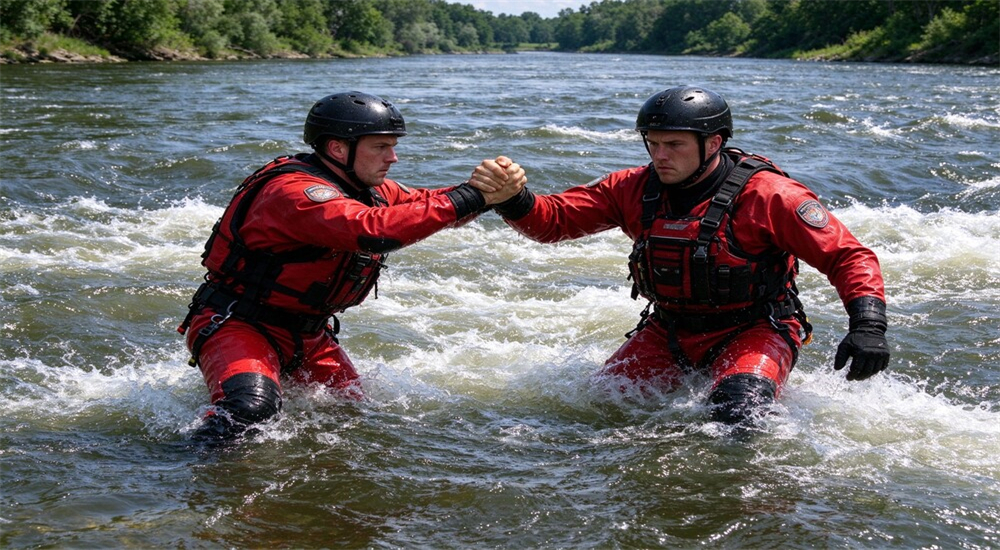
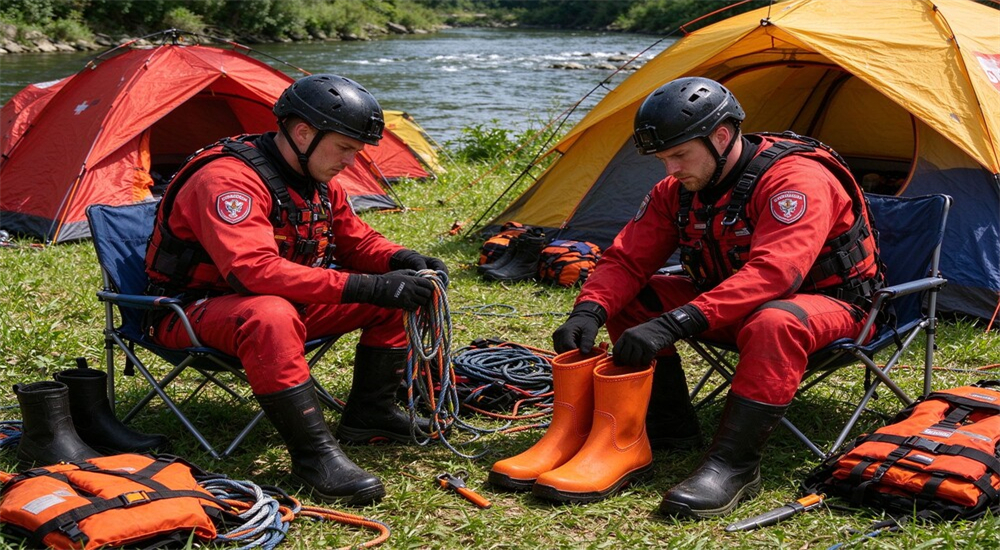
Before the crew steps into moving water, they stop on the riverbank and walk the plan through: the boat position, the rope line, the swimmer order. That ten minute huddle on the bank is what keeps a fast current from turning into a rescue of the rescuer. The boots under them are still dry at this point, but the whole team knows they will be in within minutes.
The orange and black boot family covers different job profiles in the same flood response team. High-cut for swift water, mid-cut for urban search, fluorescent for night work. Color coding lets the incident commander match a boot to a task at a glance, and keeps the crew sorted before they hit the water.
|
Model Range & Types |
Protective Construction Features |
|
How to Choose |
Product Detail Gallery |
|
Mid-Cut vs High-Cut |
Sizing & Fit |
|
Flood Rescue Boots Guide |
Maintenance & Care |
|
Application Scenarios |
Custom & OEM |
|
How the Warm Layer Works |
Wholesale & Bulk Order |
|
Rubber vs Felt Outsole |
Industry Applications |
|
Lace-Up vs BOA Closure |
About Our Company |
|
Thin Ice Rescue Operations |
Key Points to Confirm |
|
Firefighter Boots |
FAQ |
|
|
Get a Quote |
One hazard does not fit one boot. A flood wading team on city streets needs a light, fast mid-cut; a swift-water rope crew needs a tall, locked-down high-cut; a river team on slippery algae rock needs a felt outsole. We cover all of these with a clear model line so buyers can match the boot to the job instead of guessing.
Every model shares the same core build and differs only in cut, outsole and closure — that way a procurement team can mix mid, high, rubber and felt in one carton without learning a different spec for each one.
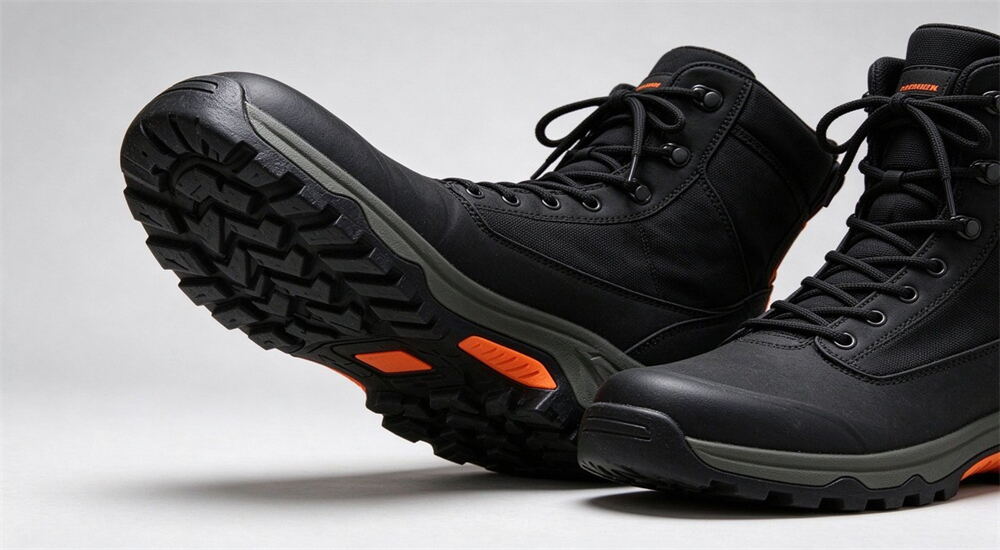
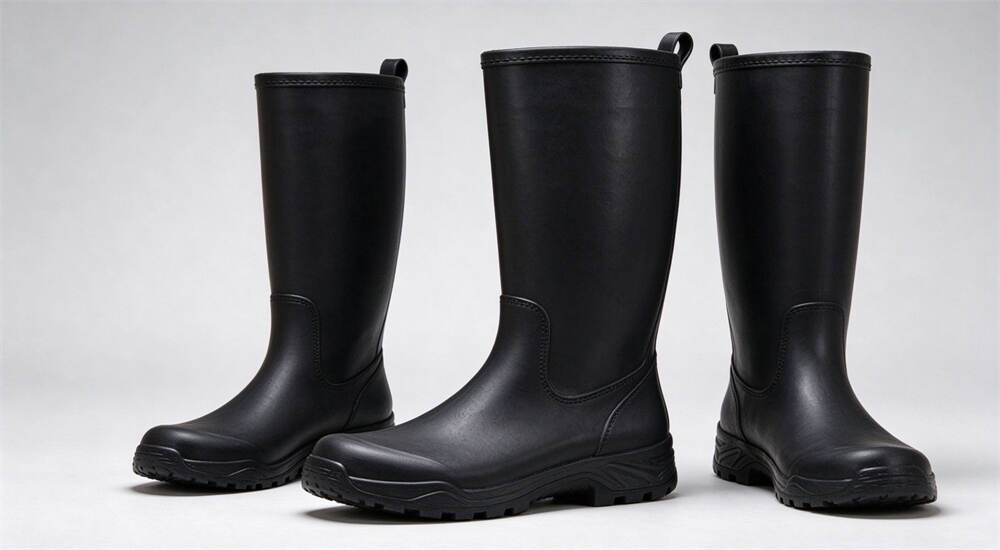
Choosing between lace-up and high-cut comes down to how much water the team expects to take on. A lace-up high top laces tight to the shin and blocks splash on shallow urban work. A slip-on high cut saves sixty seconds on every donning but trades that lace lock for a neoprene pull-on. The three angle view below shows both silhouettes side by side so a procurement team can compare shaft height, toe shape and outsole tread without guessing.
The high cut shaft also changes how the boot packs. It takes more room in a kit bag but buys lower leg protection when current pushes a rescuer sideways. Buyers usually mix mid-cut for city teams and high-cut for river teams in one carton.
Here is the full range in plain language, grouped by how the boot closes and how high the shaft runs. Tell us your terrain and roles and we will recommend the right mix.
The high cut and mid cut choice comes down to ankle support versus entry speed. A high cut wraps the lower shin and holds the ankle when current pushes sideways, but it takes a second more to slide into. Mid cut boots step on in two seconds, which matters when the fire truck is already rolling.
Across the whole range the build stays consistent so buyers can mix models without guessing the base spec. This is the one place the material spec is written down once; the rest of this page talks about what each part does in the field.
The high-cut shaft wraps the lower shin and keeps river rocks and branches from sliding inside the boot. On a single-file crossing, that extra two inches of coverage matters when a foot catches a submerged stone and rolls. The neoprene upper flexes with the ankle instead of holding rigid. On a steep river edge, that flex is what keeps the boot from twisting.
|
Specification |
Detail |
|
Upper |
Double-layer high-stretch neoprene plus synthetic leather panels at wear zones |
|
Outsole |
Molded non-slip rubber with deep lugs standard; felt outsole option for wet rock |
|
Closure |
Front-opening, BOA quick-dial or lace-up, depending on model |
|
Cut |
Mid-cut (ankle) or high-cut (above ankle, wraps lower shin) |
|
Protection |
Reinforced toe cap and heel, ankle coverage, side and heel drains |
|
Sizes |
Full EU/US range; size up when wearing thick rescue socks |
How to read this range: Start by choosing the cut (mid or high) for your water, then the outsole (rubber for mixed ground, felt for wet rock), then the closure (front-opening and BOA for speed, lace-up for a tuned fit). Tell our team your terrain and roles and we will recommend the model mix.
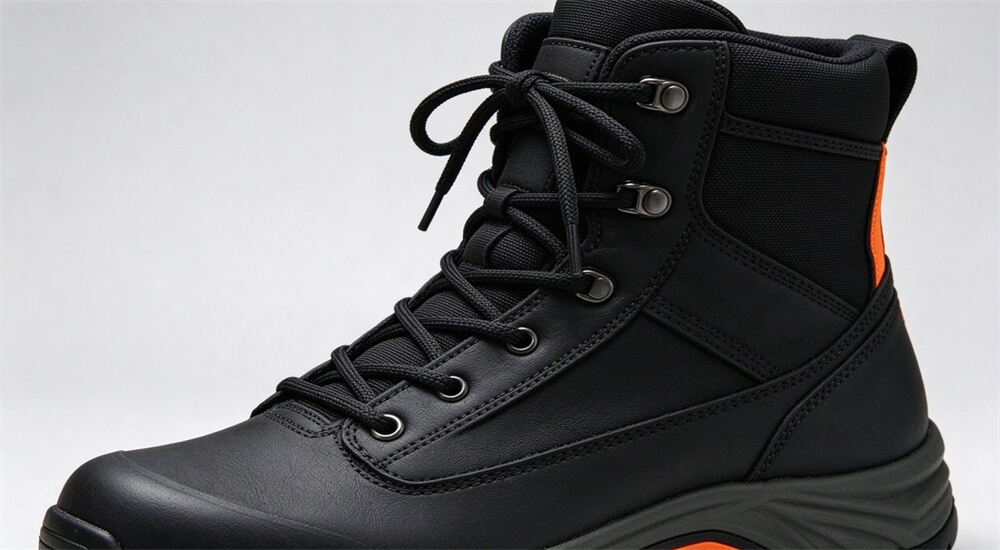
Once the model is chosen, the next decision is how the crew will wear it on moving water. A single-file river crossing puts every boot on smooth rounded stones and variable current depth. The outsole has to bite wet rock, the shaft has to shed branch scrapes, and the drain holes have to clear after each step. This is where a mid-cut boot ends and a high-cut boot earns its place.
Picking the right water safety boots comes down to matching hazards to construction, not price. Work through these points before you request a wholesale quotation. Getting them right protects wearers and cuts replacement cost across a whole fleet.
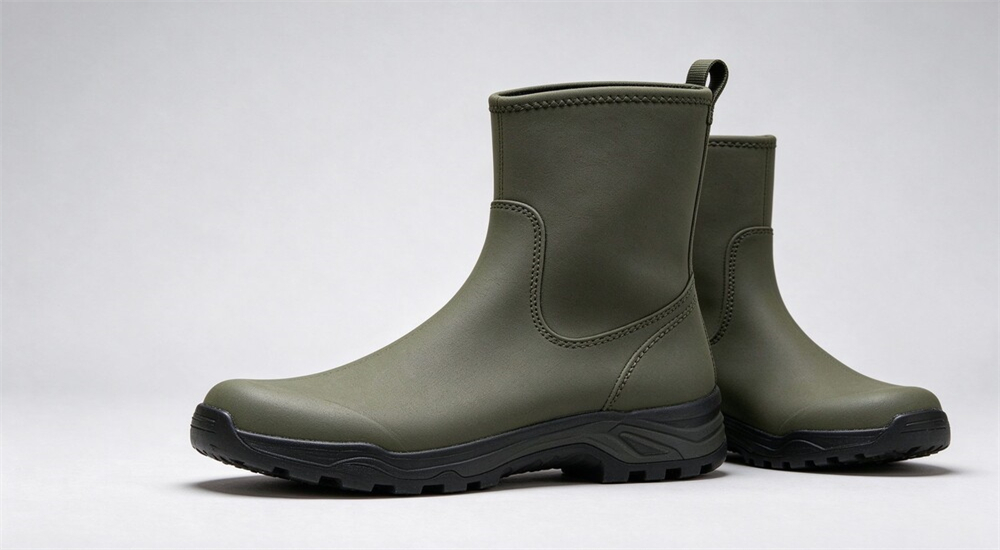
The single biggest choice after size is the boot shaft height. Mid-cut boots end at the ankle and stay light and quick to slip on. High-cut boots extend above the ankle to wrap the joint and lower shin, locking the foot in when it is pulled around by current. The comparison below explains the trade-off so procurement picks the right cut for each team role.
When a high-cut crew crosses a shallow river in single file, the shaft wraps the lower leg and keeps debris out of the boot top. A mid-cut crew steps lighter but expects water over the ankle on every step. The choice shows up in the second hour, not the first.
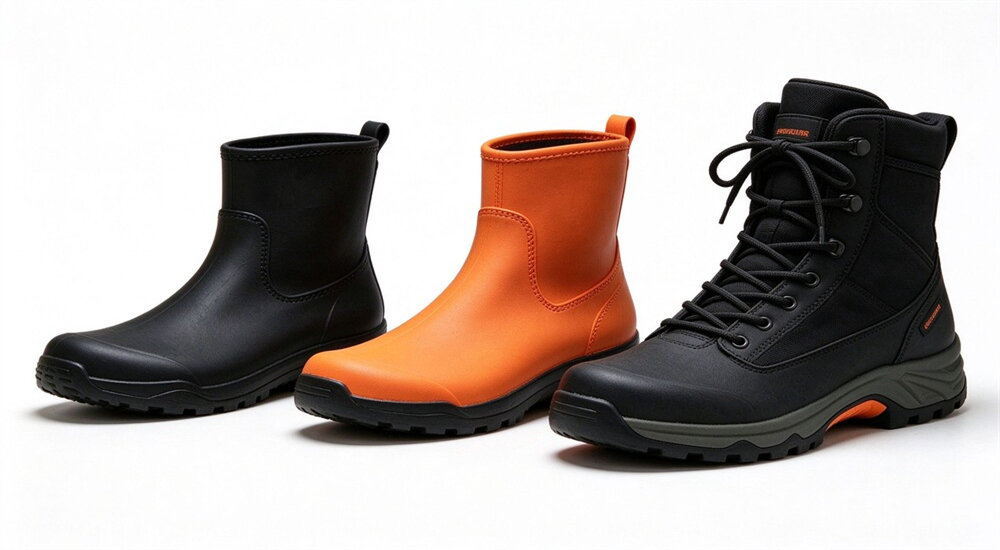
Mid-cut is about speed and comfort; high-cut is about support and lockdown. The table below lays the two side by side.
|
Point |
Mid-Cut Model |
High-Cut Model |
|
Shaft height |
At the ankle |
Above the ankle, wraps lower shin |
|
Ankle support |
Moderate; flexible |
Strong; limits twist and rollover when current pulls the foot sideways |
|
Weight / agility |
Lighter, more agile for wading and deck work |
Slightly heavier, more supportive in moving water |
|
Donning speed |
Very fast, front-opening / BOA options |
Slower; lace-up plus strap needed for a locked fit |
|
Best for |
Flood wading, boat deck, mud, hot climate |
Swift water, rope teams, uneven rubble |
|
Typical buyer |
Municipal flood response, disaster relief |
Fire & swift-water units, rescue academies |
Quick pick: If your teams mostly wade standing water and board boats, mid-cut is faster and cooler. If members stand in moving current or walk broken shoreline rubble, step up to a high-cut — one rolled ankle pulls a rescuer out of the water and off the mission.
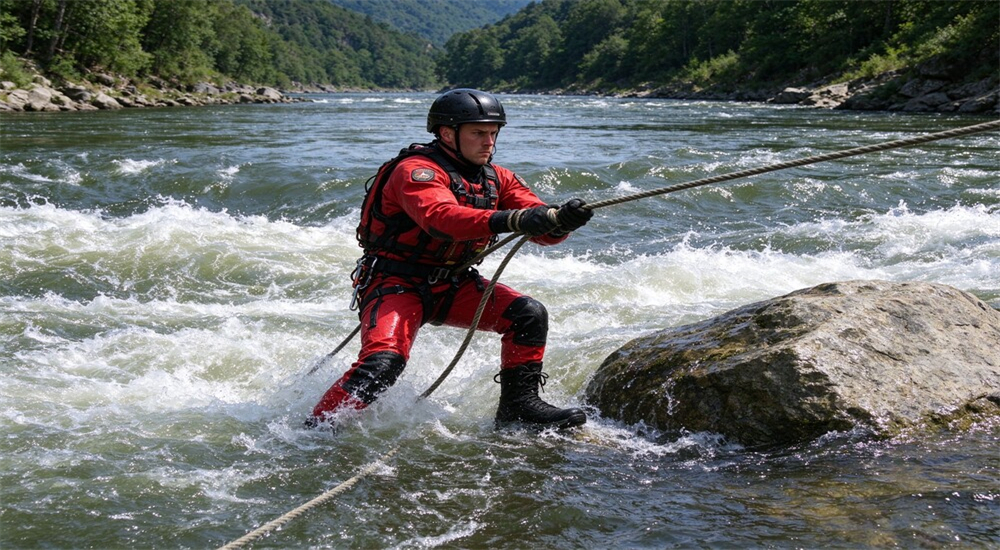
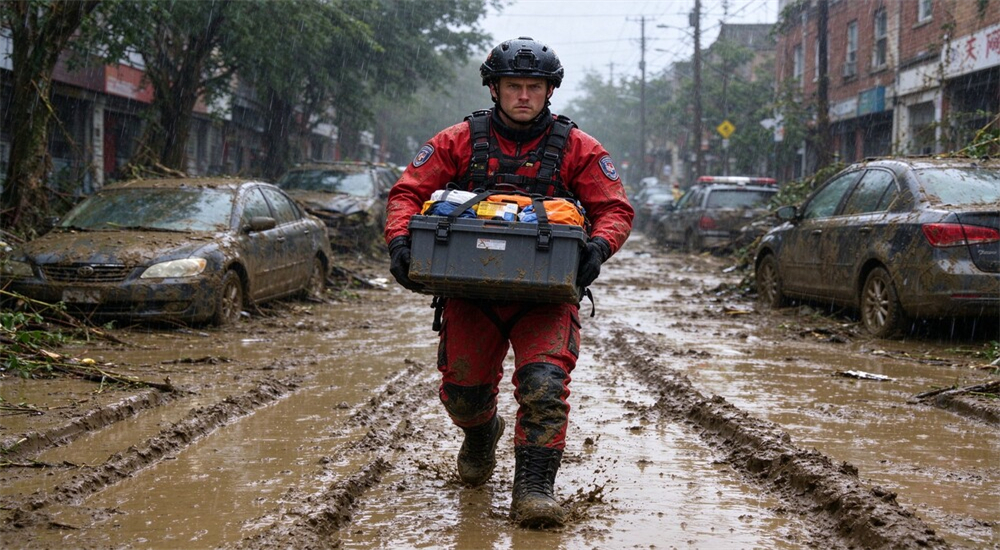
Flood scenes mix turbid standing water, hidden debris, broken glass and submerged rubble. Good flood rescue boots — what many teams call flood response boots — protect feet from sharp objects, hold warmth against cold water and grip slippery surfaces. The points below map flood-scene hazards to the build that answers them, so you buy the right boot rather than a generic rain boot.
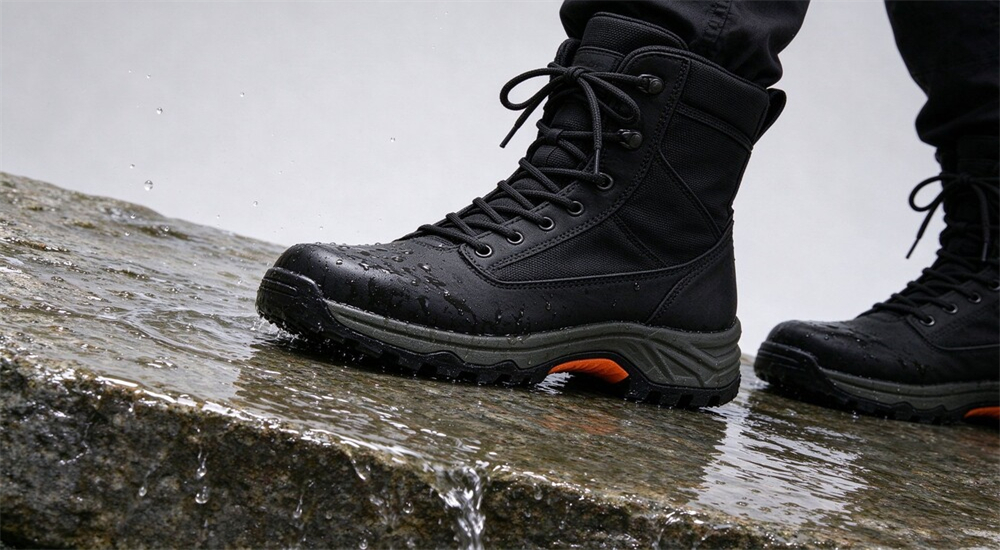
Training river scenes also reveal how the sole bites dry concrete steps, boat launches and wet pond edges, which is where urban flood teams often end up after the water recedes. That transition from fast-moving current to still shallow water is where many rescue slips happen, and the deep rubber lugs on these flood response boots keep the rescuer upright when the surface looks stable but is not.
Close-up of the deep-lug rubber outsole biting a wet concrete surface — the grip that keeps a rescuer upright on a half-submerged curb or car park slab.
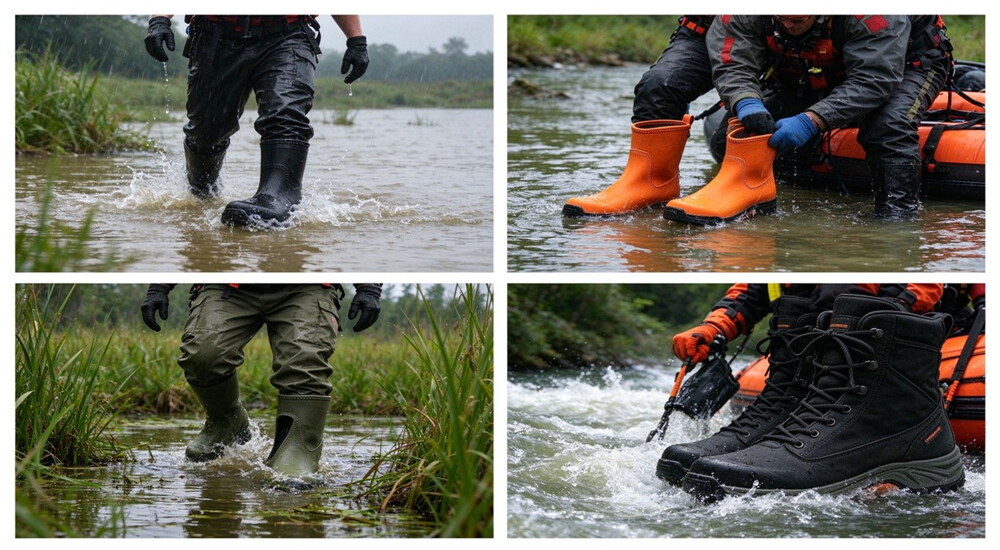
A spec sheet is only useful when it maps to a real callout. Below are seven of the most common water-rescue footwear jobs, each shown with a team actually working in the field. For every one we spell out what the ground and water feel like, what goes wrong when a rescuer shows up in ordinary rain boots, sneakers or bare feet, and exactly which part of this boot fixes it.
Match your team's daily scenes to these before you lock the wholesale spec.
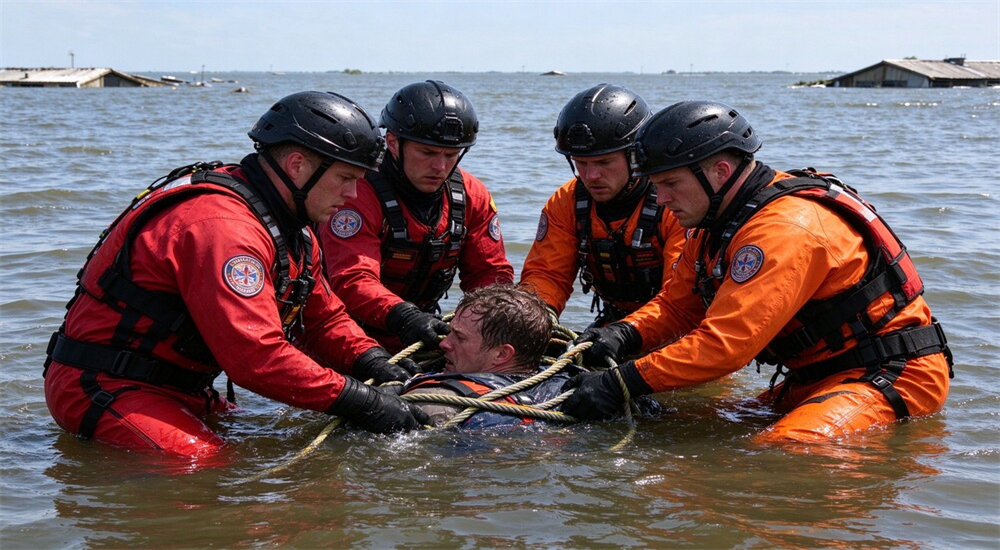
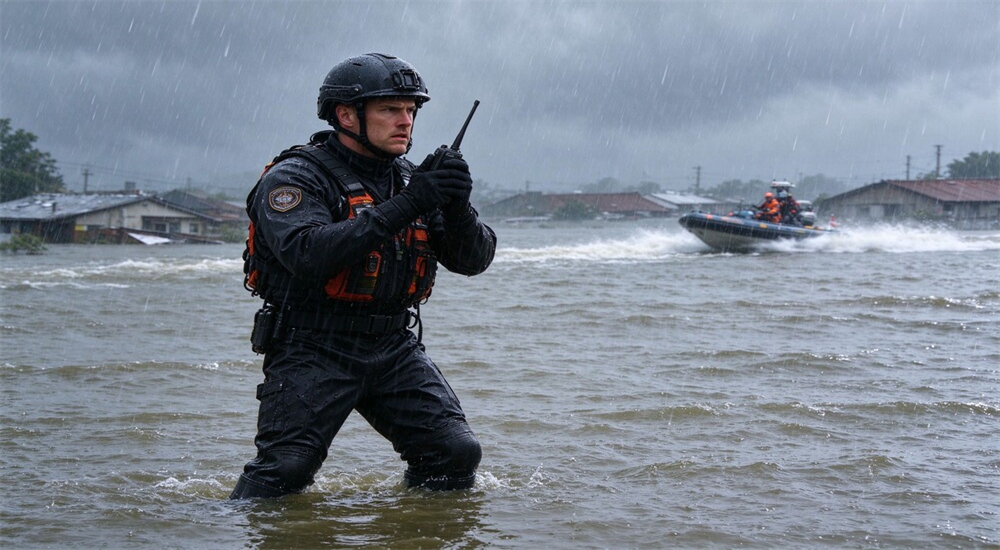
A rescuer wading through chest-high urban floodwater — the reinforced toe and deep-lug outsole are what keep him moving when the bottom is invisible.
The scene. A city road under 0.5–1.5 m of turbid water, with stalled cars, traffic signs, fallen branches and mixed household and construction debris hidden under the surface.
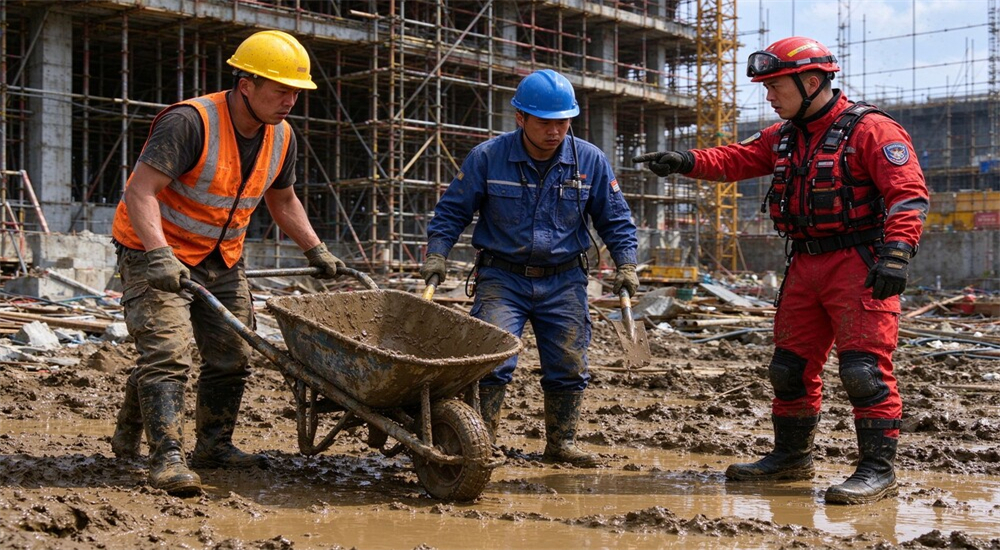
What your feet face. In chest-deep urban floodwater you cannot see the broken glass, nails and rebar under your feet. Underfoot may be a collapsed drain cover or a half-submerged car roof that rolls when you put weight on it. The water is cold and fast enough to push you off balance.
What ordinary gear does wrong. A standard rubber wellie has a thin upper that punctures on a hidden nail, and a smooth sole that slides off a slick car roof. A running shoe soaks through, heavier with every step, with zero puncture protection. One cut or slip turns a rescuer into a second patient.
How this boot solves it. These are the flood response boots municipal teams reach for: the reinforced toe cap and rubber outsole take that cut so you keep moving. The deep-lug molded rubber tread bites submerged asphalt and car roofs. The side and heel drains empty the boot the moment you climb onto dry ground, and the double-layer warm shell holds warmth through the cold water.
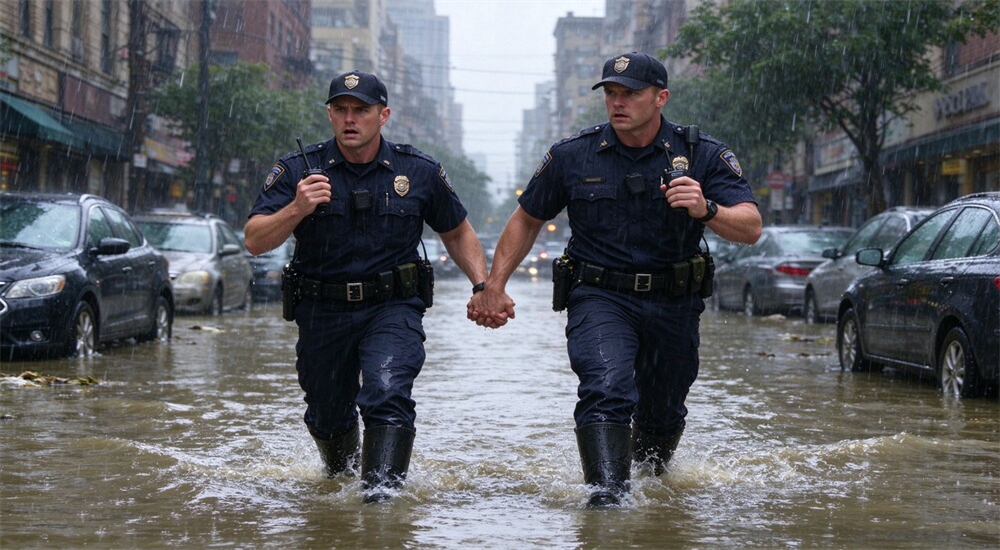
Once the crews have the street clear, police and community wardens step in to mark unsafe water depths and keep residents out. Their boots see a full shift of wet curb and sidewalk, not just the rescue push. A non slip outsole that holds on slimy concrete keeps patrols steady through the afternoon.
Back at the training ground, crews run the same wading drills over and over until the step is automatic. Each drill soaks the boots, drains them and dries them again. A pair that survives a hundred training dives will survive the real call, and a pair that doesn't will fail on the first shift.
These are water and ice rescue boots, and ice rescue boots specifically demand a firmer outsole grip on smooth frozen surface, built for both flood current and frozen surface. From the training river, the next step is cold-water ice rescue. The boot has to grip a totally different surface and keep the foot warm when the air sits just above freezing. This is where a waterproof upper and a neoprene liner earn their keep.
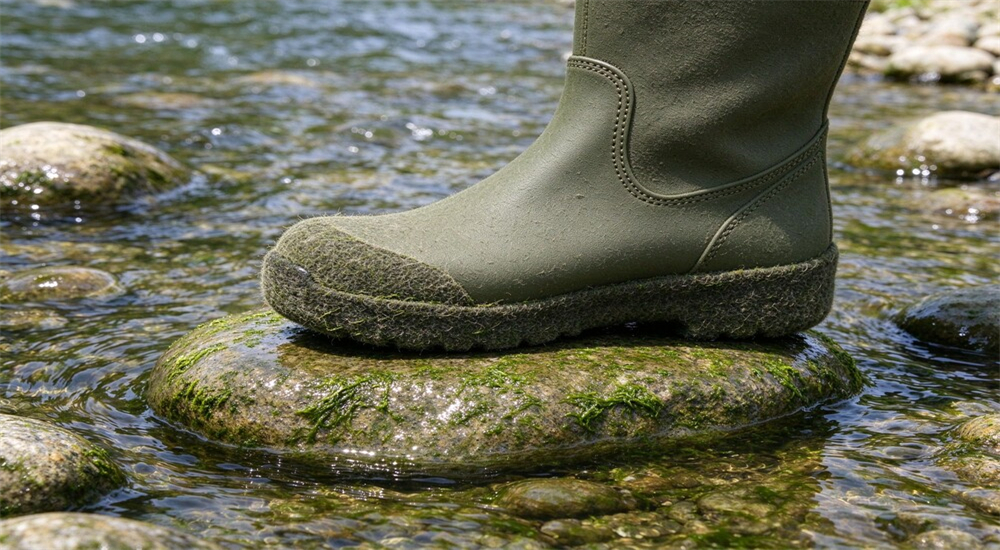
In shallow river water the outsole contact point is what keeps the rescuer from sliding off smooth algae-covered stones while carrying a victim or rope bag. A felt outsole is the better choice on this kind of surface, because rubber skates on thin wet algae and turns a steady wade into a slip. Tell us whether your team stands on rocks or on paved urban ground, and we will spec the right outsole.
Close-up of the boots planted in shallow moving water — the high-cut shaft keeps the ankle locked when the current shoves the foot sideways.
The scene. A swollen river or stream, water moving fast, pushing against your legs, able to yank your foot sideways or drop it into a hidden hole.
What your feet face. Current shoves your foot at an angle, your toe catches on a submerged rock, and your body keeps going — exactly how ankles roll. You also need the boot locked on tight, because a loose boot fills with water and slows every stroke.
What ordinary gear does wrong. A low rain boot lets the ankle bend past its limit; a loose lace-up swims in the water. A rolled ankle here means going down in moving water — you become the victim your team came to save.
How this boot solves it. These swift water rescue boots are built for exactly this: the high-cut shaft wraps the ankle and lower shin so the joint cannot roll. The BOA dial or lace-up plus ankle strap locks the foot evenly so the boot does not swim. On algae-covered rock the felt outsole grips where rubber would skate — the difference between stable footing and being swept off your feet.
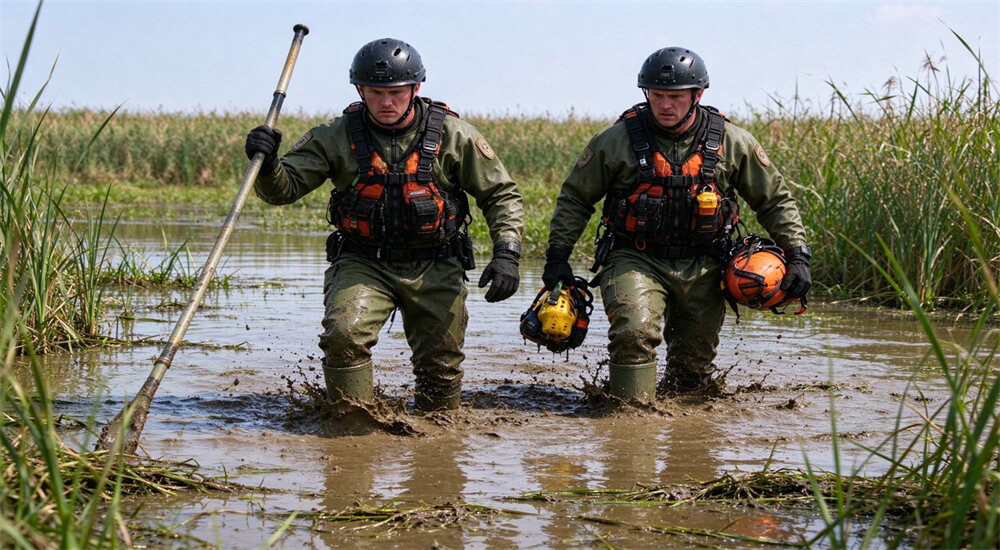
The scene. A reed bed, flooded field or coastal marsh where the bottom is soft, sucking mud — not rock or road. Each step pulls the boot down and the mud tries to pull it off your foot.
What your feet face. Two problems at once: the mud sucks the boot off as you lift your foot, and any water that seeps in stays there, making the boot heavy. You also walk long distances over uneven, invisible ground.
What ordinary gear does wrong. A heavy rubber wellie stays full of mud and water, doubling its weight by the third step — over a 4-hour search that extra load turns knee and ankle fatigue into a fall. A light sneaker lets mud in, offers no warmth and punctures on hidden sticks.
How this boot solves it. The lightweight shell keeps the boot itself low on weight, and the side and heel drains let any water flush out fast. The snug stretch fit resists the mud's pull so the boot stays on when you twist free. The deep-lug rubber outsole grips soft, unstable bottom better than a smooth flat sole.
Muddy floodwater is one surface; wet grass and soft riverbank mud is another, and the same non slip tread has to work on both without clogging up. The deep lugs self-clean as the wearer steps, so the boot does not turn into a mud ski. Marsh rescue teams who work reeds and soft bottom tell us this is the detail that separates a one-season boot from a five-season pair.
Close-up of the boot stepping through muddy floodwater — the stretch shell stays sealed while the drains let dirty water escape once you step back onto solid ground.When the rescue moves from inland swamp to open shoreline, the boot’s job changes from mud traction to boat-deck grip and surf-zone stability. Saltwater adds a third requirement: fresh-water rinse after each shift so the neoprene shell and stitched panels do not degrade early. Coastal teams run a shorter service cycle than inland flood teams, and we price replacement accordingly.
The boots planted on wet grass and suction mud — the snug stretch fit resists the mud's pull so the boot stays on when you twist free.
We also handle fire service boots wholesale for station reorders. As a military tactical boots supplier, we note that military and civil defense units move food, water and medical supplies through wet field routes. The boots under them carry heavy loads on soft mud and gravel tracks, so the outsole has to stay stiff and the heel has to lock the foot in place over a ten kilometer march.
From the muddy field track, the mission shifts to the coast. Surf and near-shore work puts the boots on wet boat decks, salt spray and abrasive sand. The outsole has to grip a fiberglass deck that a rain boot would skate on, and the upper has to shrug off repeated saltwater rinses.
On a wet fiberglass boat deck the boot color matters as much as the grip, because a dark boot disappears against a dark hull at dusk. Orange and hi-vis options keep each crew member visible to the coxswain and to other boats. If your agency does night operations, we strongly spec orange or fluorescent rather than plain black, even if the black pair looks cleaner in the warehouse.
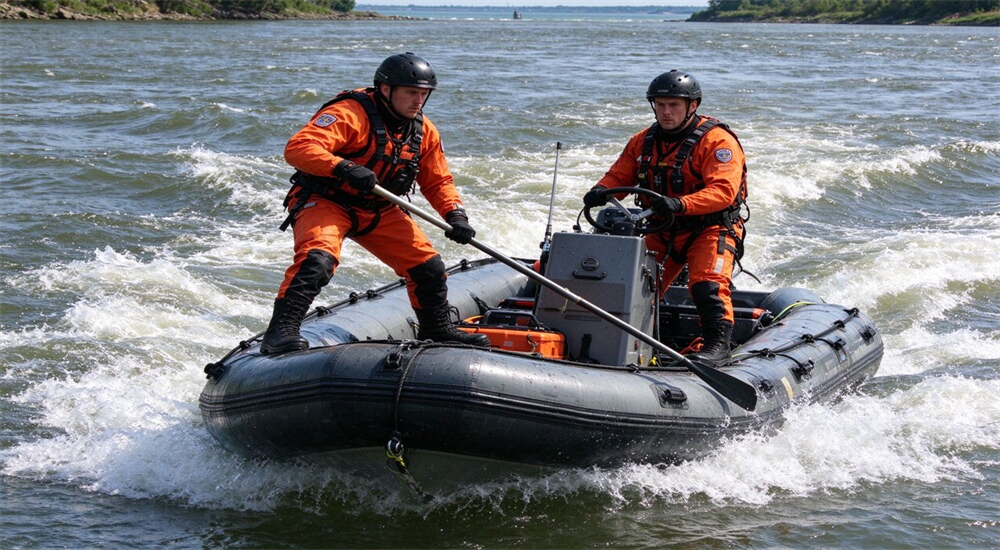
Orange boots planted on a wet moving boat deck — the deep lugs bite a fiberglass or aluminum deck while the functional orange keeps the wearer visible.
The scene. A rib boat deck, rocky shoreline or surf zone where the deck is constantly wet and spray, the boat rocks underfoot, and rope, shackles and deck hardware can abrade or pinch the foot.
What your feet face. A wet, moving fiberglass or aluminum deck plus repeated bumping into boat frames. Salt water also degrades cheap material fast, so the boot has to hold up to repeated immersion without stiffening or cracking.
What ordinary gear does wrong. A deck shoe has no toe or heel protection, so a kicked shackle can injure the foot. A plain rubber boot stiffens and cracks after repeated salt exposure and offers no ankle hold when the boat rolls.
How this boot solves it. The deep-lug molded rubber outsole bites a wet, moving deck. The reinforced toe cap and heel take kicks against boat hardware. The synthetic leather wear panels resist abrasion from rope and frame edges. After salt use, a fresh-water rinse keeps the shell from degrading early.
The scene. A callout that runs into darkness or a night-time search where the beam of a torch only lights one step ahead of you.
What your feet face. You cannot read the bottom at all. Every step is a gamble on whether there is glass, a nail, a branch or a drop-off under the water. You are also more fatigued, moving slower, and more likely to mis-step.
What ordinary gear does wrong. Without toe protection, the very first unseen stub on glass or rebar ends the shift. Without drains, a boot that fills with water sloshes on every step, throws off your balance and makes you stumble when visibility is already near zero.
How this boot solves it. The reinforced toe cap is the night-scene insurance: a shard or nail you cannot see becomes a harmless bump instead of a cut. The side and heel drains keep the boot light so each stride stays controlled. The high-cut option braces the ankle when you step wrong in the dark, and the functional orange/army-green tones keep the wearer visible to the rest of the crew.
Lightweight waterproof tactical boots help on long shifts. Long shifts wear on the rescuer as much as the boot. A pair that drains and dries between calls keeps the next shift as safe as the first one. Rotating two pairs per team member is standard practice for flood response agencies, because a waterlogged boot chills the feet and slows reaction time. We price team kits with this two-pair-per-rotation model in mind.
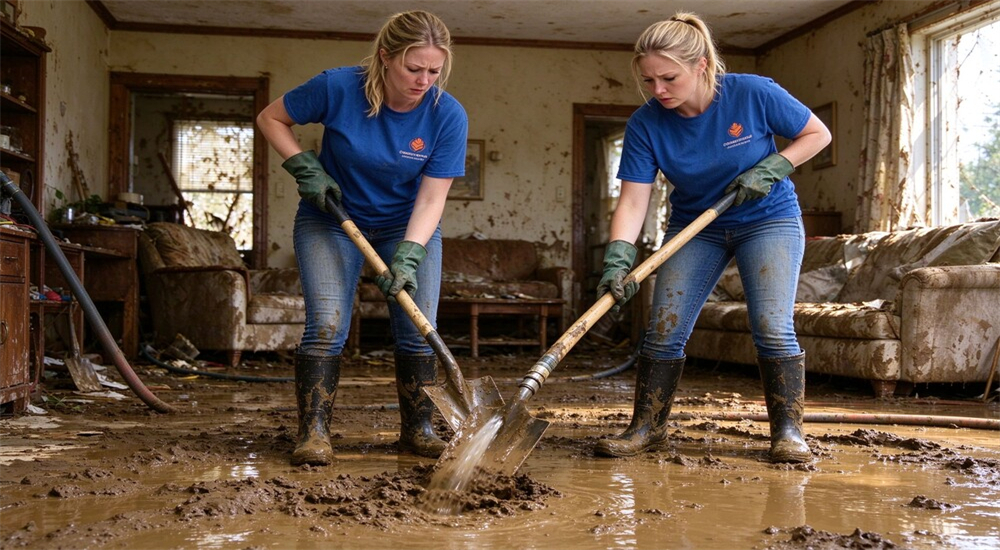
Long shifts wear the crew down, but the work does not stop at the waterline. Emergency boots for volunteer crews: once the flood starts to recede, volunteers move into the houses and start hauling out mud-soaked belongings. They kneel on wet floors, stand in slime and rinse walls for hours.
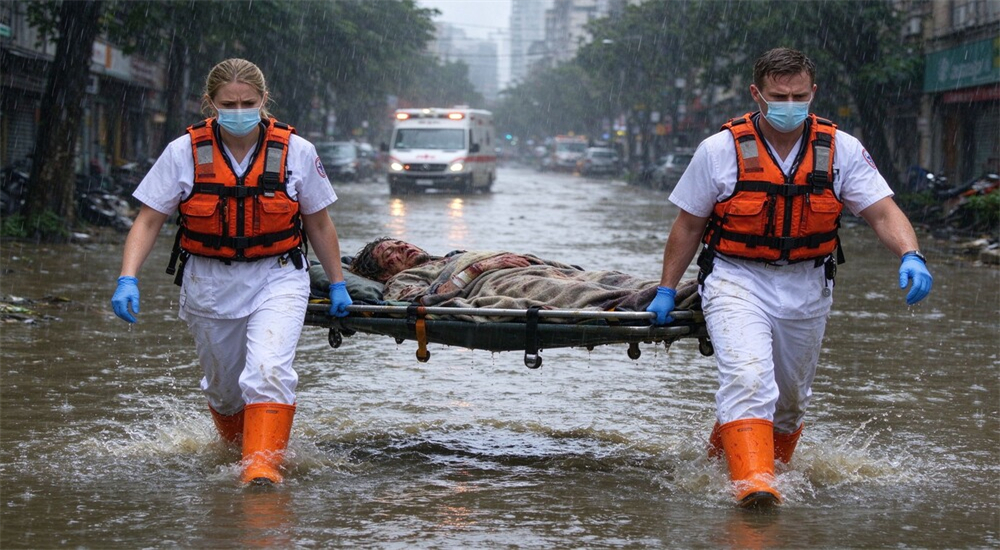
Waterproof work boots and waterproof tactical boots with an upper that hoses off in seconds keeps the indoor cleanup moving instead of turning every room into a second wet zone. Medical teams then carry stretchers through the same water to evacuate residents.
The white background shot is what buyers send to their own catalog designer. Every pair ships matched: same color lot, same outsole depth, same lining thickness, so a 100-pair order looks the same as the sample on the table.
A rescuer still on shift after hours in the water — side and heel drains stop the boot gaining weight across the long, cold shift.
The scene. A sustained flood response, camp support or multi-shift mission where the same boots stay on for a full working day, on and off the water, hour after hour.
What your feet face. The problems compound: a boot that holds water gets heavier with every step over 8 hours; cold exposure builds up slowly until numbness sets in; seams that flex all day will fail if not reinforced; and a heavy boot turns knee and ankle fatigue into slips late in the shift when the rescuer is already exhausted.
What ordinary gear does wrong. A cheap PVC boot starts light but goes clammy and stiff by hour three, offers no real warmth, and lets waterlogging add weight all day. By hour eight the wearer is stumbling on tired feet — the most dangerous moment of the whole operation.
How this boot solves it. The side and heel drains keep water from pooling, so the boot does not gain weight across the shift. The double-layer warm shell keeps heat loss slow rather than letting cold creep in. The ankle synthetic-leather plus rubber-reinforced stitching resists seam separation after thousands of flex cycles, and the lightweight shell keeps late-shift fatigue down.
Long shifts spill over into indoor cleanup. Volunteers kneel in muddied living rooms, hosing mud off walls and floors, and their boots track in river water and silt. A waterproof upper that rinses clean keeps the work moving instead of turning the house into a mud pit.
Safety standards and certifications explained in plain language: buyers who want to compare materials should ask for a sample rather than a catalog photo. A pair in hand shows the neoprene thickness, the stitch length, the outsole density and the lining feel that a product shot cannot convey. That is why we always suggest a sample before a bulk order.
The scene. A debris field, collapsed-structure flood scene, demolition zone or wreckage field where the ground is sharp, uneven metal and broken building material, partly submerged.
What your feet face. Puncture and impact are the constant risk: a nail head, a shard of window glass, a bent rebar end, a piece of sheet metal. You are stepping on things that would go straight through a soft upper or a thin sole. The uneven surface also twists the ankle.
What ordinary gear does wrong. A standard wellie or shoe upper splits on the first serious kick, and a thin sole lets a nail through the bottom. A puncture wound in contaminated floodwater is not just a lost shift — it is a serious infection and a medical problem for the whole team.
How this boot solves it. The reinforced toe cap absorbs the impact of kicked debris; the reinforced heel protects the back of the foot as you back into rubble. The molded rubber outsole and synthetic leather reinforcement zones resist puncture and abrasion where the boot takes the most abuse. The high-cut shaft braces the ankle against the uneven, twisted ground.
We also handle wholesale work boots and tactical boots for construction crews. After the rubble rescue, the job turns to moving victims out. Medical teams wade through waist-deep water carrying stretchers and backboards, and the boots under them have to grip smooth submerged concrete steps and boat ramps. These flood response boots are built for that slow, careful carry.
As a fire rescue boots supplier we hear the same call from every station. Talk to any rescuer who has stood in 10°C floodwater and they will tell you the enemy is not the water itself — it is the slow creep of cold until the feet go numb. Numb feet do not feel the ground, cannot react to a hidden hole, and lose the fine balance that keeps a standing rescuer upright.
This is why the upper is built the way it is, and why we explain the function rather than sell a warm-and-fuzzy story. These waterproof rescue boots are not a fully sealed dry boot — they let a thin layer of water in and trap it against the skin, then hold that layer warm; that is the trick that keeps feet functional through a shift.
On wet boat decks, slippery river rocks and algae-covered rubble, the outsole decides whether a rescuer stays on their feet. Most models use a molded non-slip rubber outsole — these are the non slip rescue boots teams reach for on mixed urban ground; the Felt Sole Model uses a felt outsole tuned for smooth wet rock. The comparison below shows when each sole earns its place in your wholesale order.
Where rubber ends and felt begins is a terrain choice, not a quality choice, and we will suggest the right outsole once you tell us where your team works. Rubber handles mud, deck and mixed urban ground. Felt grips smooth algae-covered wet river rock. Buyers who mix both in one fleet usually order half rubber, half felt, and we pack the carton accordingly.
Rubber is the everyday workhorse; felt is the specialist grip for wet rock. The table below compares them point by point.
| Grip factor | Molded Rubber Outsole | Felt Outsole |
|---|---|---|
| Wet smooth rock / algae | Good; can slide on very smooth, slimy stone | Excellent; felt bites damp, algae-covered stone |
| Mud, gravel, boat deck | Excellent; deep lugs self-clean mud and sand | Softer; wears faster and clogs on rough ground |
| Abrasion / rubble | High, outlasts rough rubble and rebar | Wears down; felt pad is replaceable over time |
| Drain / mud shed | Tread clears mud and sand as you step | Holds water; better for clean, smooth rock |
| Best terrain | Mixed urban flood, debris, boat deck | River rock, waterfall, creek crossings |
Quick pick: Buy molded rubber for urban flood and mixed terrain — its deep lugs are what hold you on a half-submerged car roof or a rain-slick embankment. Buy the felt outsole when your team repeatedly stands on slippery, algae-covered river rock where rubber tends to skate off the surface.
How a boot closes decides how fast it comes on and whether the wearer can tighten it with wet, cold hands. We cover three common closures: a front-side opening for fastest on and off, a classic lace-up for a tuned fit, and the BOA Quick-Dial Model with a quick-twist dial. The points below help you match closure to your team's gloves and callout speed.
With the BOA dial locked and gloves on, crews move from the drill room to the cold-water edge. Thin ice is a different animal from warm flood water. The boot has to grip smooth clear ice, resist a cut from a jagged ice edge, and keep the foot warm when the air sits just above freezing. The next scenes show that transition from training to ice rescue in real conditions.
A heel drain also means the boot dries upside down faster. Hang a pair by the heel loop and the last bit of water runs out through the rear opening instead of pooling in the toe box overnight.
Drainage design is tested in reverse too. A boot that drains too easily on ice lets cold water in through the heel opening on every step. On thin ice the balance shifts toward a tighter shaft and a less open drain, which is why ice rescue teams often spec a different model than open water teams.
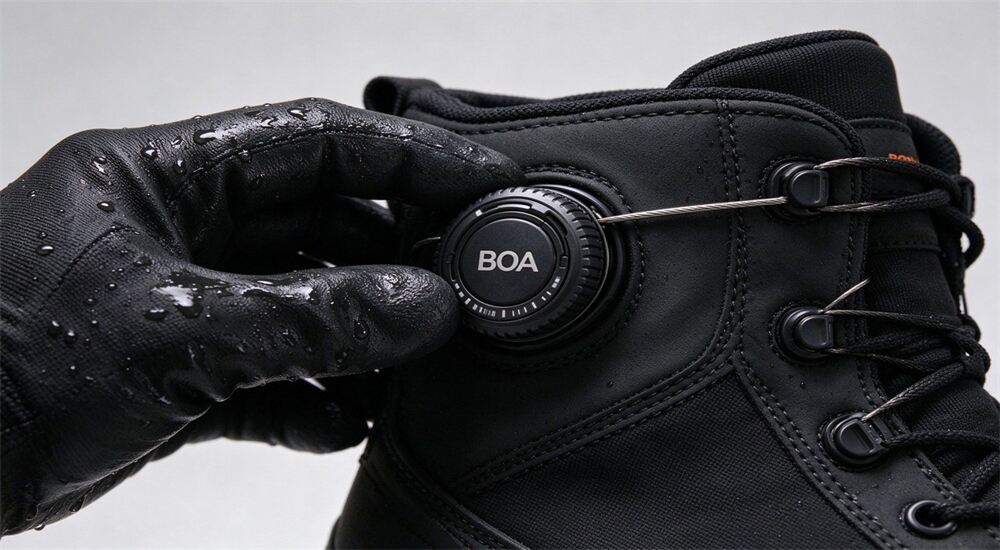
Quick pick: Choose lace-up for a familiar, fully tunable fit you can repair in the field. Choose the BOA Quick-Dial Model when hands are wet or gloved and every second of donning matters. The front-opening model is the fastest entry of all for rapid-response and hot-climate crews.
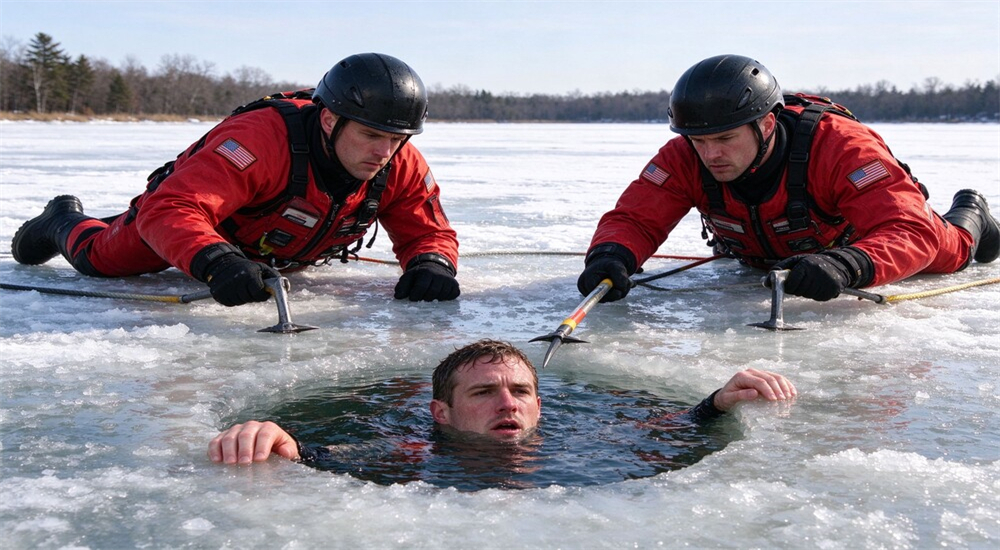
On ice the outsole story is more subtle than on rubble: a smooth ice surface gives no deep lug purchase, so the rubber compound and tread pattern have to bite differently. Thin ice rescue is about edge and flex, not deep penetration. The neoprene lining also matters here, because a wet boot on ice drains body heat fast even if the rescue itself is short.
After the ice rescue drills wrap, crews cross over to fire service flood response. Fire departments buy these boots by the station, not by the pair. EN-certified fire service boots and fire station duty boots need the same model across every shift, repeatable sizing, and a supplier who can reorder without redesign.
The firefighters below are entering a flooded ground floor in full turnout gear, and the boots under them have to survive the same repeat-soak cycle as the rest of the kit.
Felt wears faster than rubber in mud and gravel, so river teams usually replace a pair one season sooner than flood teams. It is a trade-off: more grip on wet rock, shorter sole life, and we spec it honestly rather than overpromising.
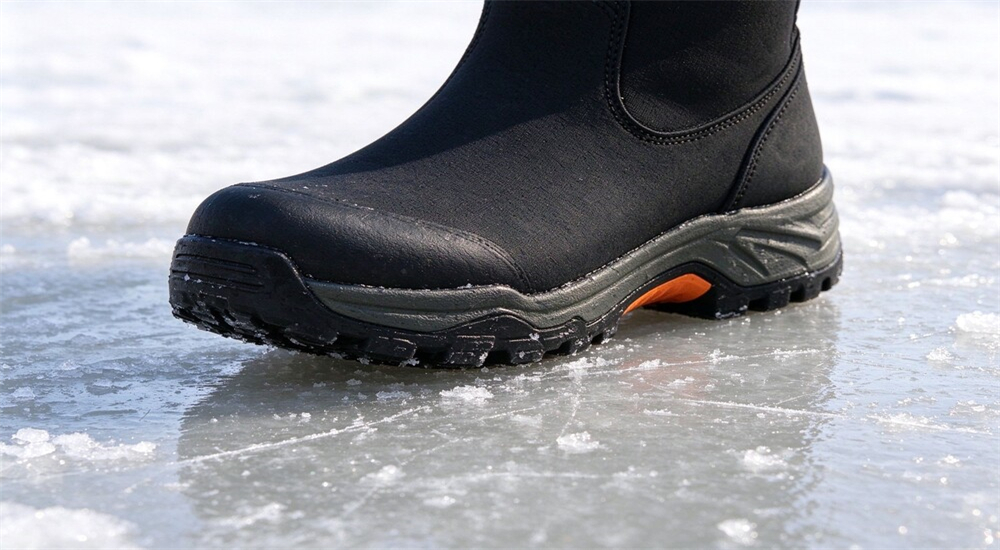
Close-up of the deep-tread rubber outsole biting smooth frozen surface — the grip that keeps the rescuer upright on glossy lake and river ice.On a real ice call, the crew does not walk slowly — they move on rope, in pairs, and every second spent on the ice raises the risk of a second faller. That is why the boot has to be light enough to carry fast, snug enough not to pull off in a hole, and sealed enough to keep meltwater from sloshing around inside.
The deep-tread rubber outsole bites smooth frozen surface so the rescuer does not skate on the way out to the victim, and the high-cut shaft braces the ankle when the ice suddenly gives way under one foot.
Moving from river rock to boat deck, the outsole choice flips again. Felt grips stone but does not grip wet fiberglass, and rubber does both jobs well enough that fire departments usually standardize on rubber across the whole fleet. Mixing outsoles in one team means carrying two spare pairs.
Field note: Ice teams always check ice thickness before walking — at least 5 cm for one person, more for two — and work on rope as standard. The boot cannot make unsafe ice safe; it can only protect the foot once you are committed out there.
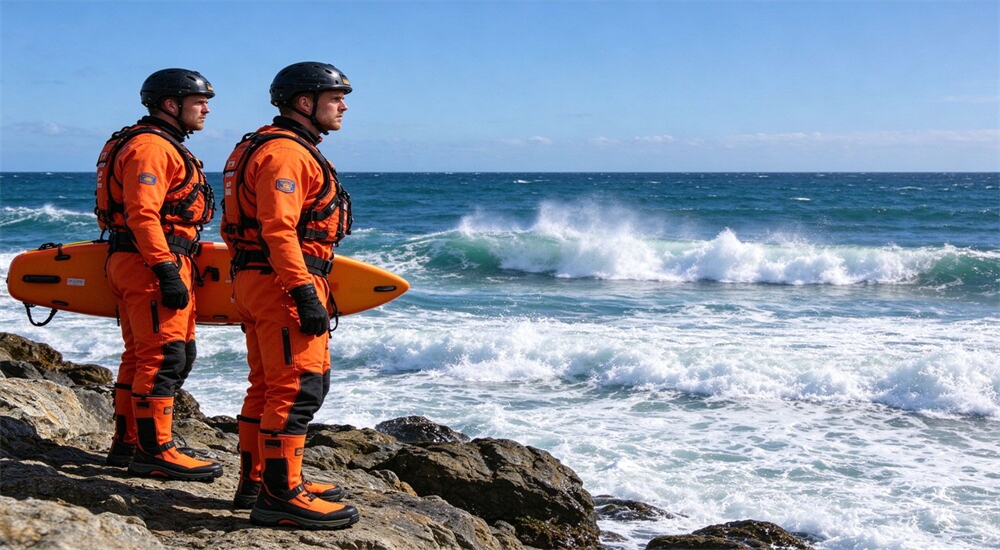
Fire departments run swift-water and flood rescue as part of urban response. Their boots must survive boat decks, rope work, mud and repeated immersion while protecting the foot from debris. These waterproof rescue boots for fire service differ from standard structural firefighting boots: a structural boot is built to withstand heat and embers, while a water-rescue boot is built to be submerged, drained and walked in mud hour after hour.
Across the range, toe and heel are reinforced, high-cut models add ankle bracing, and side or heel drains let the boot empty after a water entry. Fire departments buying in volume usually mix models across a department rather than buying one boot for everyone.
After the coastal surf drill, crews move from the water to the building entrance. Firefighters wade through flooded ground floors in full turnout gear, and the boots under them have to grip wet tile and drain after each room.
As a fire service boots supplier, we work directly with fire stations that need repeatable sizing and bulk reorders. When the water stops rising and the lights stay off, crews move into flooded ground floors. The boots under turnout gear have to grip wet tile, resist mud and drain after each room. This is the repeat-soak cycle that cheap PVC boots fail in after a dozen shifts.
In full turnout gear, the boot has to pair with the rest of the PPE without snagging on straps, flotation belts or boat hardware. Fire departments also repeat the soak-and-rinse cycle more often than municipal teams, which is why the double-layer upper and reinforced stitching matter. Many fire services buy two pairs per firefighter so one can dry while the other is on call.
When the full-gear photo comes off the wall and back onto the shelf, procurement teams start comparing the small details that separate a rescue boot from a rain boot. Reinforced toe caps, heel counters, stitched panels. The next close-ups show those details up close so a buyer can see what gets stitched where, and what takes the impact on a broken glass floor.
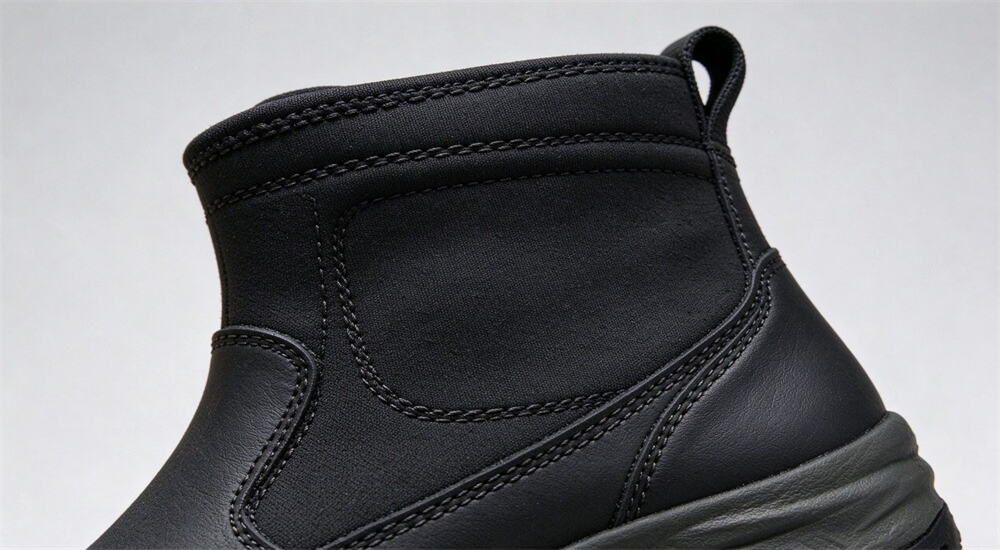
Double or triple stitching at the ankle seam is the difference between a boot that holds for three seasons and one that splits after one flood. Ask to see a close-up of this seam on your sample before approving a bulk order.
A firefighter in full water-rescue kit — the boots sit under drysuit cuffs and go through repeated immersion, rinse and dry cycles season after season.
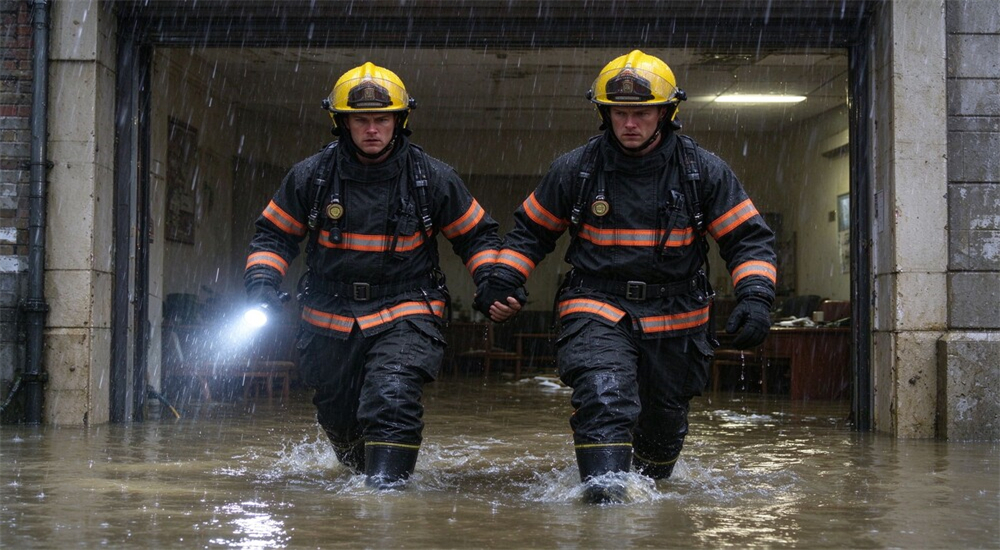
A fire department does not buy one boot for the whole crew. Boat operators, rope technicians, shoreline searchers and training cadets each need something different. Match each water role to the boot that fits it, then build one mixed bulk order — this is how most fire and rescue procurement works, and it keeps kit cost down without under-equipping any role.
Stitching and reinforcement work as a system. A strong stitch on thin neoprene will still split if the panel behind it flexes too much, which is why synthetic leather wear panels sit exactly where the stitch line flexes most. The two parts have to be specified together.
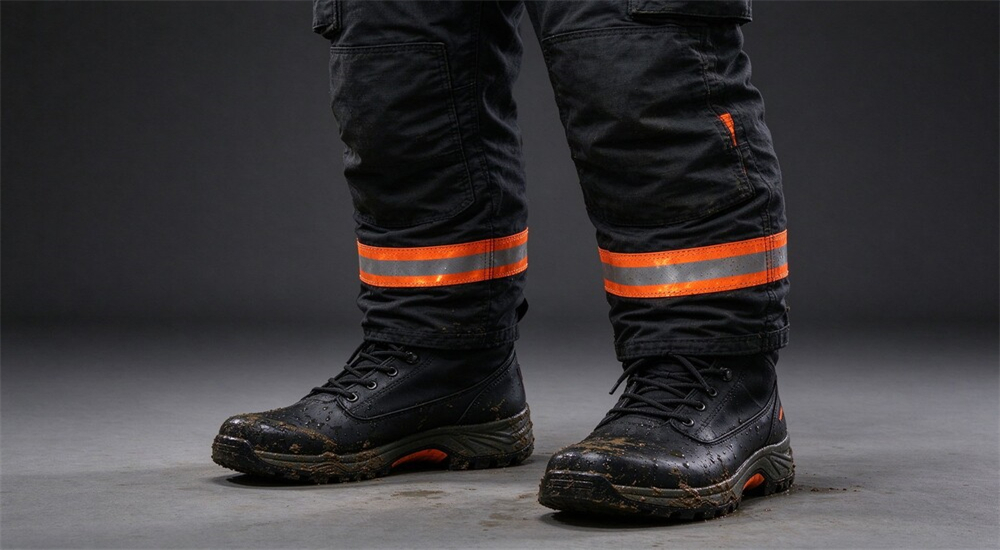
As a fire rescue boots supplier we know EN15090 certified firefighter boots are what stations ask for. As a fire rescue boots supplier we know EN15090 certified firefighter boots are what stations ask for. EN15090 certified fire service boots and flame retardant rescue rubber boots are what stations expect. Fire departments also care about repeat immersion: a water rescue boot may be fully submerged on shift one day, rinsed, dried and submerged again the next.
Cheap PVC boots stiffen, crack and let the stitching fail after a dozen cycles. The double-layer shell with rubber-reinforced ankle stitching is built for that repeat cycle.
Departments often buy two pairs per firefighter so one can dry while the other goes back on the truck — ask us about a two-pair-per-person sizing plan when you request a quote.
After the ground floor is checked, crews move to the boat on the flooded river. Rigid inflatable boats carry teams from one block to the next, and the boots under turnout gear walk across wet pontoons and slick gunwales. As a wildland fire boots supplier and wildland firefighter boots supplier, we also note that wildland fire boots and structural fire boots share the same rubber outsole spec but different shaft builds.
The same pair goes from doorway to deck without a changeover. The next shot shows the team on thin ice, where the outsole has to grip a totally different surface.
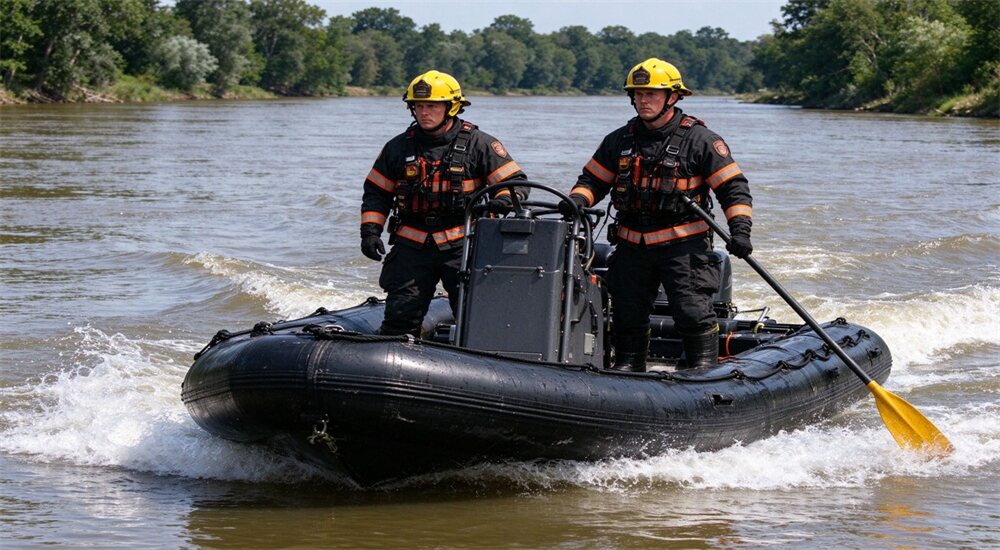
The details are what keep these boots working through real rescue duty. Below, each construction point is explained the way a working rescuer thinks about it: what problem it solves, why that problem matters, and what the wearer gets out of it. Tick these off on a sample before approving a custom or OEM spec.
The back of the ankle takes just as much abuse as the toe, from rope burns to rub against the gunwale, and synthetic leather panels there outlast the plain neoprene. This is the spot that splits first on cheap imports, because the ankle flexes every step. Reinforced stitching here is what keeps a pair going past three seasons instead of cracking after one flood season.
Inside the heel panel, a rigid heel counter locks the foot in place so the ankle does not slide inside the boot when current pulls sideways. Without it, the foot lifts and drops with every wave, and blisters show up by hour four. A stiff counter also means the boot holds its shape after repeated drying cycles, which is why cheap floppy heels feel loose after one season.
The lace-up line is the classic adjustable option. A rescuer can change the tightness by ankle, calf and instep, and a broken lace is a 10-cent fix on the riverbank instead of sending the whole boot back. The side profile shows how the shaft, outsole and heel pull loop sit together on the foot.
Lace-up models fill the rack, but the question every procurement manager asks next is what sits between the upper and the foot. As part of water rescue PPE, the neoprene liner is what makes these boots warm, not a marketing claim. It traps a thin layer of next-to-skin air that the foot warms itself, and it flexes with every step so the boot does not feel like a bucket.
The next images show that liner, the cuff and the way the panel seams are stitched to hold water out.
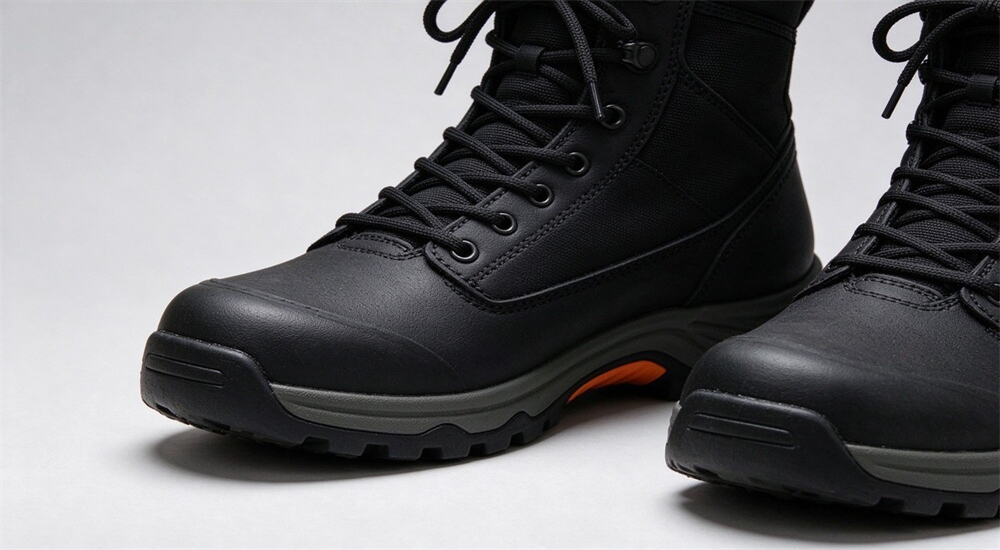
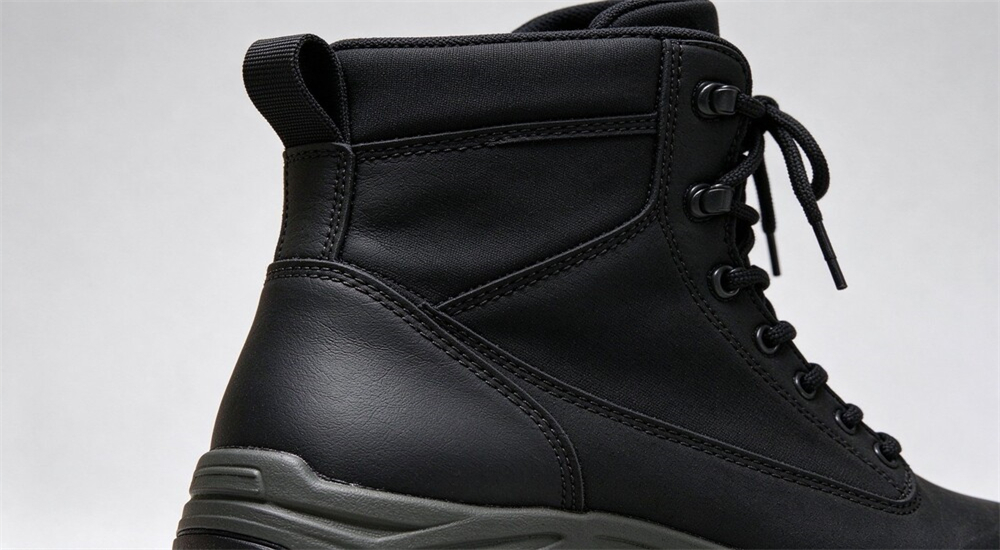
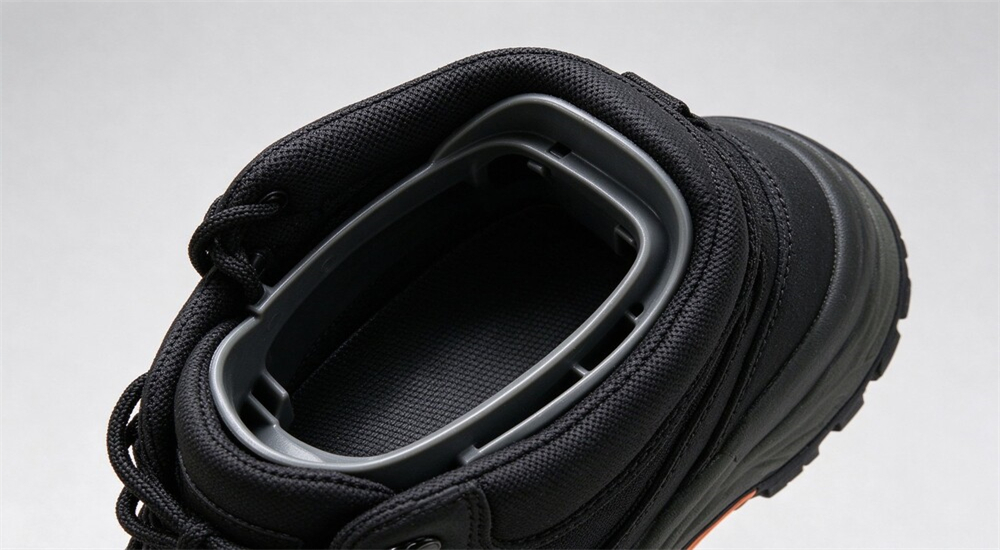
These five close-ups are what we send buyers who want to confirm the build before a bulk or private-label order. Each image shows one part of the boot that matters on a real call, so you can judge thickness, shape and finish rather than just a marketing photo. The same neoprene rescue boots construction shows through every shot: a warm stretch lining inside, hard protection where the foot takes abuse, and drainage that keeps the boot light.
Back at riverside camp between calls, a rescuer checks boot stitching, drain holes and outsole wear before the next deployment. That ten minute inspection prevents a blown seam or a clogged drain from turning a routine shift into a cold wet walk home.
Back at camp, a rescuer checks boot stitching, drain holes and outsole wear before the next deployment. That ten minute inspection catches small problems before they become mission failures on the water.
The side profile shows how the boot sits on the foot: a low heel, a straight shaft, a rounded toe box. Buyers with wide feet or high insteps should compare the side profile to their current pair before ordering a whole fleet, because a boot that looks narrow in profile will be narrow on the foot.
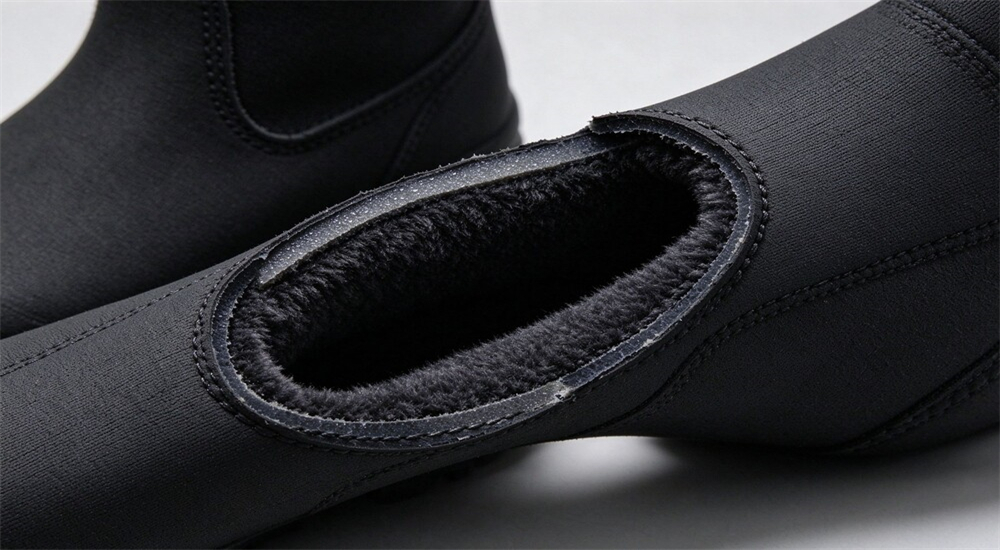
Warm insulating lining. This first shot shows the soft neoprene lining inside the boot — the layer that traps a thin warm film next to the skin instead of letting cold water wash heat away on every step. That is why these boots keep feet working in 10°C floodwater where a plain rubber wellie would have the wearer numb inside twenty minutes.
Reinforced toe cap. The second close-up shows the toe area, where a rubber and synthetic leather panel caps the end of the boot. This is the part that absorbs the kick on a hidden nail, a glass shard or a brick under murky water — the insurance that one bad stub does not end a rescuer's shift.
Side drainage holes. The third shot shows the small drain openings on the side of the boot. They look minor, but they are why the boot does not slosh after you step out of the water: trapped water escapes through these holes so each step stays light over a long shift.
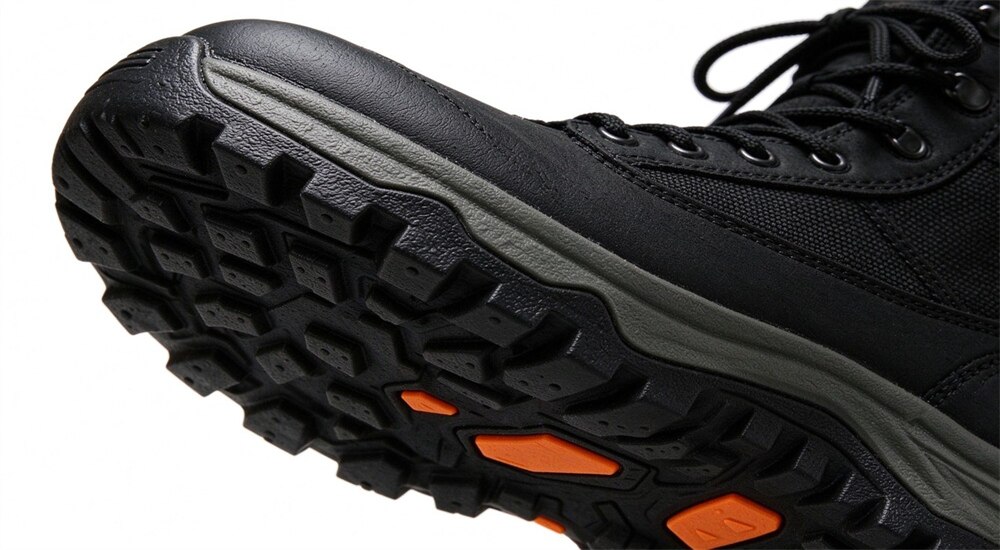
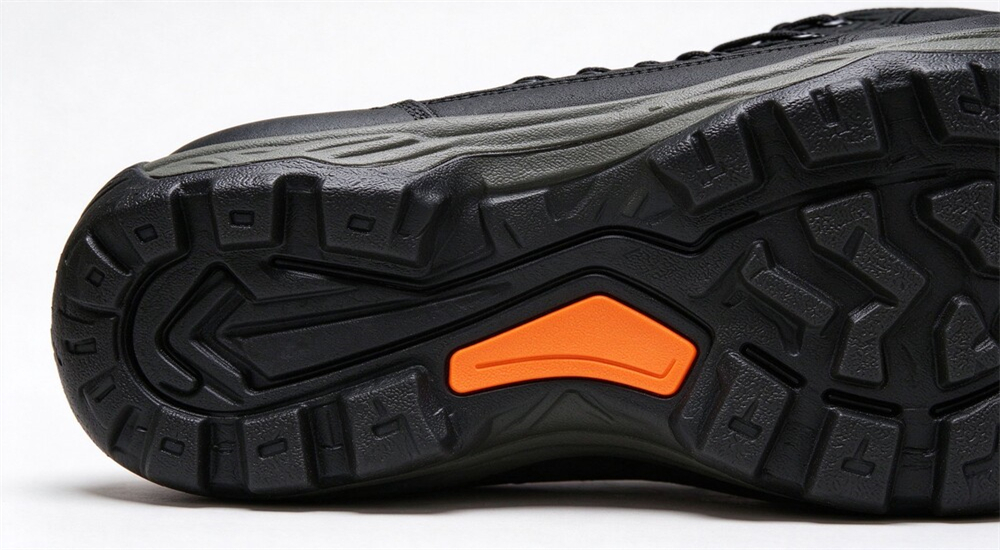
Deep-lug outsole bottom view. The fourth close-up lays the boot flat to show the tread pattern. Those deep lugs are what bite a wet concrete slab, a slimy boat deck and a muddy river bottom — the visual proof of the non-slip claim, not just a spec line.
BOA quick-dial. The fifth shot shows the twist dial on the lace-up line. With one turn it pulls the whole cable evenly across the foot, so a cold, wet, gloved hand can tighten the boot in seconds instead of fumbling wet laces.
The warm lining is the layer you cannot see from outside, but that is why the feet keep working in cold water. A plain rubber wellie lets cold water wash heat away on every step. The neoprene traps a thin warm film next to the skin, so a rescuer stays reactive and can feel the bottom underfoot for a full 30 to 60 minute shift.
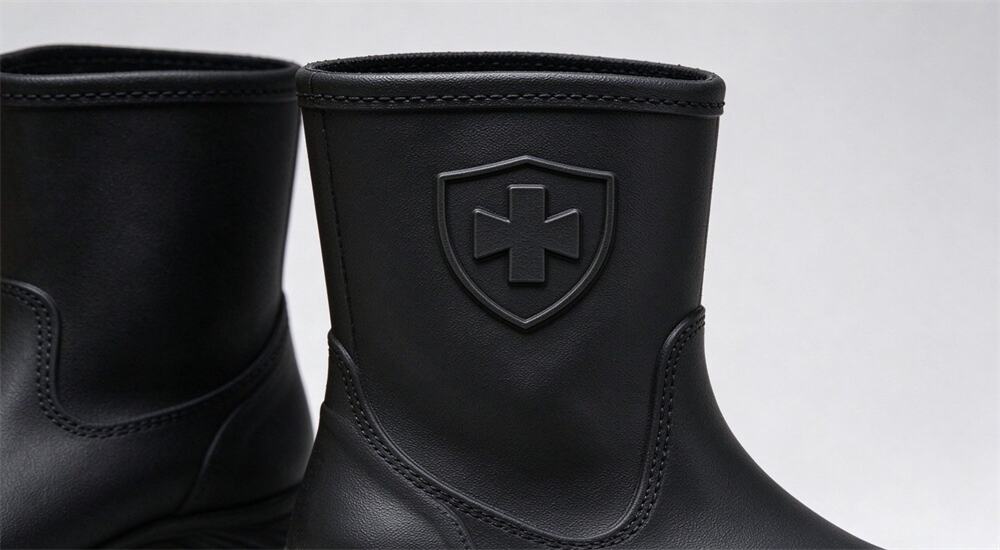
Warm liningThe toe cap is the first line of defense against hidden glass, nails and rebar under murky floodwater. One stubbed toe through a thin upper ends a shift and opens a workers comp claim. The reinforced rubber and synthetic leather cap absorbs that kick so a single bad step does not sideline a rescuer in the middle of an ongoing flood response.
Reinforced toe capThe side drain holes look small, but they are what keep the boot light after the wearer steps out of the water. A sealed boot becomes a water-filled bucket that adds weight with every stride. These holes let trapped water leave on its own, so the next step is light and the boot dries faster between shifts. Cheap boots skip this detail.
Side drainage holesThe deep lug pattern on the bottom is the visual proof of the non slip claim, not just a spec line on a datasheet. When a buyer holds the sole and sees the depth, the self-cleaning channel and the molded rubber compound, the non slip claim stops being a word and becomes a feel. That is why we send sole photos with every sample.
Deep-lug outsoleWhen buyers hold two pairs side by side, they check that the lining thickness, toe cap stiffness and outsole depth match across the whole order, not just the sample pair. A consistent build across a thousand pairs is what separates a serious supplier from a drop shipper.
That ten minute camp-side check is where crews catch small problems before they become mission failures. A clogged drain hole, a loose BOA knob, a worn outsole edge. Catching it on shore means a dry second half of the shift instead of a wet cold walk back.
Top-down pair
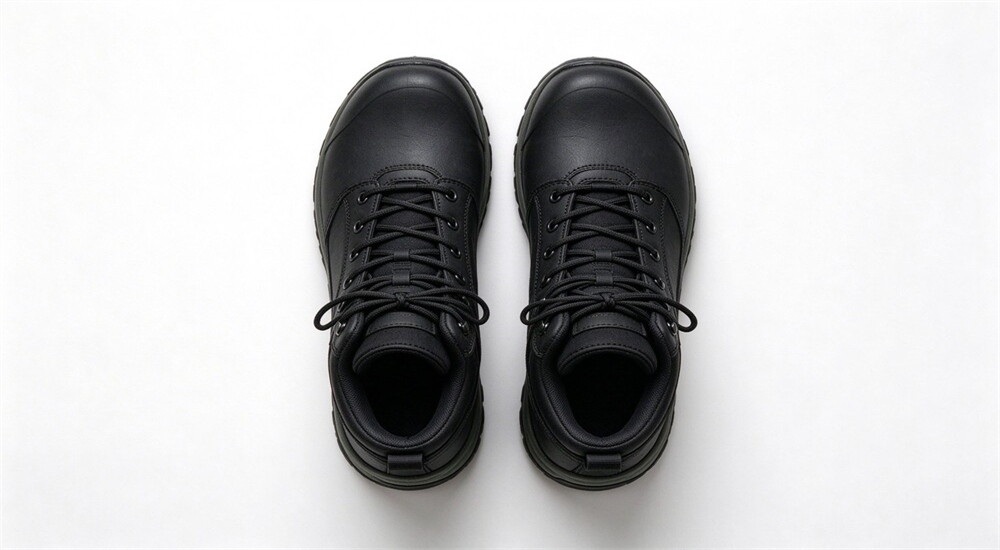
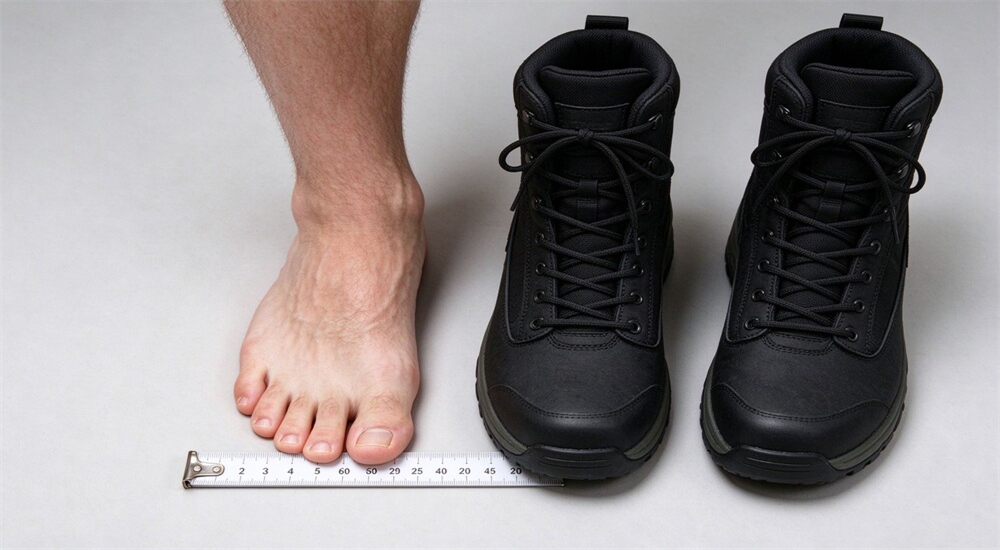
A rescue boot that does not fit is dangerous: too small restricts circulation in cold water; too large slides and blisters. Because the upper fits snug and many wearers add a sock, measure foot length carefully and size up when in doubt. These points help distributors fit a whole team correctly on the first bulk order.
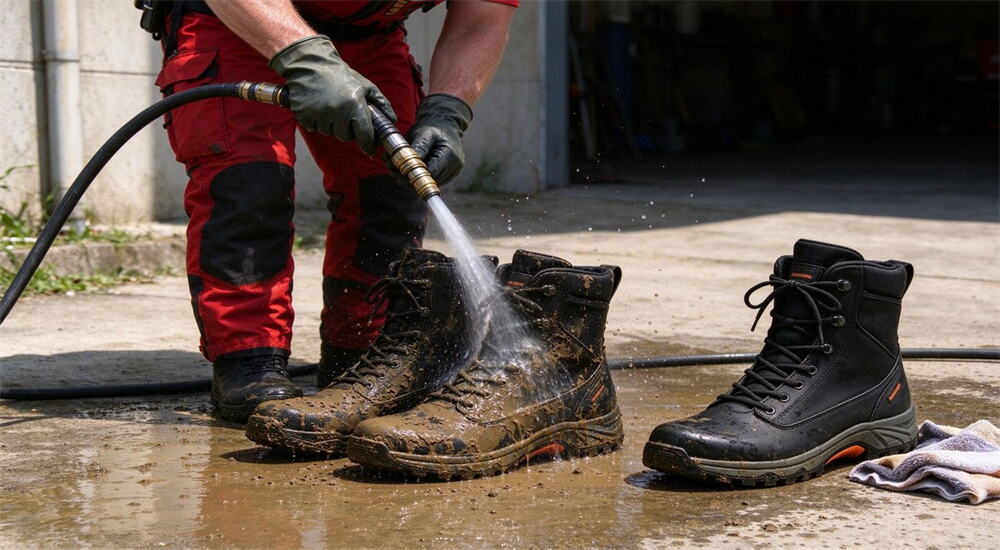
These boots last for years when rinsed and dried correctly, and fail fast when left crusted with mud or salt. Simple care extends grip life, prevents material degradation and keeps the drains clear. Follow the steps below to keep your water safety boots ready for the next callout.
Branding and specification matter for rescue agencies, distributors and kit packagers. We support OEM and custom private-label gear: logo, team colors, model mix and packaging. The options below are what you can request with your quotation; MOQ, lead time and pricing are confirmed by contract based on your exact spec.
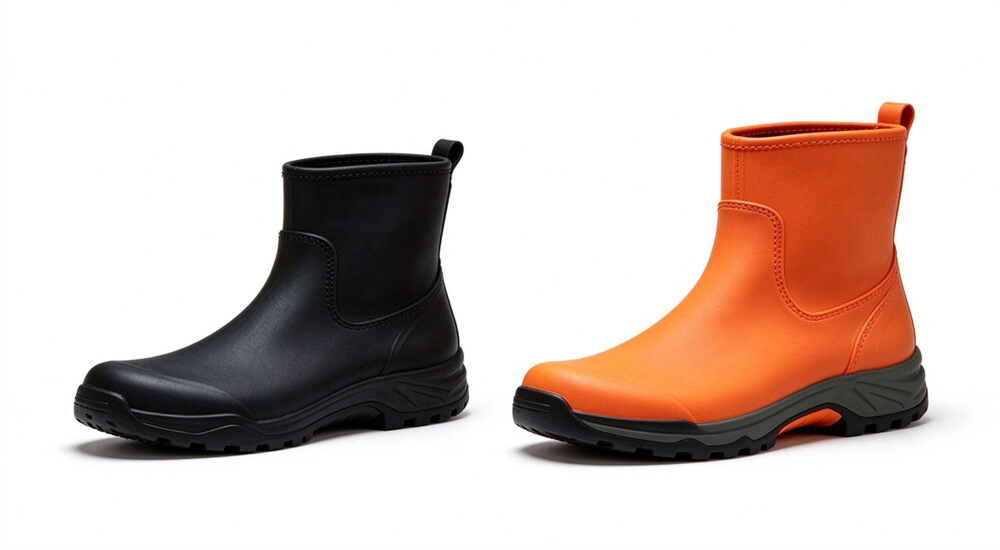
Color choice is part of the OEM spec: black for general duty, orange for night and low-light visibility, and custom colors on larger orders. Black hides mud and looks professional on parade. Orange keeps the wearer visible at dusk and under headlamp. Most agencies run a mixed order: black for daytime flood teams, orange for night boat crews and rope teams.
Black and orange side by side — standard stock tones for team identity; custom color matching is available on OEM orders.
Equipping a whole rescue service, distributor warehouse or government tender needs reliable bulk supply, consistent sizing and organized carton packing. As an experienced rescue boots supplier from China, we handle volume orders with volume-tier pricing. The points below show how a wholesale program is typically structured; exact MOQ, lead time and unit price are confirmed by contract once your spec, sizes and destination are known.
A pallet of boots looks the same from a distance, but the stitching tells the real story. Reinforced ankle seams, double-stressed toe panels, reinforced toe work boots with bar-tacked heel counters. These are the spots that tear first on a rescue boot, and the spots we stitch twice. The close-up below shows what that double stitch actually looks like on the panel, not in a catalog line.
Beyond emergency rescue, our flood rescue boots — the flood response boots municipal programs order for city flood teams — serve anyone working in persistent wet, muddy or waterlogged conditions. The groups below are the main buyers, so procurement can build a mixed bulk order by role.
Alongside the mixed worksite crews, volunteer rescue teams wear the same boots on their own shifts. Local volunteer groups respond within the first hours of a flood, often before paid crews arrive. Their boots see the same mud and broken glass, and the non slip outsole works just as well on a volunteer as it does on a professional.
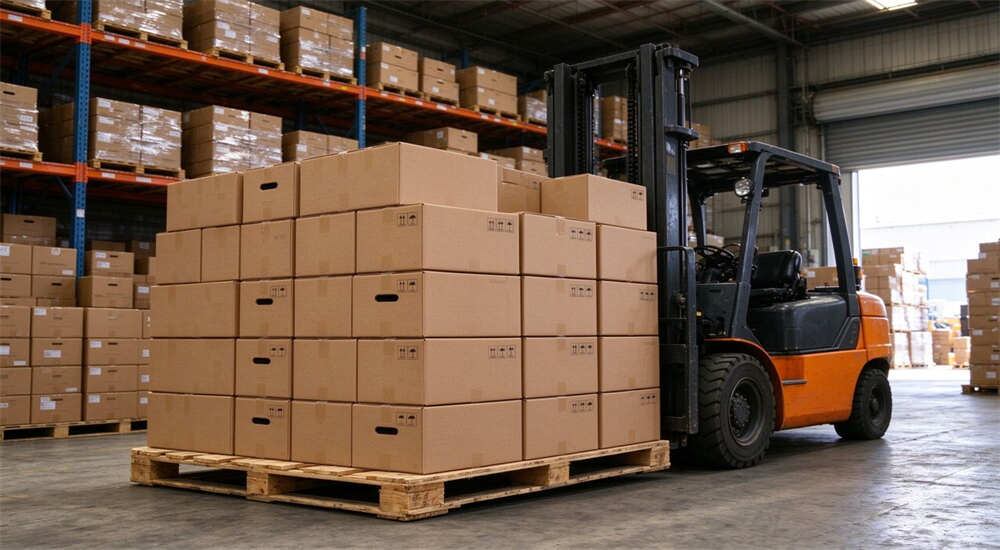
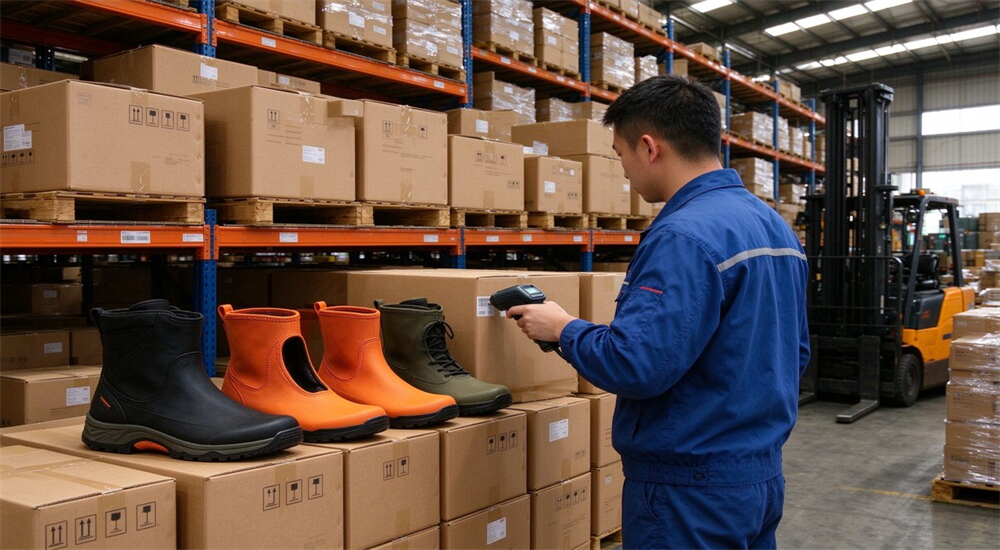
When the volunteer shift ends, the boots move down the supply chain. Distribution teams palletize cartons and hand them off to local depots. Bulk tactical boots and bulk fire service boots orders and bulk orders move by sea, sample orders move by air, and the packaging has to survive both. The next shot shows a loaded pallet ready for container, so a buyer can see what a 500-pair order actually looks like on a truck.
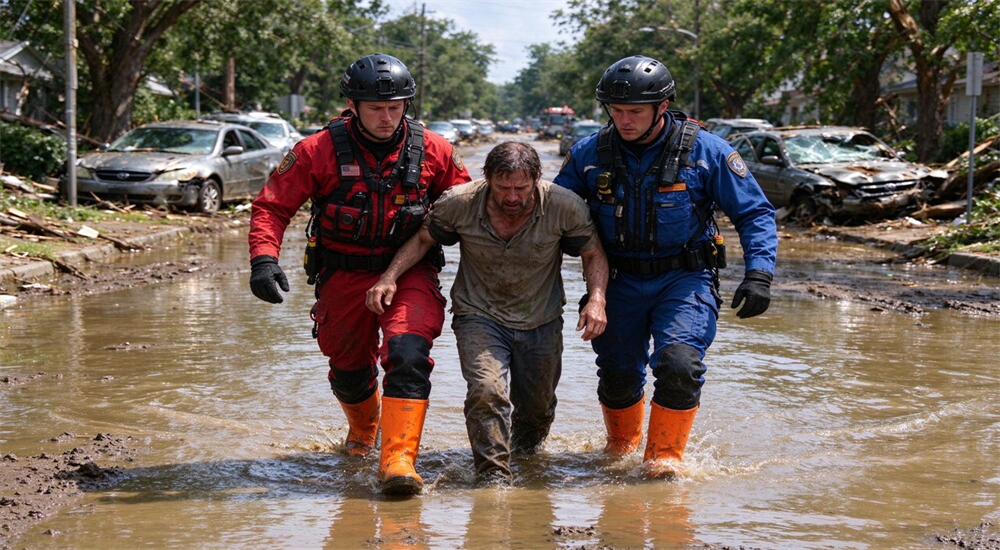
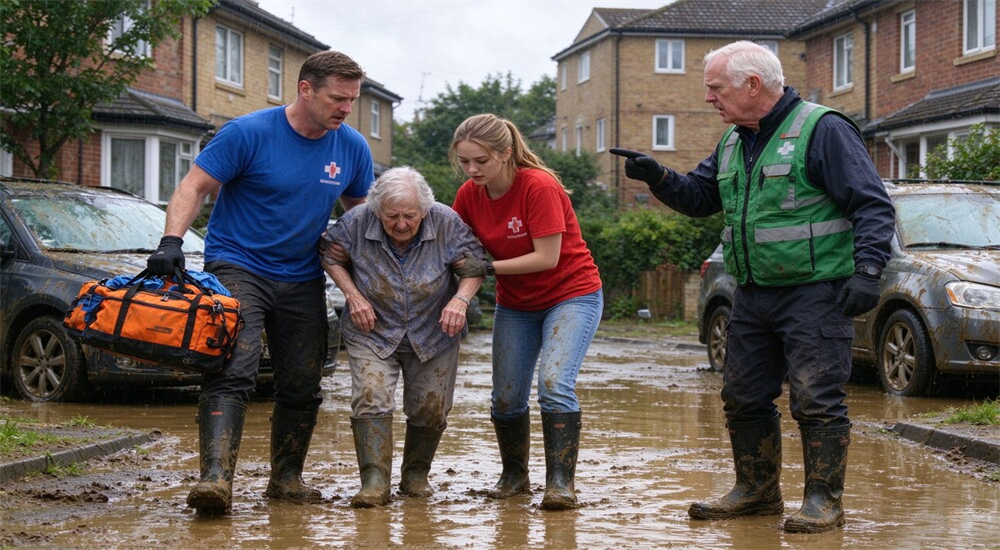
A volunteer rescue team on callout — municipal programs, community groups and disaster-relief procurement all kit up in the same build.
YIROUFANG TEXTILE is a supplier of textile and emergency-response gear based in China, with 20+ years of experience serving distributors, rescue agencies and procurement teams worldwide. Our range covers flood rescue boots, neoprene rescue boots and water safety boots. Over the years we have kitted up fire departments, municipal flood response teams, river rescue groups, distributors and disaster-relief programs across multiple countries.
Every pair goes through inline quality checks on the upper, outsole, stitching and drain holes before packing, so a small sample matches a large bulk order.
We also run spot checks on the slip resistance, drainage and flex of the boot, and keep a clear record of materials so repeat orders stay consistent year over year. We handle volume supply, OEM customization and export logistics, and work with each buyer on their own size breakdown, model mix and delivery schedule. Send your requirements through the buttons on this page, and our team will reply with a competitive wholesale quotation and sample guidance custom to your field.
Back at the warehouse, the same boots are packed and palletized ready for export, whether the carton goes by sea, air or express. Bulk orders go on shrink-wrapped pallets; small sample orders go by courier. Our export team handles customs paperwork, commercial invoice and packing list so the buyer does not chase freight forwarders themselves.
Alongside cleanup, police and community wardens patrol the flooded perimeter to keep residents out of unsafe water. They walk wet curbsides and check submerged side streets, and the boots under them have to stand up to a full shift of pavement patrol.
The patrol boot has to look right on a uniform and grip wet city sidewalk all shift. Our YRF textile supplier warehouse stocks the same model across size runs, so a department can reorder without guessing what they get.
Color matching across a bulk order is locked at the dye stage, not guessed from a catalog swatch. We send physical color samples before production so the orange arrives the orange you approved, not a darker or redder shade.
Buyers ordering rescue boots for the first time usually get the best result when they lock a few points up front rather than after the order is placed. The checklist below turns the most common pre-order questions into things to confirm with our team, so the fit, outsole and delivery match your field.
These boots are built for flood rescue, swift water operations and firefighter water rescue. They insulate the feet against cold water, grip slippery surfaces, protect from debris and drain water quickly once the rescuer steps out. Municipal flood response crews, river teams and fire departments wear them for wading, boat deck work and river recovery.
Color and build are separate decisions. A team can spec orange for visibility and still choose the same reinforced stitching, outsole depth and lining thickness as the black pair. Color is cosmetic; the stitch and outsole are the safety spec.
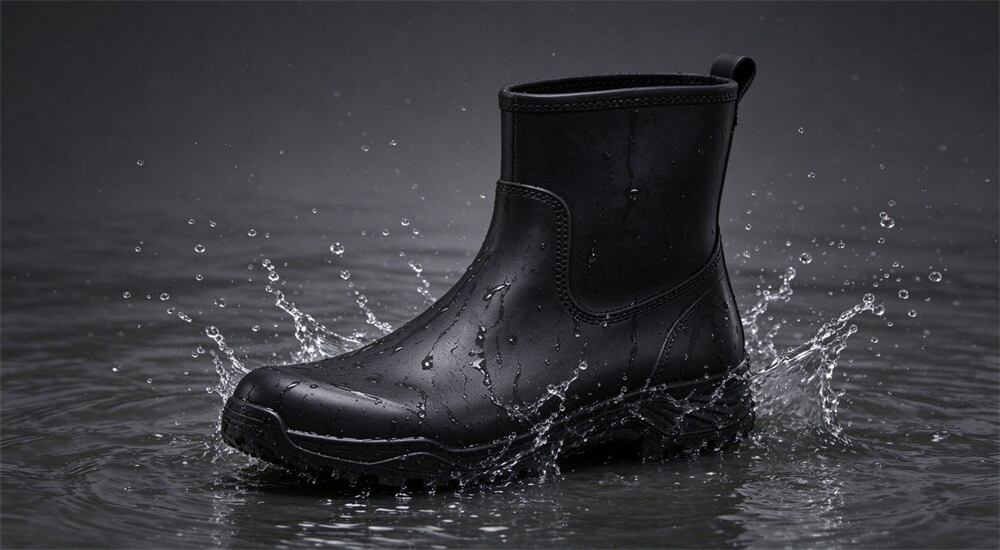
These waterproof rescue boots are not a fully sealed dry boot, because that would trap water inside and add weight with every step. Instead they shed surface water with a sealed upper and shell, then drain what enters through side and heel openings. That keeps the feet dry enough for real wet work without turning the boot into a water-filled bucket.
Mid-cut boots end at the ankle and stay light and fast to slip on, which suits city flood wading and boat deck work where speed matters. High-cut boots wrap the ankle and lower shin for support when moving current yanks the foot sideways. Choose mid-cut for urban flood response; choose high-cut for swift water, rope teams and broken rubble.
A molded rubber outsole handles mud, boat decks and mixed urban ground, and its deep lugs self-clean as you step. A felt outsole grips smooth, algae-covered wet river rock where rubber tends to skate. Buy rubber for general flood response boots duty; buy felt only when your team repeatedly stands on slippery wet river rock during swift water operations.
The BOA model uses a twist dial and steel cable to tighten the boot with one hand, even with wet gloves. It pulls the cable evenly across the foot, so a cold, numb, gloved hand can close the boot in seconds instead of fumbling wet laces. Lace-up models offer a classic adjustable fit that a rescuer can repair in the field with a new lace.
Once the stitching is approved, the order moves back to the pallet. Bulk cartons are stacked, strapped and loaded for container. Custom waterproof combat tactical boots are available on request. MOQ and lead time are confirmed per contract, samples ship before bulk, and the same pair that passed the stitch inspection is what lands on the depot floor. This is the hand-off from sample to shipment that a B2B buyer actually cares about.
Small drain openings on the side and near the heel let trapped water leave once the boot exits the water, instead of sloshing around inside. That keeps the boot lighter on every step and helps it dry faster between shifts. Without drains, a waterlogged boot adds weight with every stride and turns knee and ankle fatigue into slips late in a long operation.
Yes. These non slip rescue boots use a molded rubber outsole with deep lugs that bite wet boat decks, submerged asphalt and slippery concrete slabs. The felt outsole adds extra grip on wet river rock. Reinforced toe and heel take knocks from debris, so the boot holds up on flood response duty where a smooth sole would slide out from under you.
Measure foot length from heel to longest toe with your weight on the foot, in millimeters. Because the upper fits snug and many rescuers wear a thick rescue sock, size up when you land between two sizes. Wide feet go half a size up. We send a full EU/US size chart with your sample so your team can fit correctly on the first bulk order.
Rinse the boots with fresh water after mud, sewage or salt exposure, then open the drain holes and empty trapped water. Air dry them in the shade with good airflow, away from direct sun or a heater that would bake the flexible shell. Check the stitching, outsole and BOA dial after each major use, and store them cool and ventilated between shifts.
Yes. We supply wholesale and bulk boots for rescue services, fire departments, distributors and tenders. Volume tiers run from a trial sample of a few pairs up to thousand-pair agency programs, shipped by express, air or sea freight. MOQ, lead time and unit price are confirmed by contract once your spec, sizes and destination are known.
Yes. We support OEM private-label logo, team colors, mixed-model orders and custom packaging. You can print or emboss a logo on the shaft or heel, pick black, orange or army green, and mix mid-cut, high-cut, rubber and felt models in one order. MOQ, lead time and pricing are confirmed by contract based on your exact specification.
Standard stock colors include black and functional tones such as rescue orange and army green, chosen so the wearer stays visible to the rest of the crew at night or in low light. Team logos and custom color matching may be possible for larger OEM orders. Confirm the color options and any custom requirements with our team when you send your quotation request.
YIROUFANG is a supplier based in China and ships worldwide to rescue agencies, fire departments, distributors and procurement teams. We have 20+ years of experience exporting flood rescue boots and neoprene rescue boots. Use the buttons on this page to send your model mix and size breakdown, and our team will confirm delivery to your destination.
With proper rinsing, shading and storage, a pair typically lasts multiple seasons of regular rescue training and deployment. Rotating between two pairs so one can dry while the other goes back on shift extends service life. Inspect the stitching, outsole and BOA dial after heavy use, and replace a pair once the lugs wear down or the drain holes start to leak.
Yes. For distributor inventory and mixed-team fleets we can pack assorted sizes and a mix of mid-cut and high-cut, rubber and felt models within one order. This lets a fire department or agency kit different roles from the same shipment. Confirm the size and model breakdown in your quotation request, and we will price the mixed carton accordingly.
Liens amicaux :
droits dauteur © Custom Disaster - Relief Bedding: Tents, Sleeping Bags, Blankets Tous les droits sont réservés
léquipe professionnelle au service !