Choosing the right water rescue equipment is one of the most critical decisions a rescue team leader or procurement officer can make. When seconds count and lives are on the line, the gear your team wears and carries can mean the difference between a successful rescue and a tragedy in marine safety operations.
This guide walks you through every major equipment category—from personal flotation devices to helmets, dry suits, and complete rescue kits—so you can make informed purchasing decisions based on your team's specific operational needs, budget, and certification requirements.
Whether you are outfitting a five-person swiftwater team, stocking a government emergency reserve, or upgrading a fire department's water rescue capability, this guide provides the technical knowledge and practical decision frameworks you need. We cover buoyancy ratings, certification standards, material science, maintenance requirements, and budget-based recommendations—everything you need to build a complete, compliant, and effective water rescue equipment inventory.
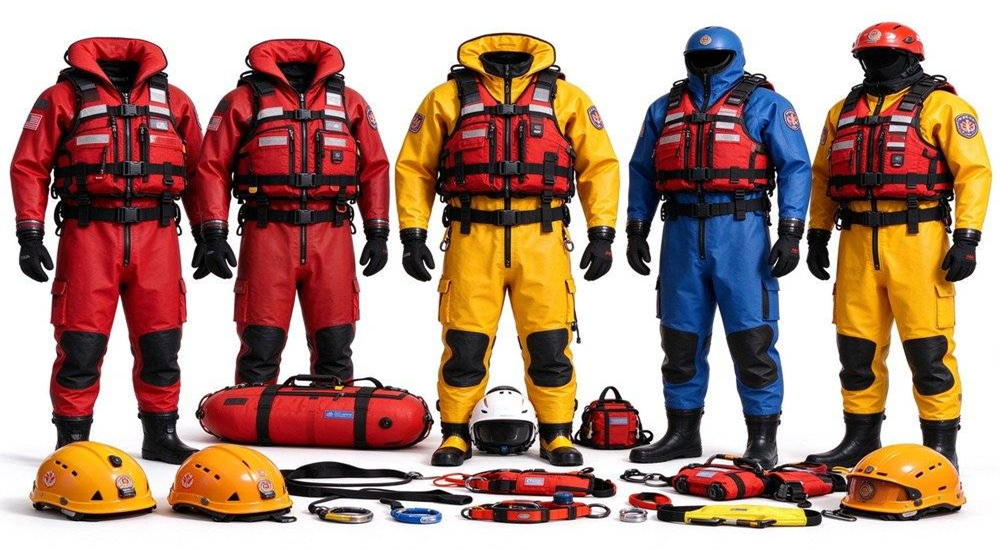
Professional water rescue equipment is not one-size-fits-all. A fire department responding to urban flood rescue needs different gear than a coastal team handling open-water operations, and a government agency stockpiling emergency reserves has different procurement requirements than a small volunteer team. This guide breaks down every major equipment category with technical specifications, certification requirements, and practical decision frameworks so you can build the right kit for your specific operational profile.
Whether you are selecting your first set of water rescue PFDs, upgrading from basic recreational gear to professional rescue equipment, or managing a large-scale procurement for government emergency stockpiles, understanding the technical details—buoyancy ratings, certification standards, material science, and maintenance requirements—ensures you make informed decisions that protect your team and maximize your budget.
Use this step-by-step decision tree to quickly identify the right equipment for your team operational profile. Each step narrows your options based on real-world conditions.
Start by determining where your team operates most frequently. This single factor drives 70 percent of your equipment decisions.
Step 2: Determine Team Size and Procurement Volume
Your team size affects both pricing and configuration options.
Step 3: Match Buoyancy Rating to User Weight and Mission
Use this quick reference to select the minimum buoyancy rating.
User Weight
Standard Operations
Swiftwater / Flood
Cold Water / Ice
Under 60kg (132lbs)
75N
100N
150N
60-80kg (132-176lbs)
100N
150N
150N+
Over 80kg (176lbs)
150N
150N+
270N
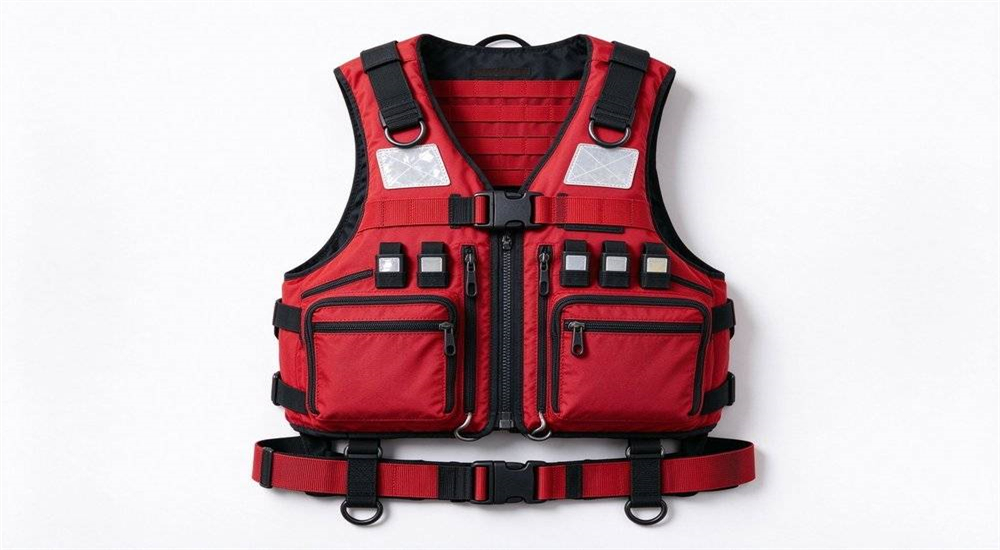
Before placing your order, verify these five items:
Following this decision tree ensures your team receives equipment that matches actual operational requirements rather than generic one-size-fits-all solutions.
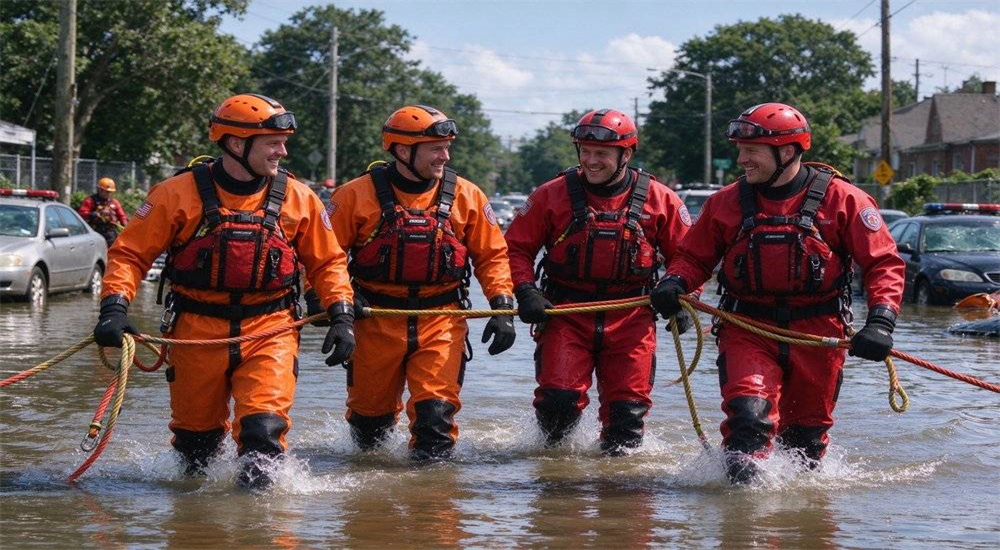
Water rescue is an unforgiving environment. A PFD that fails to keep a rescuer's face above water, a helmet that cracks on impact, or a dry suit that leaks in cold water can turn a rescuer into a victim within minutes. According to data from the U.S. Coast Guard, the American Red Cross, and international water safety organizations, a significant percentage of water rescue fatalities involve rescuers who were either improperly equipped or whose equipment failed under operational stress.
The statistics are clear: properly selected and maintained water rescue PFDs reduce drowning risk by more than 50 percent for both rescuers and victims. Helmets certified to impact standards reduce traumatic brain injury risk by a comparable margin. These are not theoretical benefits—they are measured outcomes from real rescue operations worldwide.
In water rescue, there is a concept called the "life safety window"—the critical period during which a victim's chances of survival drop dramatically. For cold water immersion, the first minute brings cold shock response (uncontrolled gasping, hyperventilation, increased heart rate), the first ten minutes bring loss of manual dexterity and muscle strength, and the first hour brings loss of consciousness from hypothermia. Your team's equipment must perform reliably within this window—there is no time for gear that malfunctions, requires complex setup, or fails to provide adequate protection.
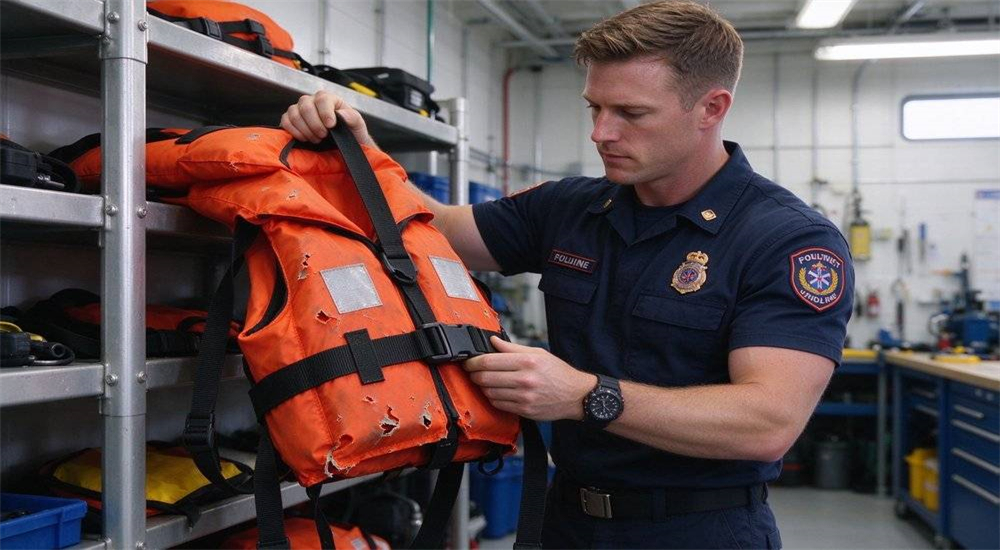
Regular equipment review ensures your team is always deployment-ready. Set a monthly inspection schedule and assign a gear officer to track maintenance records, replacement cycles, and equipment retirements.
This is why rescue gear selection is not a procurement afterthought. It is a life safety decision that directly impacts your team's ability to operate effectively within the life safety window. Every piece of equipment—from the PFD on your chest to the knife on your belt—must be chosen with the understanding that it may be the only thing standing between a team member and a fatal outcome.
Beyond the obvious safety risk, choosing the wrong water rescue equipment carries three additional costs that many organizations overlook when evaluating water rescue PFD options and complete gear configurations that many teams overlook. First is the compliance risk: equipment that does not meet applicable certification standards can expose your organization to legal liability, insurance complications, and regulatory penalties. Second is the budget waste: cheap gear that fails prematurely or requires constant replacement ends up costing more over the equipment's lifecycle than investing in quality gear from the start. Third is the operational inefficiency: gear that is uncomfortable, difficult to don, or poorly suited to your operational environment leads to slower response times, reduced team performance, and increased fatigue during long operations.
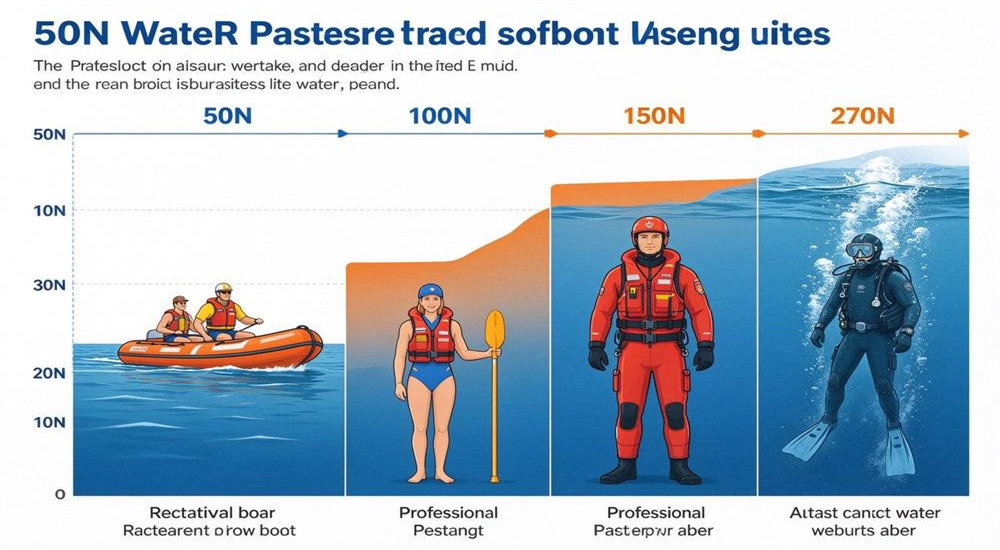
Buoyancy in water rescue equipment—particularly water rescue PFD selection—is measured in Newtons (N), the standard unit of force. One Newton is the force required to accelerate one kilogram of mass at one meter per second squared. In practical terms for flotation devices, 10 Newtons of buoyancy supports approximately 1 kilogram of body weight in fresh water (slightly less in salt water due to increased density). This means a 150N PFD provides approximately 15 kilograms (33 pounds) of buoyant force—enough to keep an adult's head and shoulders above water even when wearing heavy clothing and equipment.
It is important to understand that the total buoyancy requirement is not simply based on body weight. A 70-kilogram (154-pound) person does not need 700N of buoyancy—because the human body is already approximately 70-80 percent water and naturally buoyant. The additional buoyancy from a PFD only needs to compensate for the portion of the body that would otherwise sink, plus the weight of clothing and gear. This is why even a 50N PFD can provide basic flotation for a lean adult in calm water, while a 150N PFD is needed for fully clothed adults in rough conditions.
Water rescue PFDs are categorized by their buoyancy rating, with each level suited to specific operational conditions and user profiles. Understanding these categories is the foundation of informed PFD selection.
Understanding buoyancy ratings is the foundation of equipment selection. Higher buoyancy provides more flotation but may restrict mobility, while lower ratings offer greater freedom of movement for active swimmers.
For professional water rescue teams, the 150N rating is generally the minimum recommended level. This is because rescue personnel typically wear additional weight from helmets, tools, communication devices, and potentially heavy turnout gear or dry suits. A 150N PFD ensures that even with this additional weight, the rescuer's face remains above water in rough conditions. For teams operating in extreme cold water, open ocean, or wearing particularly heavy equipment, a 270N PFD may be appropriate to provide an additional safety margin.
|
Buoyancy Rating |
Approx. Support |
User Type |
Water Conditions |
Typical Use Case |
|
50N |
~5 kg / 11 lbs |
Competent swimmers |
Calm, sheltered water |
Recreational boating, near-shore support |
|
100N |
~10 kg / 22 lbs |
General adults |
Inland water, moderate conditions |
Standard boating, basic rescue support |
|
150N |
~15 kg / 33 lbs |
Adults in heavy clothing |
Coastal, rough water, flood |
Professional water rescue, fire department |
|
270N |
~27 kg / 60 lbs |
Adults in heavy gear/extreme |
Open ocean, extreme conditions |
Coast guard, offshore rescue, extreme cold |
Selecting the right buoyancy rating requires considering three factors together: body weight, clothing and equipment weight, and environmental conditions. Use the following step-by-step calculation to determine the minimum buoyancy rating for your team members:
Step 1: Base buoyancy by body weight.
For team members under 60 kg (132 lbs), a base of 75N is sufficient. For those between 60-80 kg (132-176 lbs), start with 100N. For those over 80 kg (176 lbs), start with 150N.
Step 2: Add buoyancy for clothing and gear.
If team members wear turnout gear or a dry suit (which can absorb water and add significant weight), add 50N. If they wear heavy layers or a wetsuit, add 25N. If they wear only a standard uniform, add 0N.
Step 3: Add buoyancy for environment.
For cold water below 15°C (59°F), add 50N (cold water increases the risk of incapacitation and requires more buoyant support). For fast current or swiftwater conditions, add 25N. For calm water or flood evacuation standby, add 0N.
Step 4: Add for mission profile.
If your team may need to tow victims or carry additional equipment during rescue, add 50N. For extended operations over four hours, add 25N. For short-duration standby, add 0N.
Step 5: Match to the nearest standard rating.
If your total is 100N or below, an economy/general purpose PFD is sufficient. If 100-150N, select a standard professional model. If 150-200N, choose a high-performance swiftwater PFD. If over 200N, an extreme/high-buoyancy 270N model is recommended.
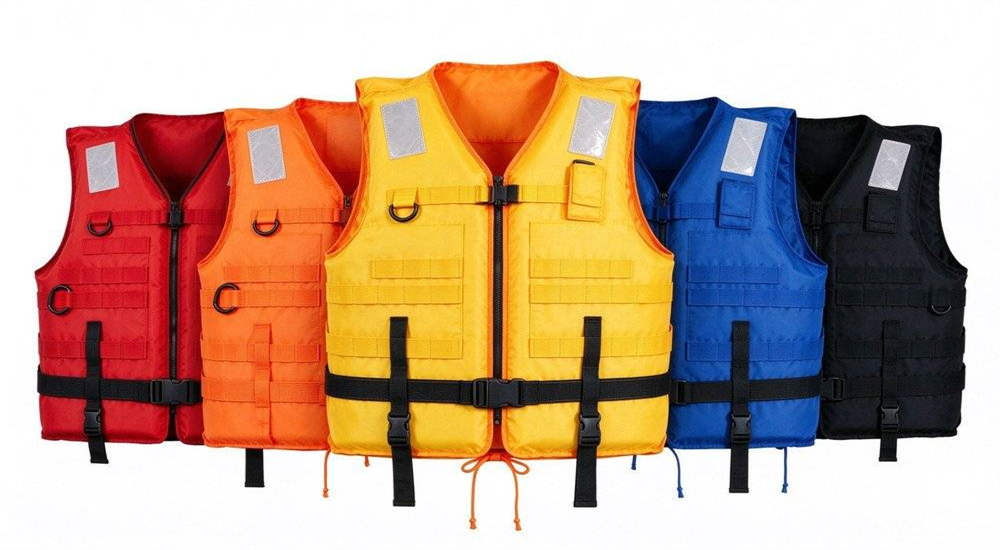
Foam life jackets use closed-cell foam (typically PVC foam or polyethylene foam) encased in a durable nylon or polyester shell to provide buoyancy. The primary advantage of foam PFDs is that they provide buoyancy at all times—there is nothing to activate, inflate, or check before entering the water. This makes them ideal for teams that enter the water frequently, operate in debris-filled environments where an inflatable might be punctured, or have limited maintenance capacity.
When evaluating water rescue PFD options for your team, foam models are available in several configurations. The basic foam vest provides 50-100N of buoyancy and is suitable for general boating and near-shore use. The rescue-specific foam PFD provides 150N+ of buoyancy with additional features like quick-release buckles, attachment points for rescue tools, reflective tape, and reinforced shoulder straps. The foam flotation suit combines a foam PFD with full-body insulation for extreme cold water operations.
The main disadvantage of foam PFDs is bulk and weight. A 150N foam PFD is significantly thicker and heavier than an equivalent inflatable model, which can restrict arm movement, cause fatigue during long operations, and make it more difficult to fit through tight spaces. However, for many rescue teams, the trade-off is worth it for the reliability and zero-maintenance benefits.
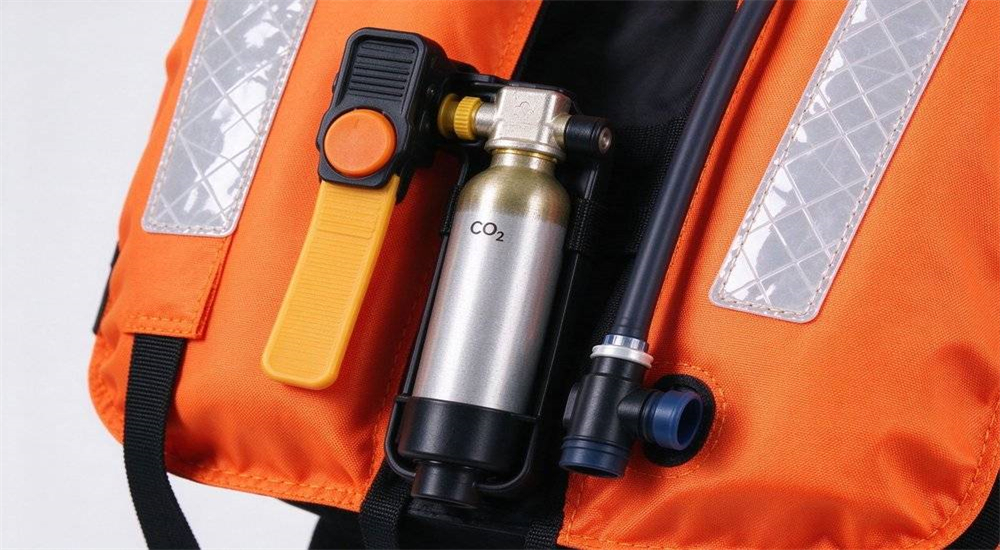
Inflatable life jackets use a CO2 gas cylinder to inflate a bladder when triggered, providing buoyancy on demand. When deflated, they are compact and lightweight—often less than 1 kilogram—making them far more comfortable to wear for extended periods. This is particularly valuable for rescue personnel who wear PFDs for entire shifts, perform technical rope work, or need maximum arm mobility for swimming and rescue techniques.
Inflatable PFDs are available in three activation types. Automatic inflatable models use a water-sensitive element that dissolves upon immersion, triggering the CO2 cylinder—this is the most common type for rescue use because it does not rely on the wearer being conscious to activate. Manual inflatable models require the wearer to pull a toggle or cord to activate—these are lighter and simpler but require the wearer to be conscious and able to reach the toggle. Dual-action (automatic + manual) models provide both activation methods, offering the reliability of automatic with the backup of manual—this is the recommended configuration for professional rescue teams.
The primary disadvantages of inflatable PFDs are maintenance requirements and vulnerability to puncture. The CO2 cylinder must be checked regularly (typically monthly) to ensure it is full and properly installed, and the water-sensitive element must be replaced after activation or at least annually (check manufacturer specifications). In debris-filled water (flood rescue, swiftwater with logs and rocks), an inflatable bladder can be punctured, causing loss of buoyancy—though many professional models include a backup oral inflation tube and some include foam backup buoyancy.
Decision guidance: If your team enters the water more than once per shift, operates in flood or swiftwater conditions with debris, or cannot commit to regular inflatable PFD maintenance, choose foam. If your team wears PFDs for extended standby periods, performs technical rope or boat work, or operates primarily in clean, calm water, choose inflatable. Many professional teams use a combination: foam PFDs for entry-level personnel and flood operations, inflatable PFDs for boat crew and technical specialists.
|
Factor |
Foam PFD |
Inflatable PFD |
|
Buoyancy availability |
Always on, no activation needed |
Only when activated (auto or manual) |
|
Weight and bulk |
Heavier, bulkier (1.5-3 kg) |
Lightweight, compact (0.5-1 kg) |
|
Arm mobility |
Some restriction |
Excellent mobility when deflated |
|
Maintenance |
Minimal (rinse and inspect) |
Regular (CO2 check, element replacement) |
|
Puncture resistance |
Excellent (foam cannot be punctured) |
Vulnerable (bladder can be punctured) |
|
Cost |
Lower ($50-200) |
Higher ($150-400) |
|
Lifespan |
5-10 years |
5-10 years (with regular servicing) |
|
Best for |
Frequent water entry, debris-filled water, low maintenance capacity |
Extended wear, technical work, calm/clean water |
A wetsuit works on a simple principle: it allows a thin layer of water to enter between the suit and the wearer's skin, and the body heat warms this water layer, providing thermal insulation. The key to effective wetsuit performance is a close fit—if the suit is too loose, water circulates freely and flushes out the warmed layer, reducing insulation. Modern rescue wetsuits are made from closed-cell neoprene rubber, which contains thousands of tiny gas bubbles that provide both insulation and inherent buoyancy.
Wetsuit thickness is the primary factor determining thermal performance. A 3mm wetsuit is suitable for water temperatures above 21°C (70°F) and is ideal for warm-water rescue operations and summer use. A 5mm wetsuit is the most versatile general-purpose thickness, suitable for water temperatures between 15-21°C (59-70°F) and appropriate for most temperate-climate rescue teams. A 7mm wetsuit provides maximum insulation for water below 15°C (59°F), though the increased thickness reduces flexibility and mobility. Some rescue wetsuits use variable thickness—5mm on the torso (core warmth priority) and 3mm on the arms and legs (mobility priority).
Dry suit maintenance extends equipment lifespan significantly. Rinse with fresh water after every use, inspect zippers and seals before storage, and hang dry in a cool, ventilated area away from direct sunlight.
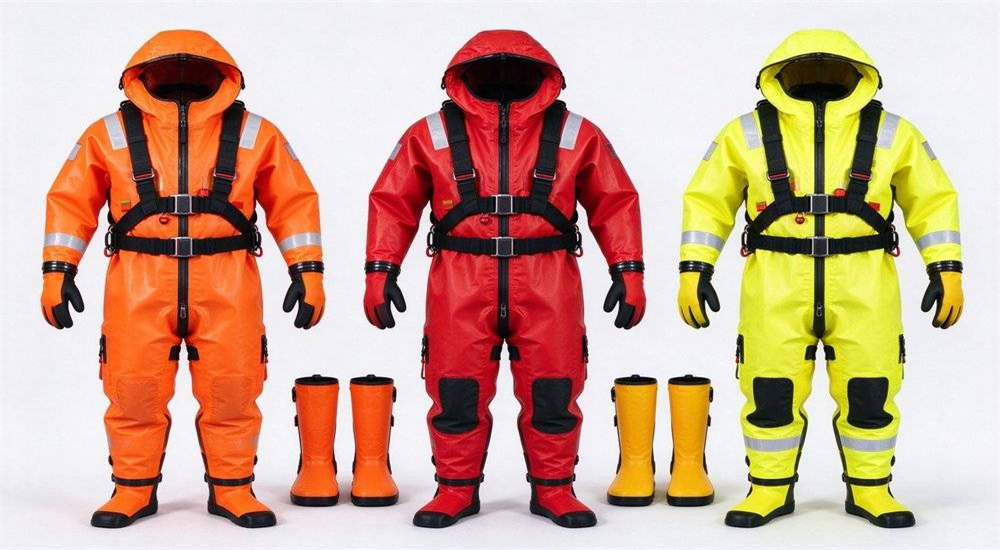
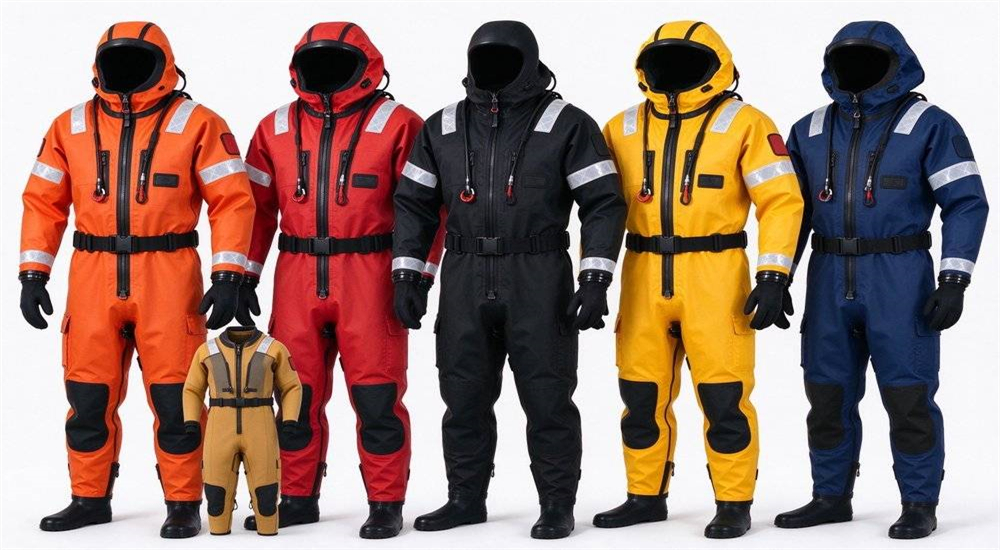
A dry suit provides complete waterproof protection by sealing the wearer entirely from water entry. Unlike a wetsuit, a dry suit does not rely on a water layer for insulation—instead, the wearer dresses in insulating undergarments (thermal base layers, fleece mid-layers) worn underneath the dry suit, and the dry suit's waterproof shell keeps these layers completely dry. This system provides superior thermal protection for cold water operations and allows the wearer to adjust insulation by changing undergarments, making a single dry suit suitable for a wide range of temperatures.
Dry suits use several sealing systems to keep water out. Latex (rubber) seals at the neck, wrists, and sometimes ankles provide a tight, waterproof seal—they are effective but can cause allergic reactions in some users and require periodic replacement as the latex degrades. Silicone seals are a newer alternative that is more durable, hypoallergenic, and comfortable, though typically more expensive. The waterproof zipper (typically a TIZIP or YKK aquaseal zipper) runs across the shoulder or down the front/back and provides the entry point while maintaining waterproof integrity.
Dry suit shells are made from several materials. Vulcanized rubber is the traditional material—extremely durable, waterproof, and suitable for heavy-duty rescue use, though heavier and less flexible. Neoprene dry suits combine the waterproof shell with inherent insulation, providing warmth even without thick undergarments. Three-layer breathable fabric (similar to high-end outdoor gear) is lightweight and comfortable, allowing moisture vapor to escape while keeping liquid water out—though typically less durable than rubber for heavy rescue use.
For flood rescue operations specifically—where water temperature can drop rapidly according to NOAA flood data—dry suits are generally recommended over wetsuits regardless of temperature, because flood water often contains sewage, chemicals, and debris that can irritate skin and contaminate wetsuits. A dry suit provides a complete barrier against contaminated water and is easier to decontaminate after operations. Additionally, flood rescue personnel may need to enter buildings, climb over debris, and work in mixed environments (water, mud, concrete) where a dry suit's durability and full-body protection are advantageous.
Water Temperature
Recommended Suit
Undergarment Layer
Additional Notes
Above 21°C (70°F)
3mm wetsuit or no suit
None (swimsuit or uniform)
Heat stress may be a concern
15-21°C (59-70°F)
5mm wetsuit
None or light base layer
Most common temperate condition
10-15°C (50-59°F)
7mm wetsuit or entry-level dry suit
Light thermal base for dry suit
Cold shock risk increases below 15°C
5-10°C (41-50°F)
Dry suit (neoprene or fabric)
Medium thermal layers (fleece mid-layer)
Hypothermia risk significant
Below 5°C (41°F)
Heavy dry suit or ice rescue suit
Heavy thermal layers + heated options
Extreme cold, limited safe exposure time
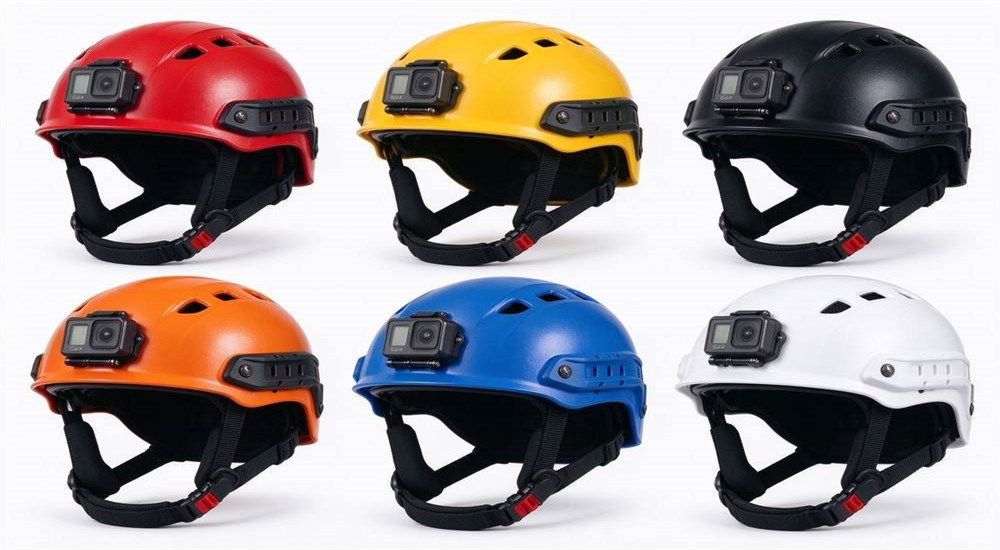
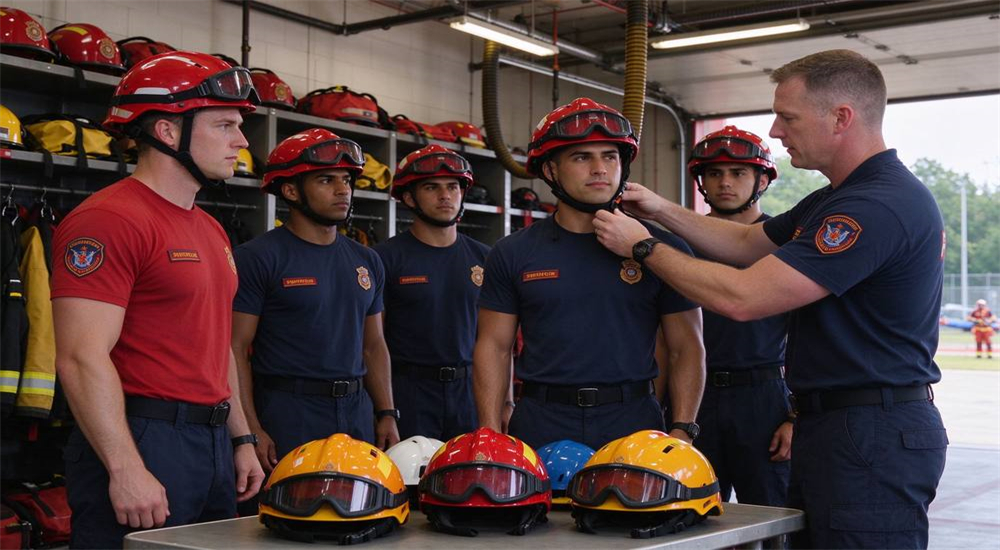
A critical component of any complete water rescue equipment package, water rescue helmets are subject to several certification standards that define impact protection, penetration resistance, and retention system performance. The most relevant standard for water rescue is EN 1385 (Whitewater Helmets), a European standard that specifically addresses the needs of whitewater and water rescue helmets. EN 1385 tests impact absorption (dropping a weighted striker onto the helmet from specified heights), penetration resistance (dropping a sharp pointed object), and retention system strength (the chin strap must keep the helmet on during force). Helmets meeting EN 1385 carry the CE mark and are widely accepted internationally for water rescue use.
Another relevant standard is EN 966 (Helmets for Air Sports), which some rescue helmets also meet because it provides additional protection for helicopter operations and high-angle rescue. EN 966 includes more stringent impact testing at multiple temperatures and requires protection against lateral impacts. For teams that perform helicopter-based water rescue or combined water/rope rescue, a helmet meeting both EN 1385 and EN 966 provides the broadest certification coverage.
It is important to note that construction helmets (EN 397) and bicycle helmets are NOT suitable for water rescue. Construction helmets are designed for falling object impacts from above only and do not provide adequate lateral impact protection or secure retention in water. Bicycle helmets are designed for single-impact protection on pavement and are not waterproof or suitable for repeated water immersion. Always verify that a helmet is specifically CE certified for water rescue (EN 1385 or equivalent national standard) before purchasing. Explore our certified water rescue helmets for professional team options.
Helmet selection should account for impact protection, fit compatibility with PFDs, and communication device integration. Test helmets with your team communication system before purchasing to ensure compatibility.
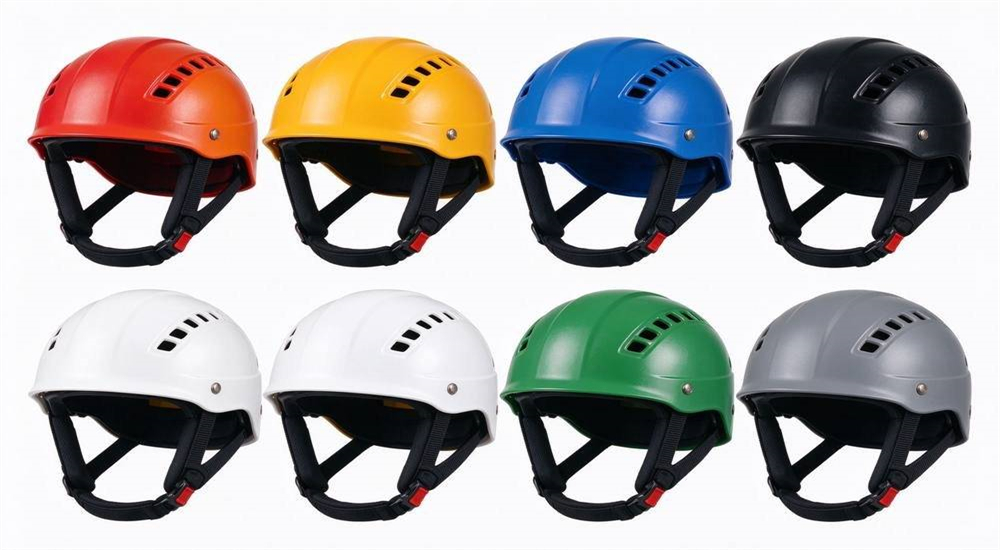
Water rescue helmet shells are primarily made from two materials: ABS (Acrylonitrile Butadiene Styrene) and polycarbonate. ABS is a tough, rigid thermoplastic that provides excellent impact resistance and durability at a lower cost. ABS helmets are typically heavier but more resistant to scratches and chemical damage, making them a good choice for heavy-duty flood and swiftwater operations where the helmet may be knocked against rocks, debris, or structures.
Polycarbonate is a lighter, more transparent thermoplastic that provides excellent impact resistance with reduced weight. Polycarbonate shells are often used in higher-end rescue helmets because they can be molded into more complex shapes and are lighter weight (reducing neck fatigue during long operations). However, polycarbonate is more susceptible to scratches and chemical damage than ABS, and may degrade with prolonged UV exposure if not properly coated.
Inside the shell, the impact-absorbing liner is typically made from expanded polystyrene (EPS) foam, which crushes on impact to absorb energy (similar to bicycle and motorcycle helmets). Some high-end rescue helmets use expanded polypropylene (EPP) foam, which is more resilient and can withstand multiple impacts without losing protective capacity—an important consideration for rescue helmets that may be subjected to repeated knocks during operations.
Many water rescue helmets include optional or integrated visors (face shields) to protect the wearer's face from water impact, flying debris, rope burn, and UV exposure. Visors are available in clear (maximum visibility), smoke/tinted (sun glare reduction), and anti-fog coated (for cold water operations where fogging is a concern). For flood rescue operations, a clear or lightly tinted visor is recommended because flood water often contains debris that can cause facial injury, and visibility in low-light flood conditions is already compromised.
Ear protection is another important helmet feature. Some rescue helmets include integrated ear covers or ear flaps that protect the ears from impact, cold water, and rope abrasion. For teams operating in cold water, ear protection helps prevent heat loss through the ears (a significant source of body heat loss in cold water). For teams using communication headsets, ensure the helmet is compatible with your communication system—some helmets have pre-installed ear cup mounts or communication wire channels.
Accessory compatibility is an often-overlooked consideration. Check that the helmet is compatible with your team's PFD (the helmet's rear profile should not interfere with the PFD's collar or back floatation), communication equipment (headset compatibility, radio microphone clips), lighting (headlamp mounts, helmet light clips), and identification (areas for team logos, name tags, or reflective tape). A helmet that is incompatible with your existing equipment creates operational inefficiencies and may require costly modifications.
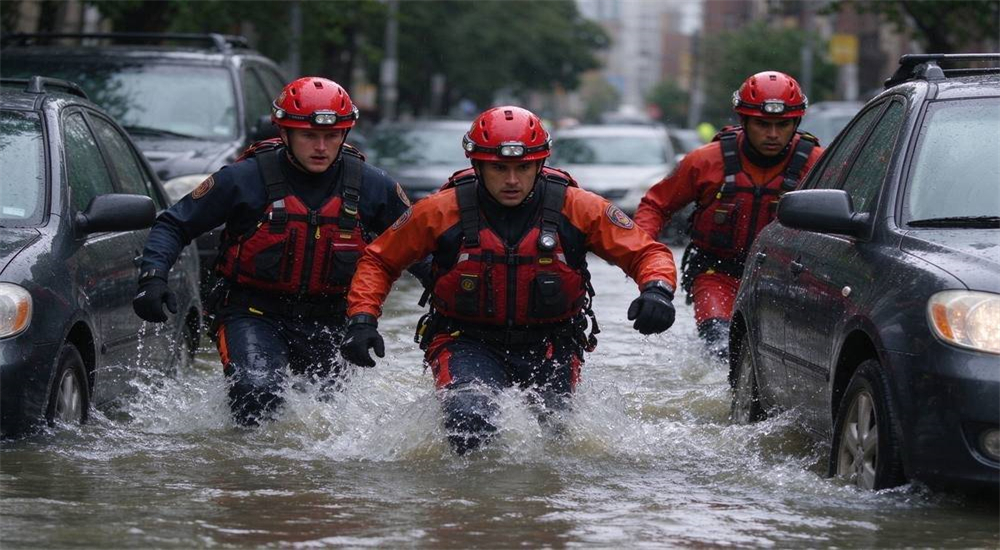
Every water rescue team member should be issued a complete set of personal protective equipment as the foundation of their water rescue equipment inventory tailored to their role and operational environment. The following checklist covers the essential PPE for a standard water rescue team member:
In addition to personal PPE, every water rescue team should maintain a set of shared team equipment that is carried on the response vehicle or boat and deployed as needed. The following is a recommended team-shared equipment list for a five-person swiftwater/flood rescue team:
For teams that respond via vehicle or boat, additional equipment should be pre-staged on the response vehicle or vessel to ensure rapid deployment. This includes spare PFDs (at least 5 additional for victims or mutual aid personnel), spare CO2 cylinders for inflatable PFDs, a comprehensive tool kit for equipment repair, rope and hardware for anchor systems, a portable pump for bailing boats, and a decontamination kit for post-operation gear cleaning. The vehicle should also carry a complete set of personal protective equipment for each team member, pre-staged in individual gear bags for rapid donning (target: full PPE donned in under 3 minutes from alarm to en route).
Equipment Category
Item
Recommended Quantity (5-person team)
Purpose
Throw Bags & Ropes
Standard throw bag (15-23m)
4 (one per active rescuer)
Victim contact from shore/boat
Rescue rope (static, 8-10mm)
2 (50m each)
Tension systems, z-drags, anchors
Tag line / guide rope
1 (100m)
Crossing fast water, victim transport
Flotation Aids
Rescue buoy / throw buoy
2
Additional flotation for victims
Inflatable rescue mat / spinal board
1
Victim transport, spinal immobilization
Medical
Waterproof first aid kit
1
Basic medical care on scene
Emergency thermal blankets
4
Hypothermia prevention for victims
AED (automated external defibrillator)
1 (vehicle-mounted)
Cardiac arrest response
Tools
Multi-tool / rescue tool
2
Equipment repair, vehicle extrication
Headlamp / portable light
4 (spares)
Low-light operations
Communication
Waterproof VHF/UHF radios
4
Team communication, command contact
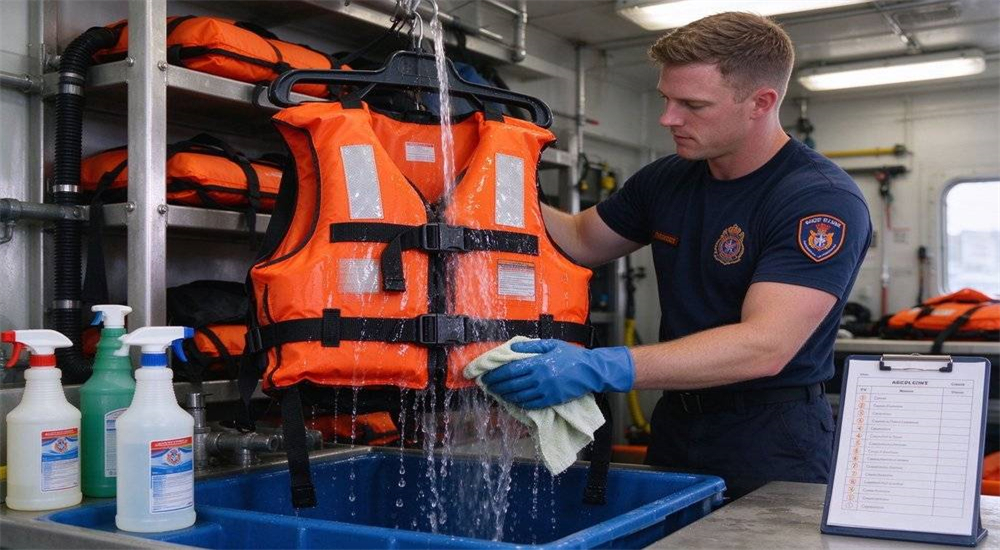
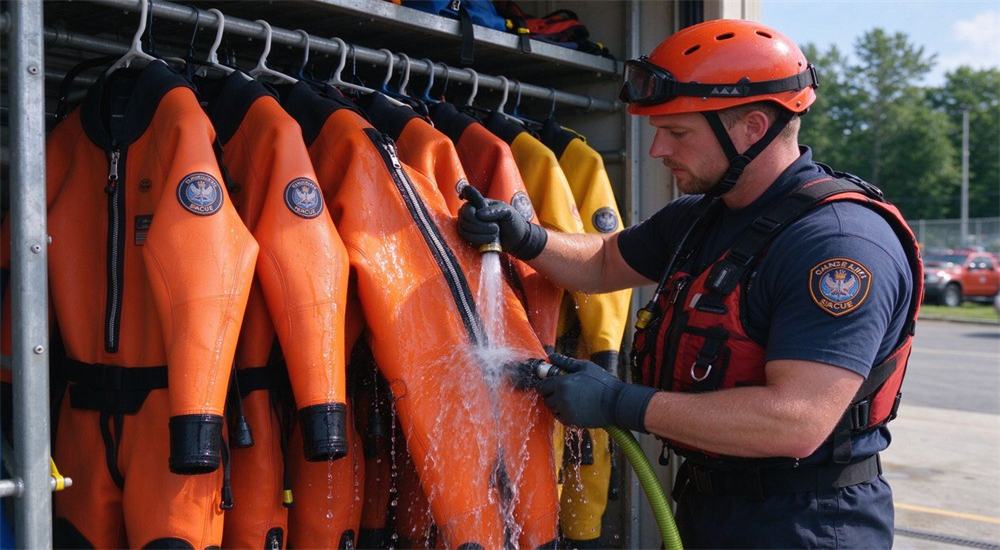
Proper water rescue equipment maintenance begins with a consistent after-use cleaning protocol that extends the lifespan of every water rescue PFD, dry suit, and helmet in your inventory. Every piece of water rescue equipment should be cleaned after every use, even if it appears clean—salt water, chlorine, mud, sewage, and chemical contaminants can degrade materials over time even when not visible. The standard cleaning protocol is: freshwater rinse → gentle cleaning → thorough rinse → air dry → inspection → proper storage.
For freshwater rinse, use a garden hose or bucket of clean fresh water to thoroughly rinse all equipment, paying special attention to zippers, buckles, webbing, and any areas where contaminants can accumulate. For gentle cleaning, use a mild soap (such as dish soap or specialized gear cleaner) and a soft brush to remove dirt and stains—never use harsh detergents, bleach, solvents, or abrasive cleaners, as these can degrade neoprene, latex seals, nylon webbing, and waterproof coatings. After cleaning, rinse thoroughly with fresh water to remove all soap residue. Finally, air dry completely in a shaded, well-ventilated area—never dry equipment in direct sunlight or near a heat source (heater, radiator, dryer), as UV radiation and heat can degrade materials and shorten equipment lifespan.
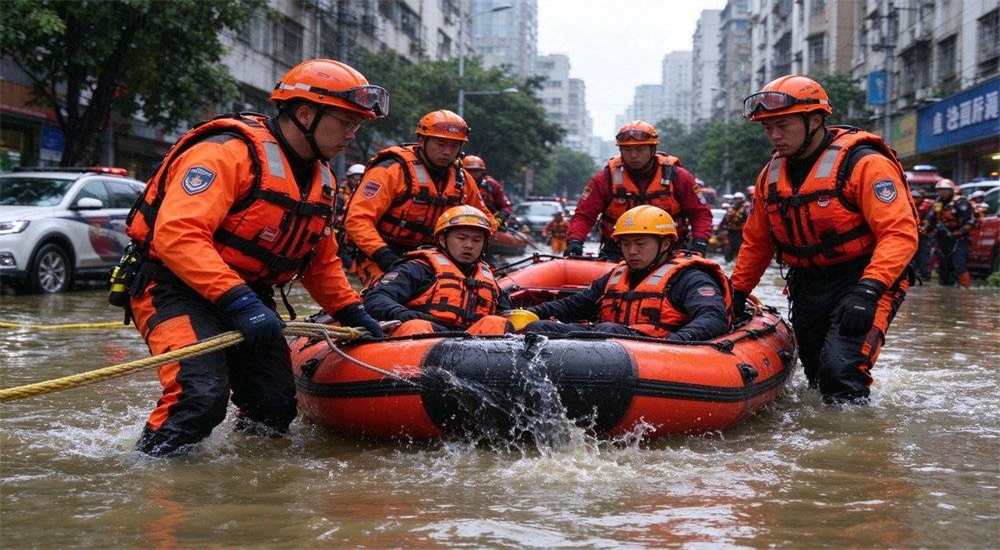
In addition to after-use cleaning, all water rescue equipment should undergo a thorough monthly inspection to identify wear, damage, or degradation that may not be apparent during routine cleaning. The following checklist covers the key inspection points for each equipment category:
PFD Inspection (monthly):
Dry Suit Inspection (monthly):
Helmet Inspection (monthly):
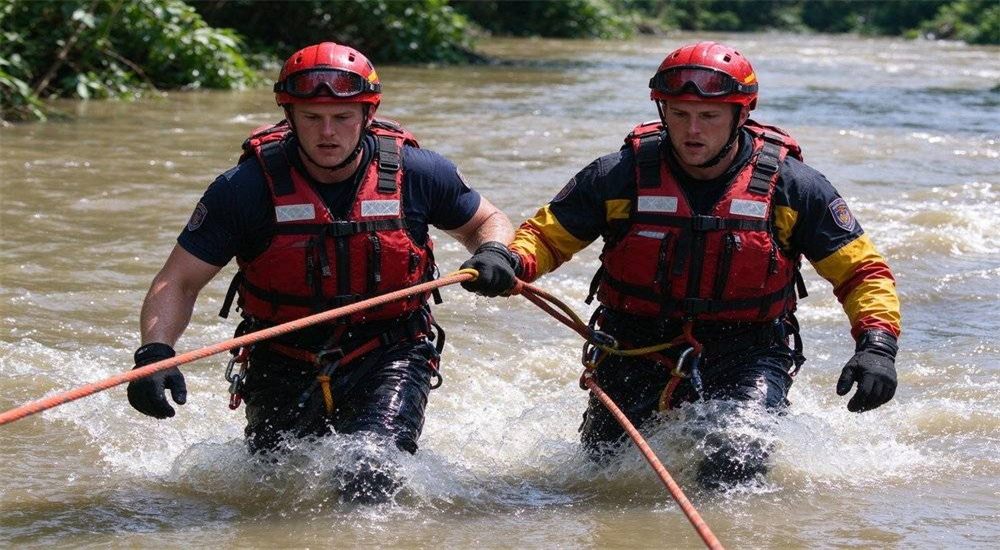
Beyond monthly inspections, certain equipment requires annual professional servicing or recertification to maintain warranty coverage and compliance with certification standards. For inflatable PFDs, the CO2 cylinder should be replaced annually (or after any activation), and the water-sensitive element should be replaced according to the manufacturer's schedule (typically every 1-2 years depending on model). Some manufacturers recommend annual factory servicing for inflatable PFDs, including complete disassembly, inspection, and pressure testing.
For dry suits, annual servicing includes replacement of latex seals (which degrade over time even with proper care—typical lifespan is 1-3 years depending on use and storage), lubrication of waterproof zippers with specialized zipper wax, and a complete leak test. For helmets, manufacturers typically recommend replacement every 3-5 years depending on use, or immediately after any significant impact (even if the helmet appears undamaged, the EPS liner may have compressed internally and lost protective capacity). Always follow the manufacturer's specific maintenance and replacement schedule—these are tested and validated recommendations, not arbitrary guidelines.
Proper storage protects your investment. Keep equipment in a climate-controlled gear room, away from direct sunlight and chemical exposure. Use dedicated racks and hangers to maintain shape and prevent compression damage.
Knowing when to retire equipment is as important as knowing how to maintain it. The following criteria indicate that equipment should be retired from service and replaced: PFD webbing that is frayed, cut, or UV-degraded (faded, stiff, or fuzzy); foam that is compressed, waterlogged, or crumbling; inflatable PFDs that fail leak tests or have damaged activation mechanisms; dry suit shells with cuts, delamination, or worn-through areas; latex seals that are torn, degraded, or no longer provide a watertight seal; helmets with cracks, dents, or significant impacts; helmet liners that are compressed or separated; and any equipment that has been involved in a significant rescue incident where it may have been subjected to forces beyond its design limits. When in doubt, retire and replace—equipment is replaceable; lives are not.
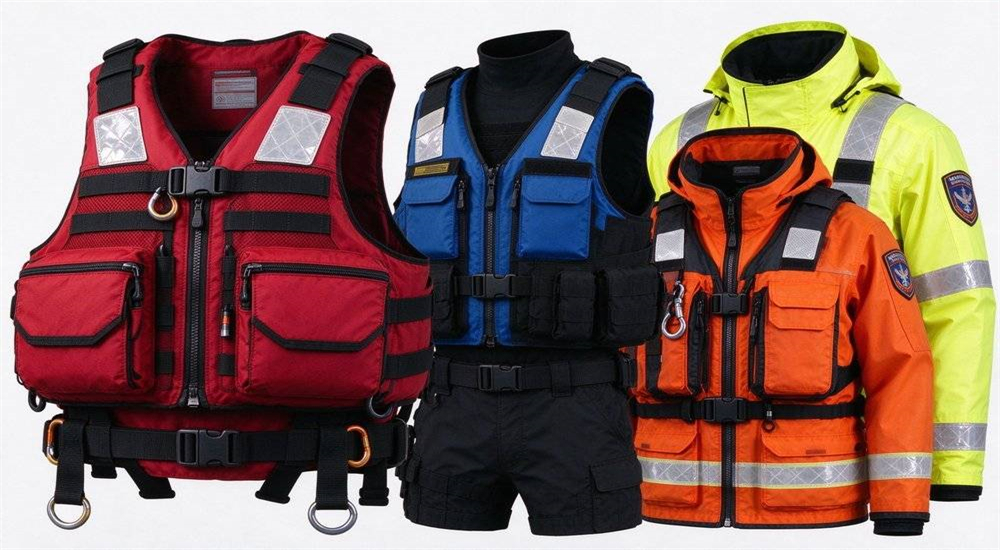
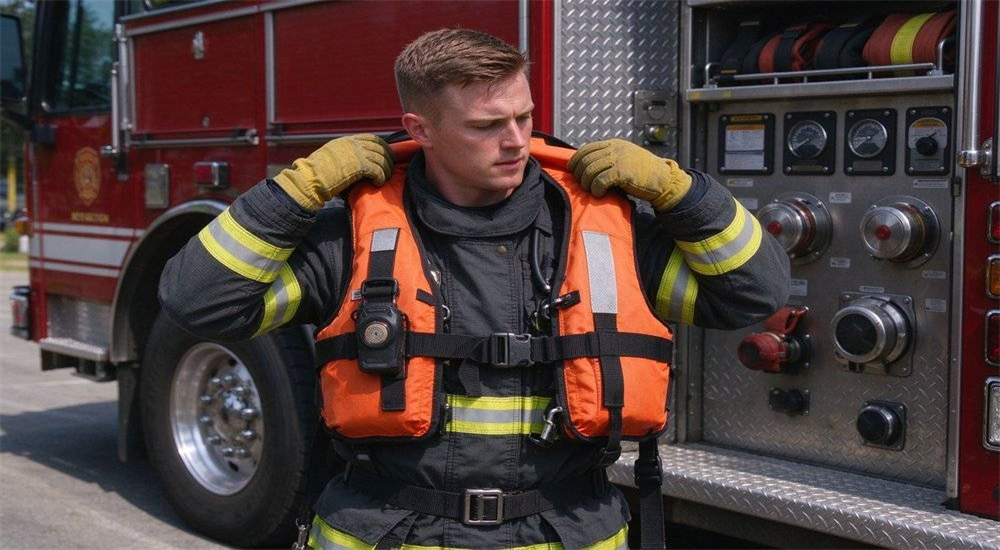
A properly fitting water rescue PFD is essential for safety—an ill-fitting piece of water rescue equipment can ride up over the wearer's face—an ill-fitting PFD can ride up over the wearer's face, fail to keep the airway above water, or cause discomfort that leads to non-compliance (team members removing or loosening the PFD during operations). The standard PFD fit test is the overhead reach test: with the PFD fully fastened and adjusted, the wearer raises both arms straight overhead. If the PFD rides up significantly (the top of the PFD reaches the chin or ears), it is too loose and needs adjustment. If the PFD stays in place (shoulder straps remain on the shoulders, bottom of the PFD does not ride up above the ribcage), the fit is acceptable.
Additional fit checks include: the chest strap should be snug but not restrictive (you should be able to take a deep breath comfortably); shoulder straps should be adjusted so the PFD sits high on the chest (not sagging down to the waist); side adjustments should be evenly tightened on both sides; and the PFD should not restrict arm movement (test by swimming strokes, reaching overhead, and simulating rescue motions). For teams using inflatable PFDs, fit should be checked both deflated (comfort and mobility) and inflated (buoyancy position and face clearance when inflated).
Dry suit fit is critical for both comfort and waterproof performance. A dry suit that is too tight restricts movement, causes fatigue, and can create pressure points that lead to discomfort during long operations. A dry suit that is too loose allows water to enter (if seals are not properly seated), creates excess material that can snag on obstacles, and reduces thermal efficiency by allowing air circulation within the suit.
The key fit checks for a dry suit include: arm mobility (raise arms overhead, cross arms in front, simulate swimming strokes—there should be no pulling or restriction at the shoulders); torso fit (bend forward, twist side to side, squat down—the suit should not pull tight across the back or shoulders); leg length (the crotch should not hang low, and the suit should not pull when walking or climbing); seal fit (neck and wrist seals should be snug but not cutting off circulation—you should be able to fit two fingers under the seal when stretched); and boot/foot fit (if integrated boots, they should fit with appropriate socks and allow toe wiggle room). Always test dry suit fit while wearing the undergarments you will actually use during operations—fit changes significantly with different undergarment thickness.
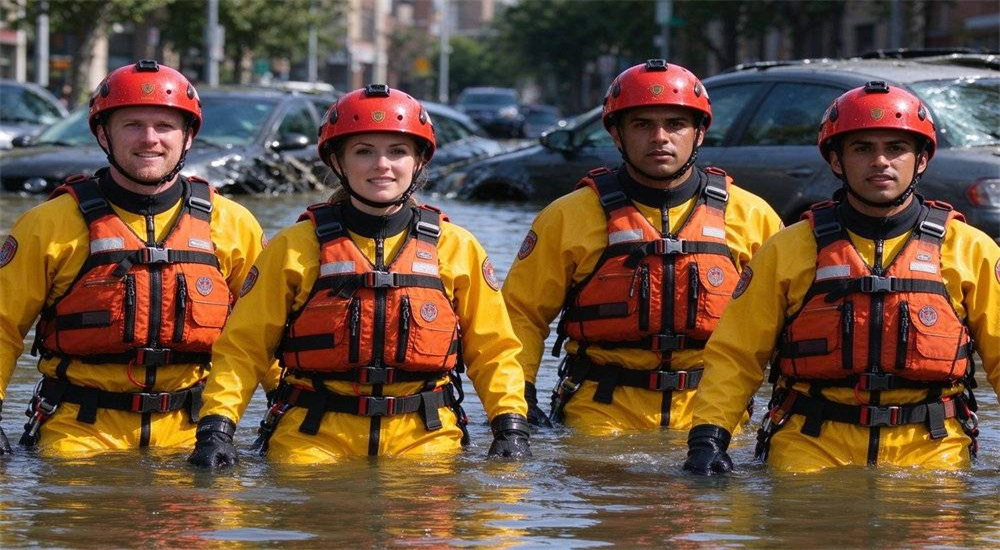
Proper helmet fit ensures that the helmet stays in place during impacts and water entry, providing maximum protection. To determine helmet size, measure the head circumference at the widest point (approximately 2.5 cm / 1 inch above the eyebrows, around the back of the head at the occipital bulge). Compare this measurement to the manufacturer's sizing chart—most rescue helmets are available in sizes XS through XL, with some models offering adjustable fit systems (dial-fit or pad-adjustable) that accommodate a range of head sizes within one shell size.
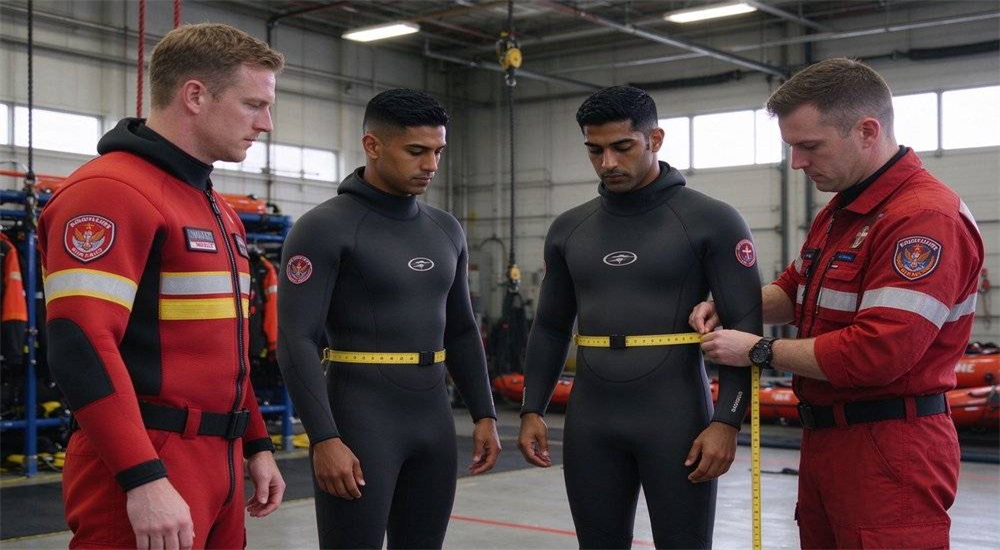
Proper sizing begins with accurate body measurements. Chest circumference, torso length, and shoulder width all affect how a PFD fits and performs in the water. Take measurements over the clothing typically worn during operations to ensure the fit accounts for layers.
Once the correct size is selected, perform the following fit checks: the helmet should sit level on the head (not tilted back or forward), with the front edge approximately 2 finger-widths above the eyebrows; the internal padding should contact the head evenly all around (no pressure points or gaps); the chin strap should be adjusted so that only one finger fits between the strap and the chin (a loose chin strap allows the helmet to come off during impact or water entry); and the nape strap (rear retention) should be adjusted to hold the helmet securely at the back of the head. Test retention by gently pushing up on the front brim of the helmet—if it rotates back easily, the retention system needs adjustment. A properly fitted helmet should feel secure and comfortable, with no excessive movement when the head is shaken vigorously.
Women make up a significant and growing percentage of water rescue personnel, and equipment fit for women requires special consideration. Standard unisex PFDs may not fit women's body shapes properly—particularly in the chest and torso areas—leading to poor buoyancy distribution, discomfort, and potential safety issues. Many manufacturers now offer women-specific PFDs with contoured chest panels, shorter torso lengths, and adjusted strap placement to accommodate women's body shapes. When outfitting female team members, prioritize PFDs designed specifically for women, or ensure that unisex models can be properly adjusted to achieve a safe and comfortable fit.
Dry suits for women also require special consideration. Women's dry suits should have appropriate torso length (many women find unisex suits have too long a torso, causing excess material in the crotch and restricting leg movement), proper shoulder width, and appropriate seal sizing (women may have smaller neck and wrist circumferences, requiring smaller seal sizes). Many manufacturers offer women-specific dry suit cuts, and custom sizing is available from some manufacturers for team members who do not fit standard sizes. Never compromise on fit—an ill-fitting dry suit is both uncomfortable and potentially unsafe.
Bulk purchasing offers cost savings but requires careful planning. Assess your team replacement cycle, storage capacity, and budget timeline before committing to large orders. Consider phased purchases to spread costs.
When preparing government procurement documents (tenders, RFQs, RFPs) for water rescue equipment, including OEM custom manufacturing specifications, it is essential to include detailed technical specifications that define exactly what is required. Vague specifications (such as "life jacket" or "rescue helmet") lead to inconsistent bids, non-compliant equipment, and potential disputes. The following technical specifications should be included for each equipment category:
For PFDs: Minimum buoyancy rating (e.g., "minimum 150N buoyancy per EN ISO 12402-2"), type (foam or inflatable), certification standard (EN ISO 12402, USCG, or equivalent), material specifications (shell fabric type and weight, foam type), required features (quick-release buckle, reflective tape, attachment D-rings, rescue knife mount), color requirements (high-visibility orange, red, or yellow), and sizing range (XS-XXL or specific size range).
For dry suits: Material type (vulcanized rubber, neoprene, or breathable fabric), seal type (latex or silicone), zipper type and placement (TIZIP or equivalent, front/shoulder entry), required features (relief zipper, pockets, adjustable cuffs), certification (if applicable), color, and sizing range. For wetsuits: thickness (e.g., "5mm full-body"), material (neoprene grade), seam type (glued and blind-stitched), knee reinforcement, and sizing range.
For helmets: Certification standard (EN 1385 or equivalent), shell material (ABS or polycarbonate), liner material (EPS or EPP), required features (visor, ear protection, ventilation, accessory mounts), color, and sizing range.
Including these detailed specifications ensures that all bidders are quoting comparable equipment, makes evaluation objective, and provides a clear basis for rejecting non-compliant bids. It is also recommended to require bidders to provide product samples for evaluation before award, particularly for PFDs and dry suits where fit and quality are difficult to assess from specifications alone.
Water rescue equipment is typically priced with volume discounts—the more units you order, the lower the per-unit cost. Understanding these discount tiers helps you plan procurement budgets and maximize value. Typical volume discount structures for water rescue equipment are:
These are approximate ranges—actual discounts vary by manufacturer, product category, and current market conditions. To maximize volume discounts, consider coordinating procurement with neighboring departments or agencies to combine orders and reach higher discount tiers. Many manufacturers also offer additional bulk purchase and wholesale discounts for repeat customers, multi-year contracts, OEM custom manufacturing, or orders that include multiple product categories (PFDs + helmets + dry suits from the same supplier). Always request quotes from multiple suppliers and negotiate—procurement of water rescue equipment is rarely a fixed-price transaction, and significant savings are often available through negotiation.
|
Order Quantity |
Typical Discount Level |
Best For |
Notes |
|
1-10 units |
List price (no discount) |
Small teams, replacement purchases |
Per-unit cost is highest |
|
11-50 units |
10-20% discount |
Medium teams, initial outfitting |
Most common procurement tier |
|
51-200 units |
20-35% discount |
Large departments, regional stockpiles |
Significant per-unit savings |
|
201-500 units |
35-45% discount |
State/provincial procurement, large agencies |
May require competitive bidding |
|
500+ units |
45-55%+ discount |
National government, military, large-scale stockpiles |
Custom pricing, may include custom branding |
Many water rescue equipment manufacturers offer custom logo printing or branding services, allowing teams to add their department logo, agency name, or identifying marks to PFDs, helmets, dry suits, and other equipment. Custom branding serves several purposes: it identifies equipment as agency property (reducing loss and theft), promotes team identity and professionalism, and can include identifying information (team member name, employee number) for inventory management.
Common branding methods include screen printing (best for flat surfaces like PFD panels and helmet sides, durable and cost-effective for medium to large orders), heat transfer / thermal printing (similar to screen printing but using heat-activated vinyl, suitable for detailed logos and multiple colors), embroidery (best for fabric dry suits and garment panels, premium appearance but higher cost), and pad printing (best for curved or irregular surfaces like helmet shells, suitable for small logos and text). Minimum order quantities for custom branding typically range from 10-50 units depending on the method and manufacturer, and setup fees may apply for first-time orders.
When ordering custom-branded equipment, provide the manufacturer with high-resolution logo files (vector format such as .AI, .EPS, or .SVG is preferred, though high-resolution .PNG or .PDF may be accepted), specify logo placement (e.g., "left chest panel of PFD, 5cm wide"), and request a digital proof or sample before production to verify logo placement, size, and color accuracy. Allow additional lead time for custom-branded orders—typically 2-4 weeks beyond standard production time.
Planning delivery timelines is critical for water rescue equipment procurement, particularly for seasonal preparation (e.g., outfitting a team before flood season or winter ice rescue season). Standard production and delivery times for water rescue equipment are typically 2-6 weeks from order confirmation, depending on quantity, custom branding requirements, and manufacturer production capacity. Custom-sized equipment or special color orders may require additional time (4-8 weeks). During peak procurement seasons (typically spring, as departments prepare for summer flooding and water rescue season), production times may be longer—plan accordingly and order early to ensure delivery before your operational season begins.
Quality control begins at the manufacturing level. Look for suppliers who conduct thorough inspections of stitching, hardware, and materials before shipping. Request quality documentation and sample units for evaluation before committing to large orders.
For emergency stockpile planning (government agencies maintaining reserve equipment for disaster response), consider the following principles: maintain a minimum reserve of 10% of your active inventory (e.g., if your team has 50 PFDs in active service, maintain at least 5 reserve PFDs for replacement during operations); rotate stock regularly (use the oldest equipment first, replace with new stock to ensure reserve equipment does not age beyond its useful lifespan); store reserve equipment in appropriate conditions (cool, dry, well-ventilated, away from direct sunlight and chemical fumes); and maintain pre-negotiated emergency supply contracts with manufacturers for rapid replenishment after major incidents (when demand may spike and lead times may increase).
One of the most common—and most dangerous—mistakes in water rescue equipment procurement and government procurement processes is selecting gear based solely on the lowest price. While budget constraints are real and must be respected, choosing the cheapest available PFD, helmet, or dry suit without verifying certification, quality, and suitability for your operational environment can have catastrophic consequences. A $30 uncertified PFD that fails to keep a rescuer's face above water in rough conditions is not a bargain—it is a liability.
To avoid this mistake, establish minimum specifications before soliciting bids, and reject any equipment that does not meet these specifications regardless of price. Specifications should include certification standards (e.g., "PFD must be certified to EN ISO 12402-2 or USCG equivalent"), minimum performance requirements (e.g., "minimum 150N buoyancy"), and material/construction quality standards. When evaluating bids, compare total cost of ownership (purchase price + expected maintenance costs + expected lifespan) rather than just initial purchase price—a $200 PFD that lasts 10 years with minimal maintenance costs less over time than a $50 PFD that needs replacement every 3 years.
Many organizations focus exclusively on the initial purchase cost of water rescue equipment and fail to budget for ongoing maintenance, inspection, and replacement costs. This is particularly true for inflatable PFDs (which require regular CO2 cylinder replacement and water-sensitive element changes), dry suits (which require periodic seal replacement and zipper maintenance), and helmets (which should be replaced every 3-5 years or after any significant impact). Failing to budget for these costs leads to equipment being kept in service beyond its useful lifespan, creating safety risks.
To avoid this mistake, calculate the total lifecycle cost for each equipment category before procurement, and include ongoing maintenance costs in your annual operating budget. A useful framework is to budget approximately 10-15% of the initial equipment purchase cost annually for maintenance, inspection, and replacement reserves. For example, if you purchase $50,000 of water rescue equipment, budget $5,000-7,500 annually for maintenance and replacement. Create an equipment inventory tracking system that records purchase dates, inspection dates, maintenance actions, and expected retirement dates for each piece of equipment, and use this system to plan replacement purchases proactively rather than reactively.
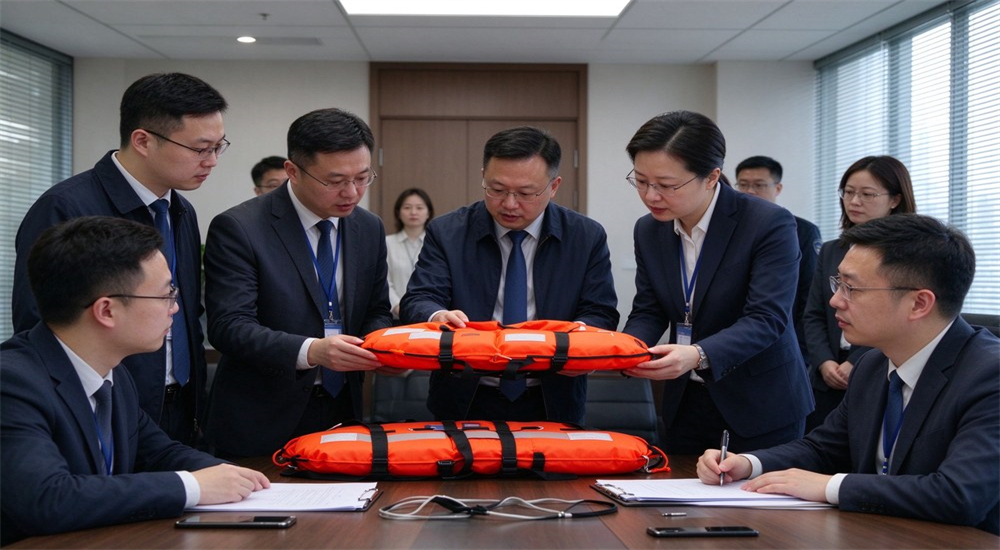
Another common mistake is procuring a single size or model of PFD for all team members, assuming that "one size fits most" or that adjustable PFDs accommodate all body types. In reality, PFD fit varies significantly by body shape, size, and gender, and an improperly fitting PFD is both uncomfortable and potentially unsafe (it may ride up over the face, fail to provide proper buoyancy distribution, or cause chafing that leads to non-compliance). This is particularly problematic for teams with diverse body types, including female team members who may not fit standard unisex PFDs properly.
Certification labels verify that equipment meets established safety standards, but visual inspection remains essential. Check for UV damage, seam separation, and hardware corrosion before each deployment, even on certified gear.
To avoid this mistake, offer multiple PFD sizes and models within your team's inventory, and allow team members to select the PFD that fits them best (within your approved specification range). Consider including women-specific PFD models in your inventory for female team members. When procuring new PFDs, require suppliers to provide sizing samples for team members to try on before finalizing the order, and ensure that your order includes a range of sizes (typically XS through XXL) to accommodate all team members. Document each team member's assigned PFD size and model in your equipment inventory system.
Water rescue equipment does not operate in isolation—PFDs must be compatible with helmets, communication systems must be compatible with helmets and PFDs, dry suits must be compatible with PFDs and footwear, and all equipment must work together as an integrated system. A common mistake is procuring equipment from multiple manufacturers without verifying compatibility, leading to operational issues such as PFD collars that interfere with helmet retention, communication headsets that do not fit under helmet ear protection, or dry suit cuffs that are too thick to fit under PFD arm openings.
To avoid this mistake, evaluate equipment as a complete system rather than as individual items. When procuring new equipment, test it with your existing equipment to verify compatibility before finalizing the purchase. If outfitting a new team from scratch, consider purchasing a complete equipment system from a single manufacturer (or from manufacturers with documented compatibility) to ensure all components work together seamlessly. Include compatibility requirements in your procurement specifications (e.g., "PFD must be compatible with standard water rescue helmets with ear protection and communication headsets"), and require suppliers to demonstrate compatibility during product evaluation.
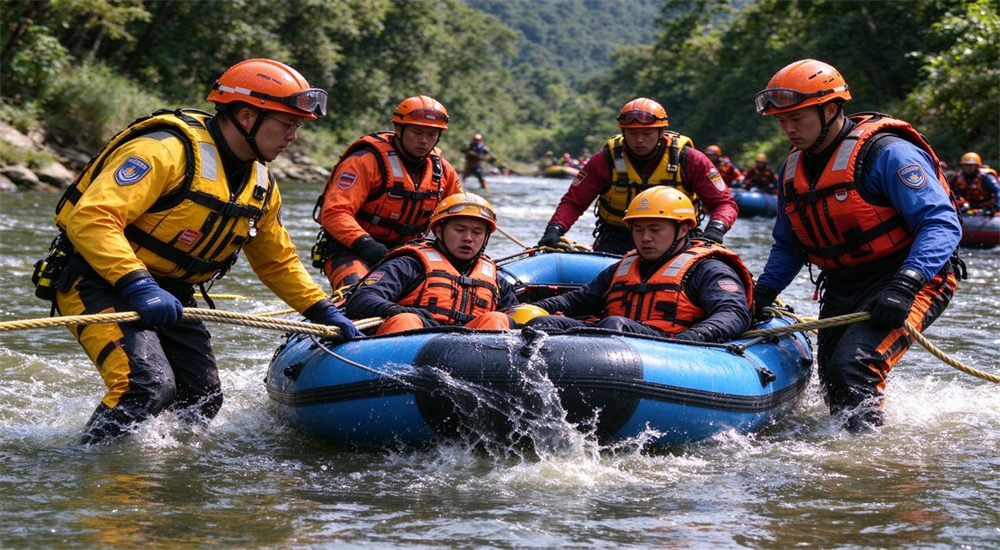
The entry-level package is suitable for small teams, volunteer organizations, or teams with limited budgets that need basic compliant equipment. This package prioritizes essential safety equipment while keeping costs manageable, and is appropriate for teams that perform occasional water rescue or flood response as a secondary function.
Equipment
Specification
Approx. Cost
PFD
100N foam, basic certification, reflective tape
$50-80
Helmet
EN 1385 certified, ABS shell, basic retention
$40-60
Wetsuit
3mm or 5mm neoprene, basic construction
$50-100
Gloves
Basic neoprene gloves
$10-20
Booties
Basic neoprene booties
$15-30
Whistle + Knife
Basic rescue whistle and blunt-tip knife
$10-20
Total per person
$175-310
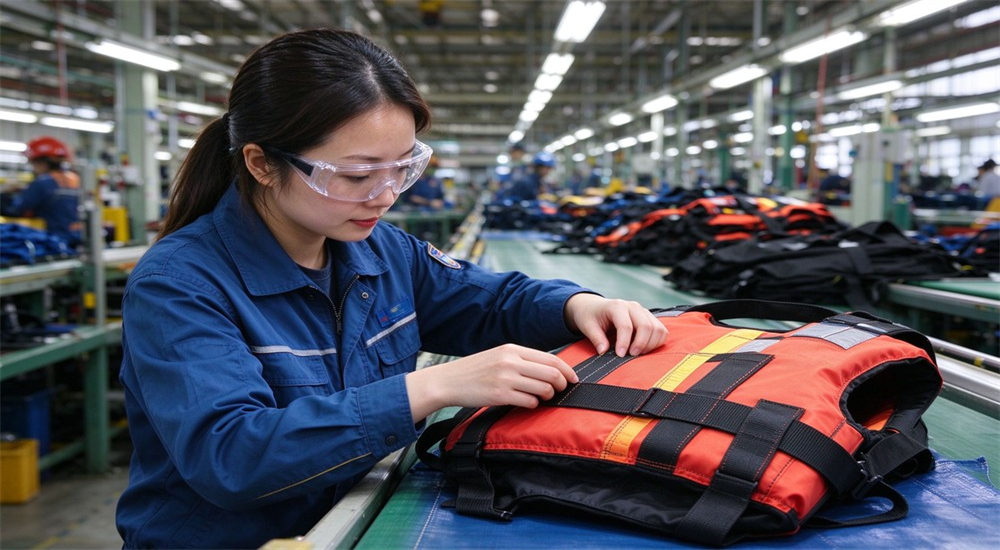
The professional-grade package is recommended for full-time fire departments, dedicated water rescue teams, and government agencies that perform water rescue as a primary function. This package includes higher-quality, more durable equipment with additional features that enhance safety, comfort, and operational effectiveness.
Cold water operations demand specialized equipment. Hypothermia sets in quickly even in mild temperatures, so thermal protection should be a priority for any team operating in water below 20 degrees Celsius.
Equipment
Specification
Approx. Cost
PFD
150N rescue-specific foam, quick-release, MOLLE webbing, SOLAS reflective
$120-200
Helmet
EN 1385 + EN 966, ABS/polycarbonate shell, visor, ear protection
$80-150
Dry Suit
Entry-level neoprene or fabric dry suit, latex seals, front zipper
$200-400
Gloves
Kevlar-reinforced rescue gloves
$20-40
Footwear
Rescue water shoes or integrated dry suit boots
$30-60
Accessories
Rescue knife, pealess whistle, waterproof light, helmet mount
$30-60
Total per person
$480-910
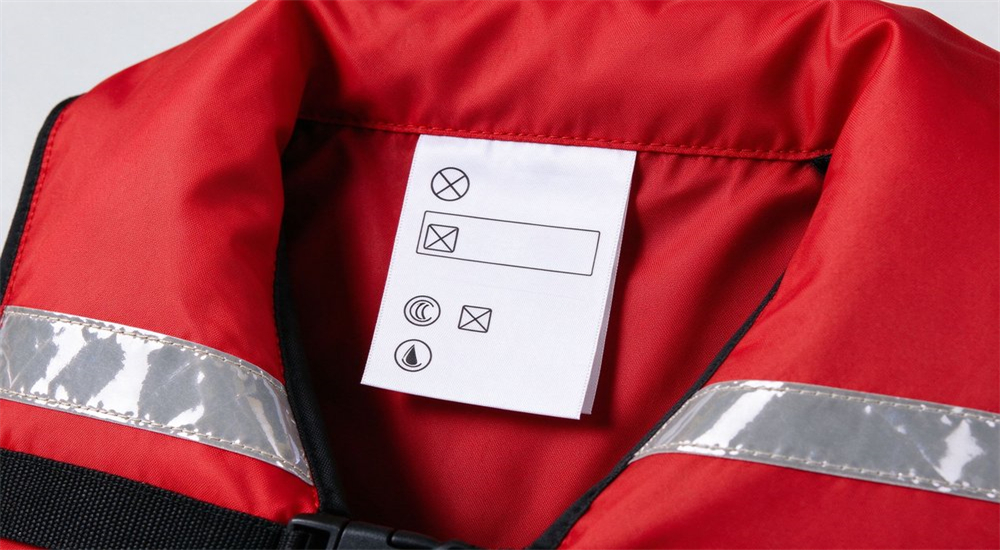
The extreme environment package is designed for teams operating in extreme conditions: cold water below 5°C, ice rescue, open ocean/coastal guard operations, or technical swiftwater rescue. This package includes the highest-performance equipment available, with features specifically designed for extreme environments.
These budget ranges are approximate and vary by manufacturer, quantity, custom branding, and current market conditions. Always obtain detailed quotes from multiple suppliers and negotiate for the best pricing. Remember that the most expensive equipment is not always the best equipment for your specific operational needs—focus on certified, suitable, well-fitting equipment rather than the highest price point.
Equipment
Specification
Approx. Cost
PFD
150-270N high-performance, rescue-specific, premium materials, full feature set
$200-400
Helmet
Premium EN 1385+966, polycarbonate shell, anti-fog visor, communication-compatible
$150-250
Dry Suit
Professional-grade vulcanized rubber or heavy neoprene, silicone seals, heavy-duty zipper
$500-900
Thermal Layers
Premium base layer + fleece mid-layer system for dry suit
$100-200
Gloves + Footwear
Premium dry gloves system, heavy-duty rescue boots
$80-150
Full Accessory Kit
Rescue knife, whistle, light, helmet camera mount, communication interface
$50-100
Total per person
$1080-2000
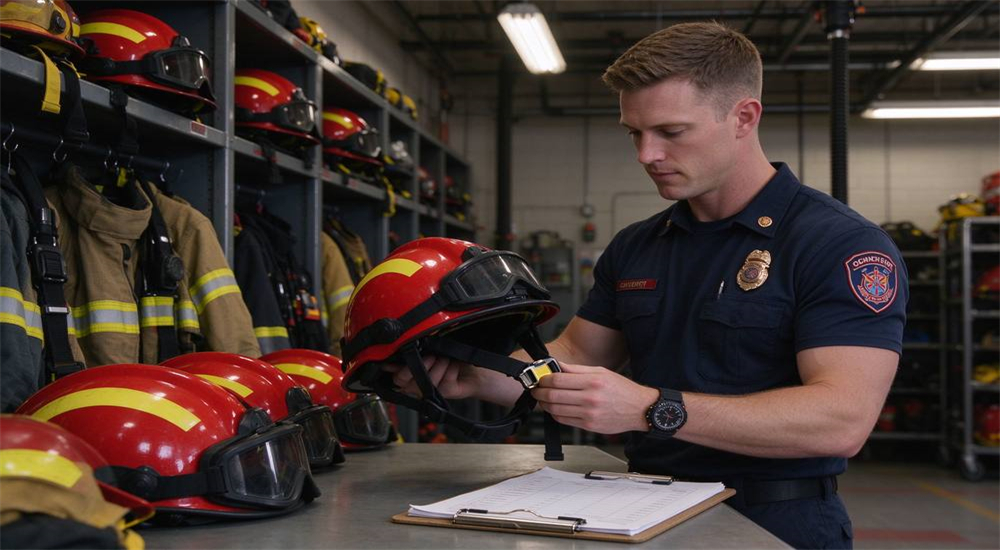
Water rescue equipment is subject to various certification standards that verify performance, safety, and quality. Understanding these standards helps you evaluate equipment and ensure compliance with regulatory requirements. The major certification standards for water rescue equipment include:
EN ISO 12402 (Personal Flotation Devices): This is the primary European and international standard for PFDs, replacing the older EN 393/395/396 standards. EN ISO 12402 is divided into parts: Part 2 covers PFDs with buoyancy greater than 150N (performance level 275, 150), Part 3 covers PFDs with buoyancy 50-150N (performance level 100, 50), Part 4 covers foam PFDs, Part 5 covers inflatable PFDs, and Part 9 covers test methods. PFDs certified to EN ISO 12402 carry the CE mark and are accepted throughout Europe and many other regions.
Certification labels provide assurance of tested performance, but they do not replace proper training and maintenance. Verify that certifications are current and match the specific standards relevant to your operations.
USCG (U.S. Coast Guard) Approval: In the United States, PFDs must be USCG-approved to meet legal requirements for recreational and commercial vessels. USCG approved gear is divided into Types I-V, with Type I providing the highest buoyancy (22 lbs / ~100N for offshore use) and Type V being special-use devices (including rescue-specific PFDs). For professional water rescue in the U.S., a USCG Type V PFD (approved for rescue use) or a Type I PFD is typically required. Note that USCG approval is specific to the U.S. market and may not be accepted in other countries.
EN 1385 (Helmets for Canoeing and Whitewater Sports): This European standard specifies requirements for helmets used in whitewater sports and water rescue, including impact absorption, penetration resistance, retention system strength, and field of vision. Helmets certified to EN 1385 carry the CE mark and are the most widely accepted certification for water rescue helmets internationally.
EN 966 (Helmets for Air Sports): While not specifically a water rescue standard, EN 966 is often referenced for helmets used in helicopter-based water rescue because it provides additional impact protection requirements (including lateral impact and multi-temperature testing) beyond EN 1385. Helmets meeting both EN 1385 and EN 966 provide the broadest certification coverage for combined water and helicopter operations.
SOLAS (Safety of Life at Sea): The International Convention for the Safety of Life at Sea (SOLAS) sets minimum safety standards for ships and their equipment, including life jackets and rescue equipment. SOLAS-approved PFDs are required on commercial vessels and are designed for extreme conditions (typically 150N+ buoyancy, with specific requirements for whistle, light, and retro-reflective tape). For teams operating in coastal or maritime environments, SOLAS-approved equipment may be required or recommended.
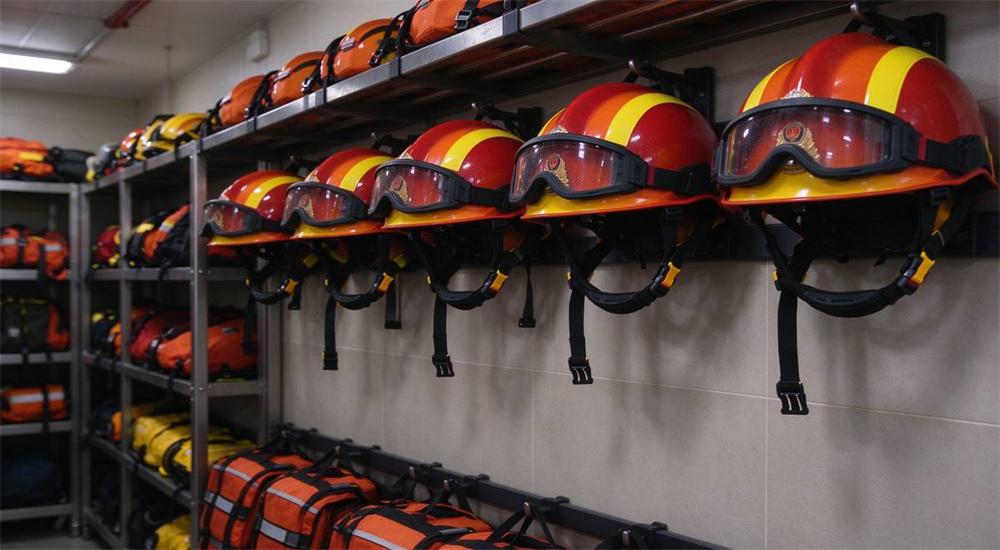
Unfortunately, counterfeit or falsely certified water rescue equipment exists in the market, and verifying certification authenticity is an important procurement step. To verify that equipment is genuinely certified, take the following steps: first, check for the appropriate certification marks on the equipment itself (CE mark for EN standards, USCG approval number for USCG-approved PFDs, certification label with standard number and certification body name). Second, request a copy of the certification certificate from the supplier or manufacturer—genuine certifications are issued by accredited third-party testing bodies (such as TÜV, BSI, SGS, or similar) and include detailed test reports, certificate numbers, and expiration dates. Third, verify the certification with the issuing body—most certification bodies provide online verification systems where you can enter the certificate number to confirm its validity and scope. Finally, be wary of equipment with unusually low prices, no certification marks, or vague certification claims (such as "meets all applicable standards" without specifying which standards)—these may indicate counterfeit or non-compliant equipment.
For government procurement, it is recommended to include certification verification requirements in your tender documents, requiring bidders to provide valid certification certificates with their bids and to allow verification with the issuing certification body. This helps ensure that only genuinely certified equipment is procured and reduces the risk of non-compliant equipment entering service.
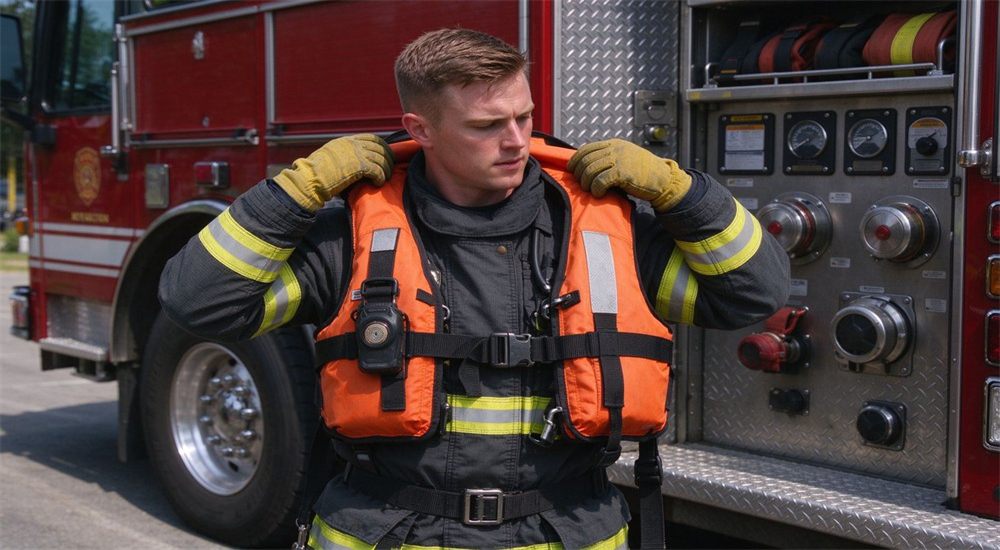
Q1: What is the difference between a foam PFD and an inflatable PFD for water rescue?
When comparing water rescue PFD types, foam models provide constant buoyancy using closed-cell foam and require no activation—they are always ready to use, making them ideal for frequent water entry and debris-filled environments. Inflatable PFDs use a CO2 cylinder to inflate a bladder on demand (automatically upon immersion or manually by pulling a toggle), providing superior comfort and mobility when deflated but requiring regular maintenance (CO2 cylinder checks, element replacement) and being vulnerable to puncture in debris-filled water. For professional water rescue, many teams use foam PFDs for entry-level and flood operations, and inflatable PFDs for boat crew and extended standby.
The lifespan of any water rescue equipment—especially a water rescue PFD—depends on the type, frequency of use, and maintenance. With proper care and regular inspection, a foam PFD typically lasts 5-10 years, while an inflatable PFD lasts 5-10 years (with regular servicing and CO2 cylinder replacement). However, PFDs should be replaced immediately if they show signs of damage: webbing that is frayed, cut, or UV-degraded (faded, stiff, or fuzzy); foam that is compressed, waterlogged, or crumbling; buckles that are cracked or do not lock properly; or inflatable PFDs that fail leak tests or have damaged activation mechanisms. When in doubt, replace—PFDs are life safety equipment, and using a compromised PFD is not worth the risk.
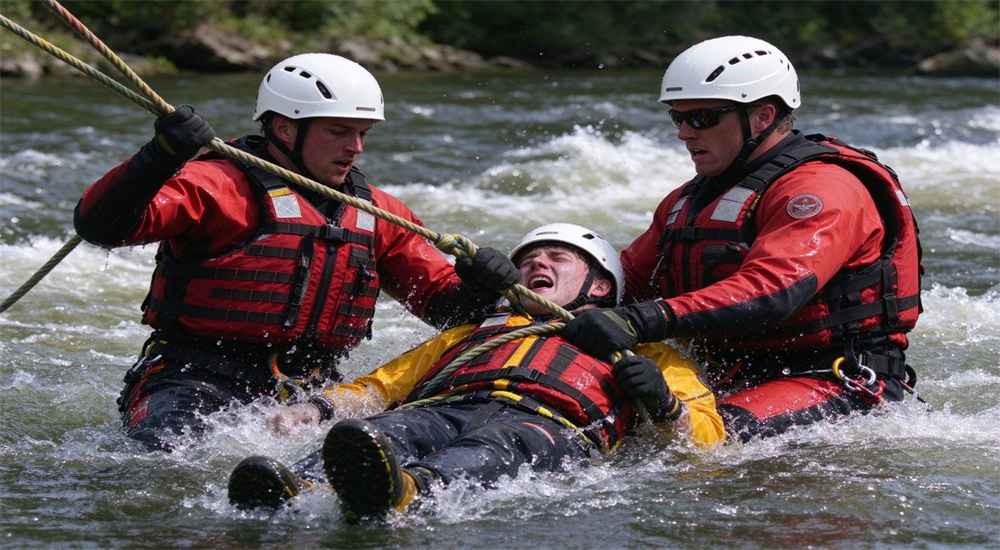
No—construction helmets (EN 397) and bicycle helmets are NOT suitable for water rescue. Construction helmets are designed only for falling object impacts from above and do not provide adequate lateral impact protection or secure retention in water (they can easily come off during water entry or swimming). Bicycle helmets are designed for single-impact protection on pavement and are not waterproof, may degrade with water immersion, and do not provide the secure retention or face protection needed for water rescue. Always use a helmet specifically certified for water rescue (EN 1385 or equivalent national standard)—this is tested and validated equipment designed specifically for the water rescue environment.
For flood rescue operations, a minimum buoyancy rating of 150N is recommended for all rescue personnel. This is because flood rescue typically involves heavy clothing (turnout gear or dry suits that can absorb water and add weight), debris-filled water (where additional buoyancy helps keep the rescuer afloat if entangled), and potentially rough conditions. A 150N PFD provides approximately 15 kg (33 lbs) of buoyant force, which is sufficient to keep a fully clothed adult's face above water in most flood conditions. For teams operating in extreme conditions (fast current, cold water, heavy equipment), a 270N PFD may be appropriate to provide an additional safety margin. Always calculate your specific buoyancy needs using the body weight × clothing × environment formula provided in this guide.
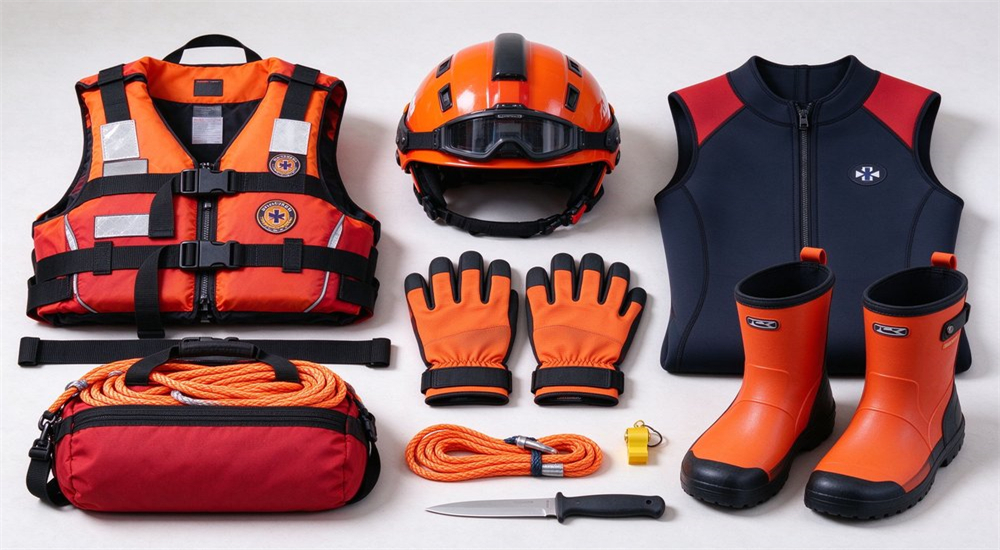
After flood operations, dry suits require thorough cleaning because flood water often contains sewage, chemicals, and debris that can degrade materials and cause skin irritation. The cleaning protocol is: first, rinse the suit thoroughly with fresh water (inside and out) to remove bulk contaminants; second, wash with a mild soap or specialized gear cleaner and a soft brush, paying special attention to seals, zippers, and high-wear areas; third, rinse thoroughly with fresh water to remove all soap residue; fourth, turn the suit inside out and wash the interior as well (sweat, body oils, and contaminants can accumulate inside); fifth, air dry completely in a shaded, well-ventilated area (never in direct sunlight or near heat); and finally, store on a wide hanger (not folded) in a cool, dry, well-ventilated area, with zippers partially open and seals dusted with talcum powder or specialized seal lubricant. Latex seals should be replaced every 1-3 years depending on use and storage, and waterproof zippers should be lubricated with specialized zipper wax after every 5-10 uses or at least annually.
EN 1385 is the European standard specifically for helmets used in canoeing, whitewater sports, and water rescue. It tests impact absorption (dropping a weighted striker onto the helmet), penetration resistance (dropping a sharp object), retention system strength (chin strap performance), and field of vision. EN 966 is the standard for helmets used in air sports (paragliding, hang gliding, skydiving), which includes more stringent impact testing at multiple temperatures (including cold temperatures relevant to high-altitude helicopter operations), lateral impact requirements, and additional retention system testing. For water rescue teams that also perform helicopter-based rescue or high-angle rope rescue, a helmet meeting both EN 1385 and EN 966 provides the broadest certification coverage. For teams that perform only water-based rescue (no helicopter or high-angle operations), EN 1385 certification alone is sufficient.
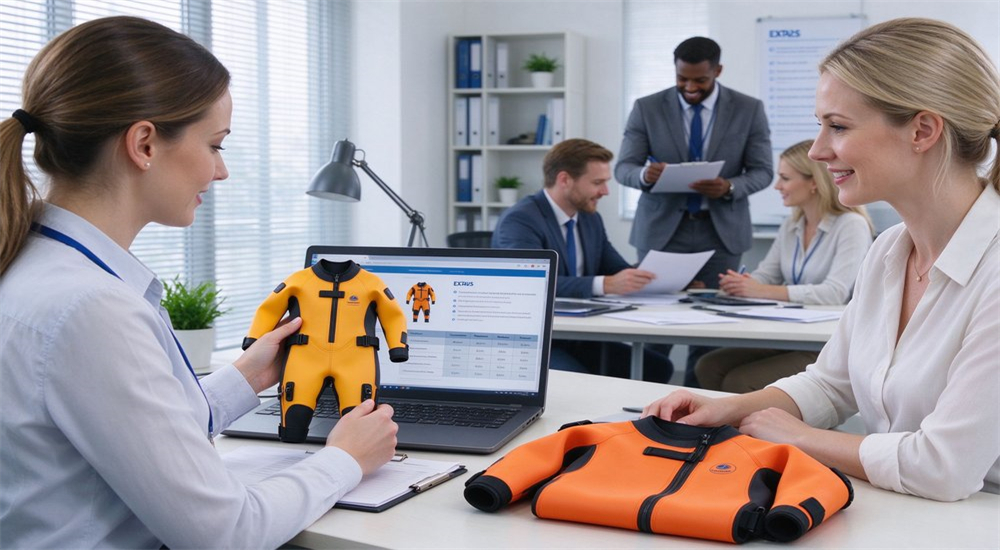
Yes—many water rescue equipment manufacturers offer custom logo printing or branding services for PFDs, helmets, dry suits, and other equipment. Common branding methods include screen printing (best for flat surfaces like PFD panels, durable and cost-effective for medium to large orders), heat transfer/thermal printing (suitable for detailed logos and multiple colors), embroidery (best for fabric dry suits, premium appearance), and pad printing (best for curved surfaces like helmet shells). Minimum order quantities typically range from 10-50 units depending on the method and manufacturer, and setup fees may apply for first-time orders. When ordering custom-branded equipment, provide high-resolution vector logo files (.AI, .EPS, .SVG preferred), specify logo placement and size, and request a digital proof or sample before production to verify accuracy. Allow 2-4 weeks additional lead time for custom-branded orders.
Determining the correct dry suit size requires more than just height and weight—dry suit fit depends on torso length, arm length, leg length, shoulder width, chest circumference, waist circumference, and neck/wrist circumference (for seal sizing). Most manufacturers provide detailed sizing charts that include all these measurements, and many offer custom sizing for team members who do not fit standard sizes. To measure for a dry suit: measure chest circumference at the widest point, waist circumference at the natural waist, hip circumference at the widest point, torso length (from shoulder, through crotch, back to shoulder), arm length (from shoulder to wrist with arm slightly bent), inseam (from crotch to ankle), neck circumference (for neck seal sizing), and wrist circumference (for wrist seal sizing). Always try on the dry suit while wearing the undergarments you will actually use during operations—fit changes significantly with different undergarment thickness. If possible, test the suit in water to verify seal integrity and mobility before finalizing the purchase.
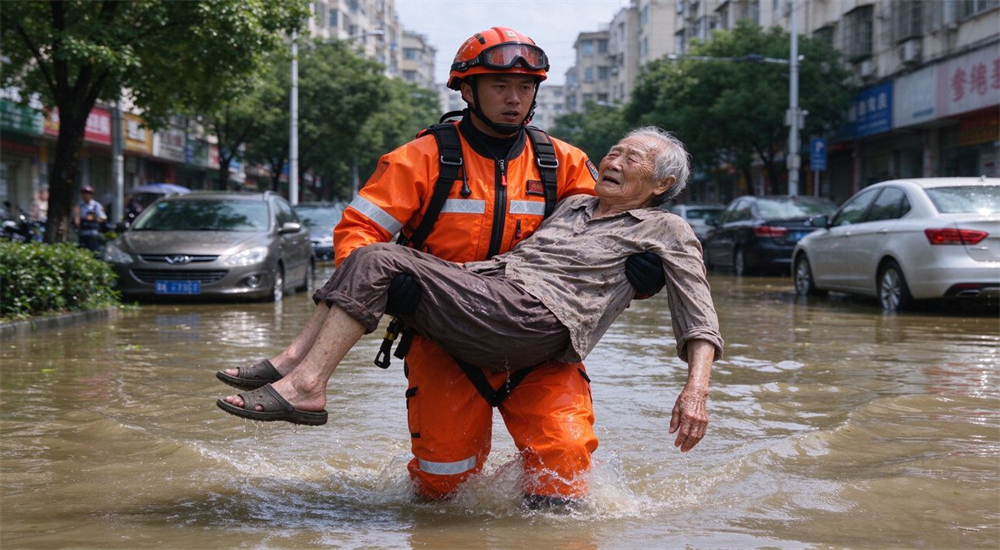
A complete equipment inventory for a 5-person water rescue team includes: personal PPE for each team member (5 PFDs, 5 helmets, 5 dry suits or wetsuits, 5 pairs of gloves, 5 pairs of booties, 5 rescue knives, 5 whistles, 5 headlamps); team-shared equipment (4 throw bags, 2 rescue ropes (50m each), 1 tag line (100m), 2 rescue buoys, 1 spinal board/inflatable rescue mat, 1 waterproof first aid kit, 4 emergency thermal blankets, 1 AED, 2 multi-tools, 4 waterproof VHF/UHF radios); and vehicle/boat-mounted equipment (5 spare PFDs for victims, spare CO2 cylinders, comprehensive tool kit, portable pump, decontamination kit, individual gear bags for each team member). The total cost for a complete 5-person team inventory ranges from approximately $5,000 (entry-level) to $25,000+ (professional/extreme environment), depending on equipment grade and specifications. Refer to the complete rescue kit section of this guide for a detailed itemized list with quantities and purposes.
Water rescue equipment should be inspected at three intervals: after every use (cleaning and visual inspection for obvious damage), monthly (thorough detailed inspection of all components using the checklists in this guide), and annually (professional servicing and recertification, including replacement of consumable items like CO2 cylinders and latex seals). After every use: rinse all equipment with fresh water, clean as needed, air dry completely, and perform a visual inspection for cuts, tears, abrasion, or other damage. Monthly: inspect PFD webbing and buckles, test inflatable PFD CO2 cylinders, inspect dry suit seals and zippers (perform leak test), inspect helmet shell and liner, check all ropes for wear, and verify all equipment is present and in serviceable condition. Annually: replace inflatable PFD CO2 cylinders and water-sensitive elements, replace dry suit latex seals (if degraded), lubricate dry suit zippers, perform factory servicing if required by manufacturer, and replace any equipment that has reached the end of its useful lifespan (typically 5-10 years for PFDs and dry suits, 3-5 years for helmets). Document all inspections and maintenance actions in your equipment inventory tracking system.
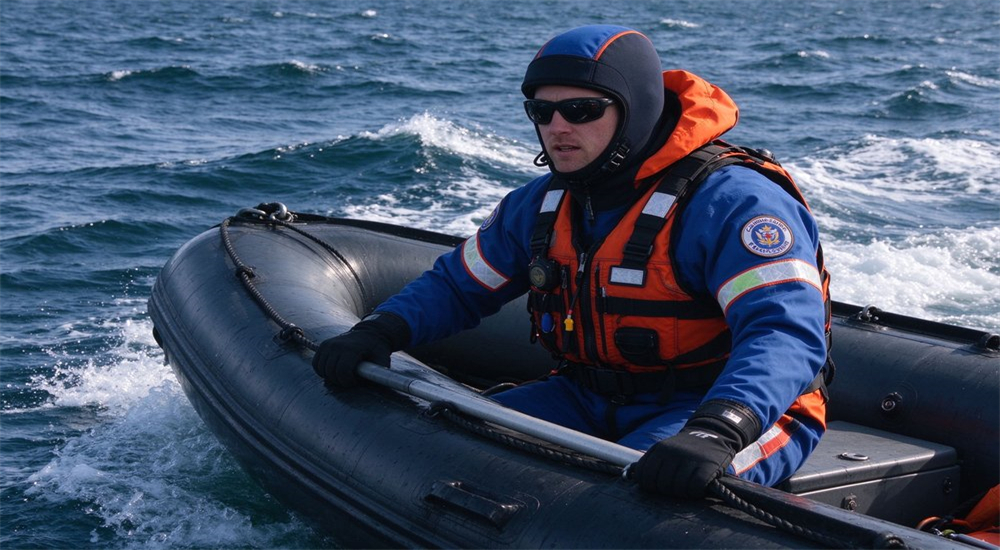
For flood rescue specifically, dry suits are generally recommended over wetsuits for several reasons. First, flood water often contains sewage, chemicals, oil, and other contaminants—a dry suit provides a complete waterproof barrier that protects the wearer's skin from contact with contaminated water, while a wetsuit allows water (and contaminants) to enter and remain in contact with the skin. Second, flood rescue personnel often need to enter buildings, climb over debris, and work in mixed environments (water, mud, concrete, rebar)—a dry suit's durable shell provides better abrasion protection than a wetsuit. Third, dry suits are easier to decontaminate after flood operations (simply rinse the exterior), while wetsuits absorb contaminants and require more thorough cleaning. Fourth, dry suits allow the wearer to adjust insulation by changing undergarments, making a single suit suitable for a wide range of temperatures, while a wetsuit's insulation is fixed by its thickness. The primary disadvantage of dry suits for flood rescue is cost (typically 2-4 times more expensive than a comparable wetsuit) and maintenance requirements (seal replacement, zipper maintenance). For teams with limited budgets that operate primarily in clean, temperate flood water, a high-quality 5mm wetsuit may be an acceptable alternative.
No—using a PFD that is not specifically certified for water rescue (or at minimum certified as a personal flotation device to an applicable standard like EN ISO 12402 or USCG) is not recommended and may not meet regulatory requirements for professional rescue operations. Reputable brand name alone does not guarantee safety performance—certification by an accredited third-party testing body is the only reliable verification that a PFD meets minimum buoyancy, construction, and performance standards. Using uncertified PFDs exposes your organization to legal liability, insurance complications, and most importantly, puts your team members at risk if the PFD fails to perform as expected. Always verify that PFDs carry valid certification marks (CE mark with applicable standard number, USCG approval number, or equivalent national certification), request copies of certification certificates from suppliers, and verify certification authenticity with the issuing body. If a PFD does not have valid certification, do not use it for professional water rescue operations.
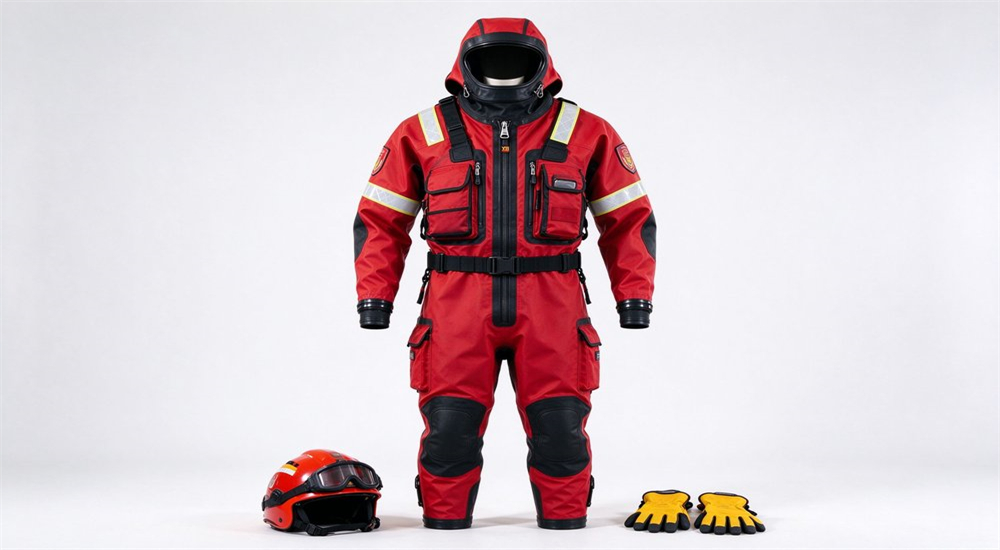
Water rescue helmets should be replaced immediately after any significant impact, even if the helmet appears undamaged on the outside. This is because the impact-absorbing liner (typically EPS foam) is designed to crush on impact to absorb energy—once crushed, it loses its protective capacity and cannot be restored, even though the outer shell may show no visible damage. Signs that a helmet needs replacement after an impact include: visible cracks or dents in the outer shell; visible compression, cracking, or deformation of the inner liner; the helmet felt different or "gave" during the impact (indicating liner compression); the wearer experienced head pain, dizziness, or concussion symptoms after the impact (indicating the impact force was significant); or the helmet was involved in a vehicle collision, fall from height, or other high-force impact. When in doubt, replace—helmets are relatively inexpensive compared to the cost of a traumatic brain injury. Even without a specific impact, helmets should be replaced every 3-5 years depending on use and manufacturer recommendations, as materials degrade over time (UV exposure, sweat, oils, and environmental factors can degrade both the shell and liner).
For children or smaller team members (under 40 kg / 88 lbs), a 50N PFD may provide sufficient buoyancy in calm conditions, but for professional water rescue operations, a minimum of 100N is recommended regardless of body weight. This is because rescue personnel (even smaller ones) typically wear additional weight from helmets, tools, and clothing, and may need to assist victims or carry equipment. A 100N PFD provides approximately 10 kg (22 lbs) of buoyant force, which is sufficient to keep a smaller adult's face above water in most conditions. For children who are not rescue personnel but may be involved in water activities (e.g., youth programs, public education), follow the manufacturer's weight-based sizing recommendations: infant PFDs (under 15 kg / 33 lbs) typically provide 40-50N, child PFDs (15-30 kg / 33-66 lbs) typically provide 50-70N, and youth PFDs (30-40 kg / 66-88 lbs) typically provide 70-100N. Always choose a PFD specifically designed and sized for the user's weight range—using an adult-sized PFD on a child can be dangerous because it may not fit properly and could ride up over the child's face.
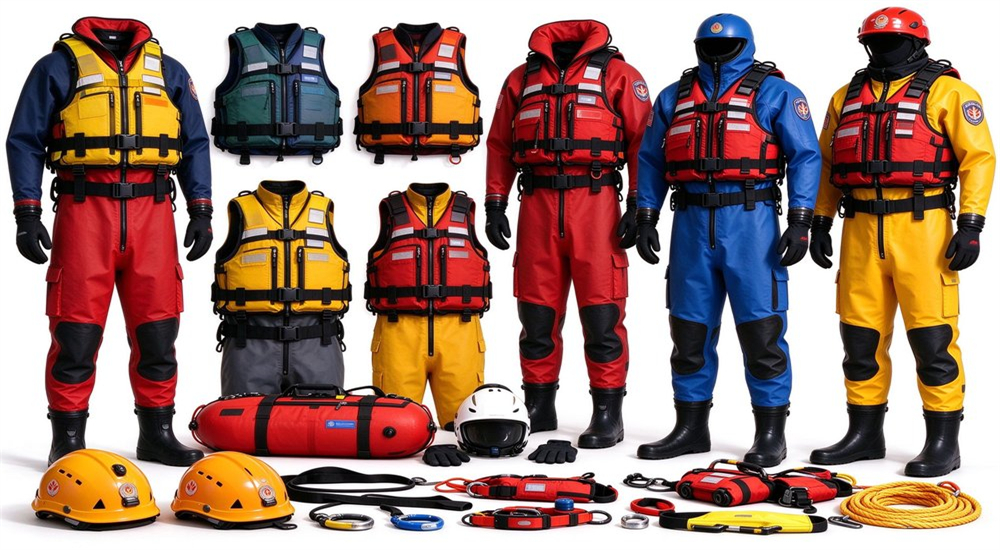
Explore our complete range of certified water rescue equipment, from professional-grade PFDs and dry suits to helmets and complete rescue kits.
Disclaimer: This guide is for informational purposes only and does not constitute professional advice or certification. Always follow manufacturer specifications, applicable regulations, and the guidance of qualified training professionals when selecting and using water rescue equipment. Equipment certifications and standards may vary by country and jurisdiction—verify applicable requirements in your specific location.
Liens amicaux :
droits dauteur © Custom Disaster - Relief Bedding: Tents, Sleeping Bags, Blankets Tous les droits sont réservés
léquipe professionnelle au service !