After reading this article, if you need further guidance on the selection logic and technical specifications for emergency relief sleeping bags in disaster relief and resettlement scenarios, please refer to our site's How to Choose High-Quality Emergency Relief Sleeping Bags | 2026 Professional Buying Guide. The two articles form a complete decision chain covering "selection and intake—long-term management."

I. Product Positioning from a Government Reserve Perspective and Core Procurement Needs
The fundamental difference between government emergency reserve sleeping bags and one-time disaster-deployment supplies lies in the requirement to withstand storage cycles of three to five years or longer, and to be immediately deployable without any advance warning. This means that a material's long-term storage stability, packaging seal integrity, and inventory traceability matter more than raw product performance metrics alone.
Different stakeholders have different priorities. Warehouse management departments focus most on batch traceability and the operational feasibility of rotation procedures. Project audit departments prioritize document chain completeness. Emergency response command units care most about the immediate deployment readiness rate when a disaster strikes. These three sets of requirements must be incorporated into the reserve scheme from the outset—not patched together at the audit or response stage.
Standing in different roles and looking at the same batch of government reserve emergency sleeping bags, the warehouse officer checks whether stacking is compliant, the auditor checks whether batch records are complete, and the commander checks whether supplies can be distributed immediately when needed. The four core modules in this article are designed to address all three perspectives simultaneously.
(3)Flame Retardancy Rating The risk of electrical fires in storage facilities is real. Flame-retardant protective emergency sleeping bags that comply with relevant fire safety standards should be treated as a mandatory verification item in government procurement technical specifications, and cannot be substituted by a general "no anomalies at shipment" declaration.
III. What Basic Conditions Should a Government Reserve Warehouse Meet for Storing Emergency Sleeping Bags?
A substandard storage environment is the primary cause of performance degradation in government emergency reserve sleeping bags. The following guidance should be implemented in accordance with the applicable warehouse standards or national emergency supply reserve regulations for the specific project:
Temperature Control Prolonged exposure to extreme heat or repeated freeze-thaw cycles should be avoided. The former accelerates aging of the outer coating and oxidation of zipper hardware; the latter causes cumulative damage to waterproof coating durability. Warehouses in high-altitude cold regions should pay particular attention to freeze-thaw effects.
Humidity Management Excessive humidity is the direct cause of fill clumping and fabric mold. Storage facilities should be equipped with humidity monitoring devices and conduct regular ventilation or dehumidification as conditions require. Mold-resistant and moisture-proof emergency relief sleeping bags have a certain degree of inherent material protection, but this cannot replace environmental controls—both must be in place simultaneously.
Light Exclusion and Ventilation Storage areas should avoid prolonged direct sunlight and maintain adequate ventilation to prevent heat accumulation that accelerates material aging.
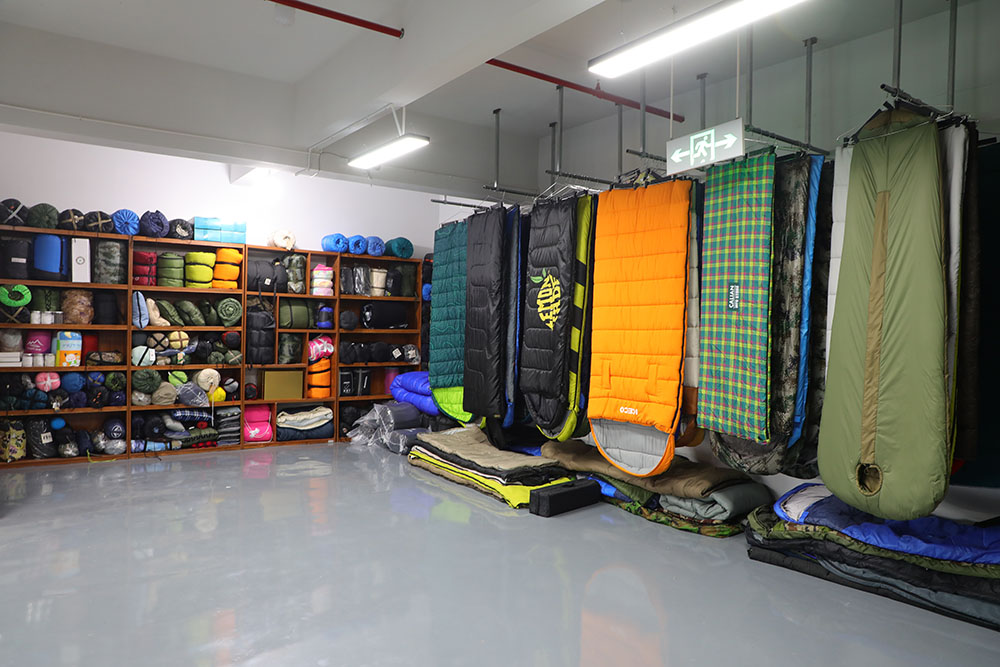
Stacking Standards Use pallets as the basic unit, consolidate the same batch into one area, and maintain visible separation markings between batches. Mixed-batch stacking is strictly prohibited, enabling precise batch-by-batch retrieval during subsequent operations.
IV. Batch Labeling Standards and Inventory Management
Each batch of government reserve emergency sleeping bags entering the warehouse should have an independent inventory record. The following fields are recommended:
(1)Batch Number Directly linked to the procurement contract number on a one-to-one basis
(2)Production Date and Warehouse Entry Date Used as the baseline for calculating rotation cycles
(3)Model Specification and Fill Type Distinguishing material differences between batches
(4)Inbound Quantity and Current In-Stock Quantity Updated in real time to reflect drill consumption and dispatch activity
(5)Recommended First Inspection Date Determined based on fill type and storage environment rather than a single fixed timeline
(6)Recommended Rotation Deadline Serves as an advance signal to trigger replenishment procurement
(7)Historical Inspection Records and Disposition Conclusions Fully archived to support audit traceability
Records should be maintained in both paper and electronic formats, corresponding to the physical shelf markings. Where conditions permit, a QR code batch tracking management system can be introduced so that a single scan retrieves the full batch record, enabling rapid status verification during disaster deployment.
One operational pain point that is often overlooked: when inventory is urgently dispatched in response to a disaster and replenishment batches arrive and are mixed in with existing stock during restocking, old and new batches easily become disordered, making subsequent rotation operations impossible to execute correctly. It is recommended to strictly enforce the procedure of "keeping existing batches and new replenishment batches in separate stacking zones with simultaneous record updates" at every restocking event, eliminating mixed-batch risks at the point of initial entry.
VI. How Should a Regular Inspection Mechanism Be Established?
A dual-track mechanism combining routine scheduled inspections and triggered special inspections is recommended; the two tracks cannot substitute for each other:
Routine Scheduled Inspections Determine a reasonable initial inspection interval based on fill type and storage conditions—the timing of the first inspection may differ between fill materials—then conduct rolling inspections at fixed intervals thereafter. Core items for each inspection: fill loft recovery after decompression, fabric tensile strength and seam integrity, zipper operating smoothness, and packaging seal integrity with legible batch labeling.
Triggered Special Inspections Following any environmental anomaly in the storage area—such as humidity exceedance, water leakage, or pest infestation—immediately launch a special inspection covering all batches in the affected area, without waiting for the next scheduled inspection cycle.
Inspection conclusions should be fully archived in the inventory records for two purposes: first, as documentation for quality traceability in subsequent procurement tenders; second, to provide an independently verifiable chain of supply status records during government audits.
VII. Supplier Selection and Receiving Inspection
For government emergency sleeping bag long-term reserve projects, beyond standard qualification verification, three capabilities deserve particular attention:
Batch Consistency Assurance Over multiple years of rolling replenishment, whether fill weight, fabric specifications, and compressed packaging standards remain consistently stable is the most common source of deviation in long-term partnerships. This should be addressed at the tender stage through explicit technical specification constraints locked into the contract.
Batch Labeling Document Output Capability Whether a supplier can provide batch number, date, specifications, and fill type information in formats required by the procurement authority directly determines the initial workload for inventory management.
Long-Term Replenishment Stability Large reserve projects require annual replenishment or framework agreement renewals. Supplier production capacity stability and continued supply willingness must be assessed upfront rather than discovered mid-project.
Receiving Inspection Key Points:
(1)Appearance and Workmanship Inspect fabric surface and stitching integrity; check for damage or abnormal odor
(2)Specifications and Fill Weight Measure actual dimensions and fill weight; verify compliance with contract specifications
(3)Fill Loft After decompression and unfolding, observe fill distribution uniformity and recovery performance
(4)Packaging and Batch Labeling Verify batch number, production date, and completeness of labeling language
(5)Test Documentation Match Verify that factory inspection reports correspond one-to-one with the current batch number
If inspection issues are discovered, immediately preserve photographic evidence and initiate the contractually prescribed resolution procedure. Under no circumstances should problem items be mixed into storage with compliant batches.
If you are currently drafting a technical annex for a government emergency reserve sleeping bag procurement tender but lack a ready-made parameter template, you may submit a brief project overview and storage scale description through the contact form on this site. A general batch labeling requirement example and receiving inspection checklist template will be provided without involving any specific client information, for internal reference and benchmarking purposes only. All final terms are subject to the formal contract signed by both parties.
IX. Core Advantages of Sourcing Emergency Relief Sleeping Bags from China
In large-scale government emergency reserve sleeping bag procurement, Chinese suppliers offer several notable advantages:
Supply Chain Completeness China's textile supply chain covers the complete spectrum from fabric, fill materials, and accessories through to finished goods and testing. Industrial cluster effects reduce the impact of raw material fluctuations on lead times and quality, forming the foundation for stable large-scale standardized supply.
Scale Production Capacity and Multi-Batch Delivery Capability Established factories have the capacity to handle large government reserve orders with multi-batch phased delivery, aligning closely with government annual budget-based procurement models.
Export Service Maturity Chinese suppliers have extensive operational experience under common trade terms such as FOB and CIF, and can assist government procurement projects in preparing complete clearance document packages—including commercial invoices, packing lists, certificates of origin, and inspection certificates—reducing documentation risk in cross-border procurement.
One-Stop Complementary Supply Capability Beyond emergency relief sleeping bags, suppliers can simultaneously provide moisture-proof sleeping pads, emergency blankets, folding beds, and basic emergency lighting equipment, reducing the number of suppliers a government project must manage and lowering the risk of inconsistent standards across cross-batch supplies.
X. YRF Recommended Solution: Tailored Support for Government Long-Term Reserve Projects
YRF Emergency Relief Supplies has directly relevant capabilities across the following dimensions:
Certifications and Qualifications YRF holds OEKO-TEX certification (textile harmful substance safety) and ISO certification (quality management system), which can serve as verifiable documents during government procurement acceptance. For projects requiring additional specific certifications, assistance in engaging third-party certification bodies is available.
Batch Management Coordination Capability YRF can provide standardized batch labeling documents in formats specified by the procurement authority, including batch numbers, production dates, specification descriptions, and recommended inspection intervals—directly compatible with government inventory management formats to reduce the workload of intake verification. This is a service dimension that many one-time suppliers are unable to consistently deliver.
Production Scale and Long-Term Replenishment Stability YRF has the production capacity to handle medium-to-large government bulk emergency sleeping bag orders. For reserve projects requiring annual framework agreement replenishment, product consistency across batches can be maintained without changes to technical specifications. Specific capacity figures and lead time ranges should be confirmed at the project's outset based on actual order configuration and quantities; all final terms are subject to the formal contract signed by both parties.
Export Service Support Supports common trade terms including FOB and CIF. Neutral packaging and multilingual labeling are available, with full support for clearance document preparation and acceptance requirements for government procurement projects.
Reserve Scheme Design Support For procurement authorities with a clearly defined project background, YRF can provide preliminary configuration recommendations and complementary supply checklists based on reserve scale, climate zone, and rotation cycle, helping reduce the exploratory phase of internal scheme discussions.

XI. Summary and Five Immediately Actionable Recommendations
The effectiveness of a government emergency sleeping bag reserve system is determined by "how well every day after warehouse entry is managed"—not by procurement price. Meeting storage environment standards is the prerequisite for long-term usability. Standardized batch labeling is the foundation for error-free rotation. A robust inspection mechanism provides early detection of risks. The long-term replenishment stability of the supplier is the external support that keeps the entire system sustainably operational. A weak link in any of these four areas will eventually become a point of failure for the entire reserve system when it matters most.
Five Immediately Actionable Recommendations:
(1)Establish an Inventory Record Template Using the fields listed in Section IV of this article as a reference, prepare an emergency relief sleeping bag inventory management spreadsheet that ensures batch numbers, fill type, entry date, and first inspection date fields are complete and ready for use.
(2)Evaluate Current Storage Environment Conditions Benchmark against the environmental requirements in Section III, assess the current state of temperature and humidity control, stacking standards, and ventilation facilities. Document existing gaps and develop a remediation plan.
(3)Design a Batch Rotation Plan Based on the entry dates, fill material types, and climate zone of current inventory batches, identify the batches that should be prioritized for inspection or rotation scheduling in the near term.
(4)Confirm Batch Management Capability with Candidate Suppliers During the inquiry or tender stage, explicitly request that suppliers describe the output format of their batch labeling documents and verify whether they can be directly integrated with internal inventory systems.
(5)Include Inspection Mechanisms and Non-Conformance Handling Clauses in the Contract Contracts should explicitly specify routine inspection milestones, triggered inspection conditions, inspection sampling ratios, and procedures for handling non-conforming items. Oral commitments must not substitute for written contract terms.
FAQ: Four Questions Most Frequently Asked by Government Reserve Managers
Q: What is the general long-term storage shelf life of emergency relief sleeping bags?
There is no single figure that applies to all products. Fill type, waterproof coating technology, and storage environment together determine the actual usable storage period. Hollow-fiber fill emergency sleeping bags generally demonstrate good long-term storage adaptability under standard warehouse conditions. Cotton fill products in high-humidity regions should have relatively shorter rotation intervals. Specific rotation thresholds should be determined based on the results of periodic inspections—relying solely on the manufacturer's recommended service life is insufficient.
Q: Does rotation require mandatory full-batch disposal and replacement?
No. Rotation does not mean forced full-batch disposal. Batches where inspection results remain acceptable may have their service cycle appropriately extended, or may be prioritized for consumption in lower-risk scenarios. Only batches where performance has demonstrably declined should be disposed of or downgraded, and should no longer be included in major disaster relief mission reserves.
Q: What specific impacts can substandard storage conditions have on emergency sleeping bags?
Sustained above-threshold humidity causes fabric mold and fill clumping. Prolonged extreme temperatures cause coating cracking and zipper metal oxidation. Sustained heavy stacking pressure causes permanent loft loss in fill material. All three types of problems are typically only discovered during actual deployment or inspection. Effective storage environment controls can keep these risks within predictable and manageable bounds.
Q: After replenishment batches arrive, how can mixed-batch storage be prevented?
Strictly enforce the procedure of "stacking new and existing batches in separate zones with same-day inventory record updates." Set up visible batch identification between shelf zones, prioritize older batches for dispatch, and queue new batches in sequence according to the rotation plan. Where conditions permit, introducing a QR code batch tracking management system can significantly reduce the probability of batch mixing.
Liens amicaux :
droits dauteur © Custom Disaster - Relief Bedding: Tents, Sleeping Bags, Blankets Tous les droits sont réservés
léquipe professionnelle au service !