Key Conclusions at a Glance
(1)The core difference between emergency relief sleeping bags and ordinary outdoor sleeping bags lies not in the level of specifications, but in whether they can pass batch inspection, withstand long-term storage, and support rapid unified distribution.
(2)Temperature rating, fill weight, and shell material must be configured separately based on target climate and user group; using a single specification to cover all scenarios is one of the most common selection errors in large-scale projects.
(3)Sourcing from China offers clear advantages in terms of supply chain completeness, large-batch production response, and one-stop-shop configuration; the prerequisite is controlling technical and delivery risks within acceptable limits through qualification review, sample verification, and contractual agreements.
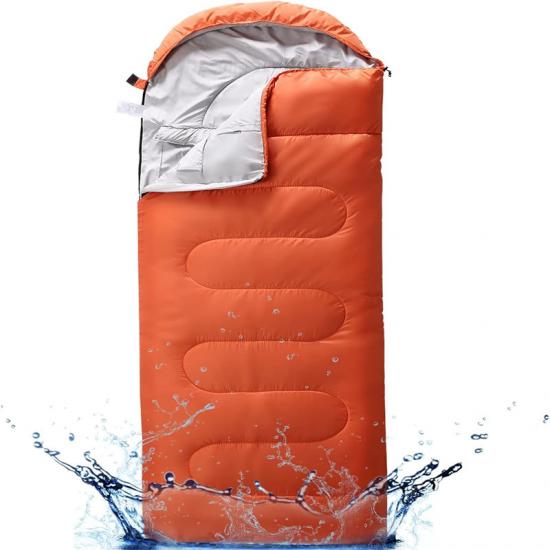
The sleeping bags used in post-disaster resettlement sites, government stockpile warehouses, or military field training camps may look similar to camping products on the shelf, but their design logic is entirely different.
Camping products center on individual experience, prioritizing lightweight comfort and typically sold as single units. Disaster-relief bulk distribution sleeping bags need to address three specific questions: Can they be uniformly stacked and loaded into containers by the hundreds or even tens of thousands? Can they maintain basic insulation performance after rapid distribution in crowded, damp resettlement environments? Can they withstand repeated use, disinfection, and re-distribution cycles while keeping their structural integrity intact?
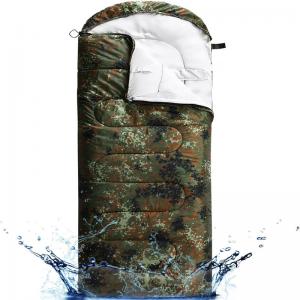
Military field support sleeping bags must additionally meet regulation color standards, high-frequency folding-without-deformation requirements, and field storage anti-mold and anti-pest criteria. Police and law enforcement scenarios place greater emphasis on lightweight quick-access design, uniform appearance, and compressed dimensions that fit vehicle equipment spaces.
For this reason, sleeping bags for professional applications typically need to comply with the EN 13537 / ISO 23537 temperature rating system or the relevant provisions of China's GB/T 22761, pass flame-retardant or antibacterial testing, with shell fabric ideally rated at hydrostatic pressure PU1500mm or above—PU2000–3000mm is recommended for heavy-rain or high-humidity environments. Packaging must be suitable for full-pallet and full-container transport and long-term warehousing.
For NGO relief sleeping bags and humanitarian aid sleeping bags projects, the difference also appears at the documentation level: verifiable batch numbers, third-party inspection reports, and compliance declarations meeting destination-country standards are baseline requirements for passing donor audits and project acceptance reviews.
For proper selection of emergency disaster relief sleeping bags, refer to How to Source High-Quality Emergency Rescue Sleeping Bags from China | 2026 Professional Selection & Procurement Guide to move from basic understanding to practical selection.
The material selection logic for relief versions and military versions differs significantly and must be discussed separately.
Core Materials for Relief Versions
Shells commonly use 190T or 210T polyester taffeta with PU waterproof coating—moderate in weight and cost, suitable for large-volume distribution. Projects in high-humidity regions should require suppliers to provide anti-mold and antibacterial treatment test certificates, with this requirement explicitly stated in the technical annex of tender documents.
Fill materials fall into three main categories:
(1)Hollow-fiber fill (hollow polyester fiber): withstands multiple wash cycles, stable resilience, lower cost; widely used in heavy-duty relief sleeping bags for bulk distribution and is the mainstream fill choice for mass-distribution projects.
(2)Down fill: excellent compression ratio and superior warmth-to-weight ratio, but demands a stringent waterproof shell—once moisture penetrates, insulation drops sharply and maintenance costs rise considerably; more commonly seen in extreme-cold emergency sleeping bags or premium military versions. Taking fill power FP650 as an example, this specification falls in the mid-range tier (FP600–700 is mid-range; high-end typically starts from FP700 and above), suitable for -10°C to -20°C scenarios. Tender specifications should indicate the required rating range rather than simply stating "high-quality down."
(3)Polyester batting: lowest cost, suitable for short-term resettlement in temperate climates; not recommended for long-term stockpile projects in cold regions.
Important note: silk and hollow-fiber fill are two entirely different materials—the former is a natural protein fiber, the latter a hollow polyester synthetic fiber, with significant differences in performance and cost. Technical specification documents must clearly differentiate between the two to avoid misunderstandings during the quoting stage.
Core Materials for Military Versions
Military emergency sleeping bag configurations typically use high-density nylon shells. A lower denier (D) number means lighter and thinner fabric—not more durable. 20D–40D lightweight options suit rapid-mobility scenarios where weight is strictly limited; 70D and above is recommended for high-intensity field use requiring abrasion resistance. Fill is usually high-loft down or cold-resistant composite fiber, with anti-mold and anti-aging treatments required; insulation performance must remain stable after repeated compression and packing.
Key workmanship indicators: stitch density is generally recommended at 12–14 stitches per 3cm or above; zippers should be YKK or equivalent specification; down versions must specify the method for anti-leakage stitching (baffled construction or heat-sealed seams), stated in the specification annex; coating durability should note wash-cycle durability, e.g., "PU coating effectiveness remains stable after 30 standard wash cycles."
This is the stage with the highest error rate in actual projects. Many procurement orders simply state "emergency sleeping bags, quantity XX" without specifying a temperature rating or differentiating by user group—only to discover on-site that the configuration does not meet actual needs. At that point it is too late to make substitutions and costs are already locked in.
Temperature Rating System Selection (Reference: EN 13537 / ISO 23537)
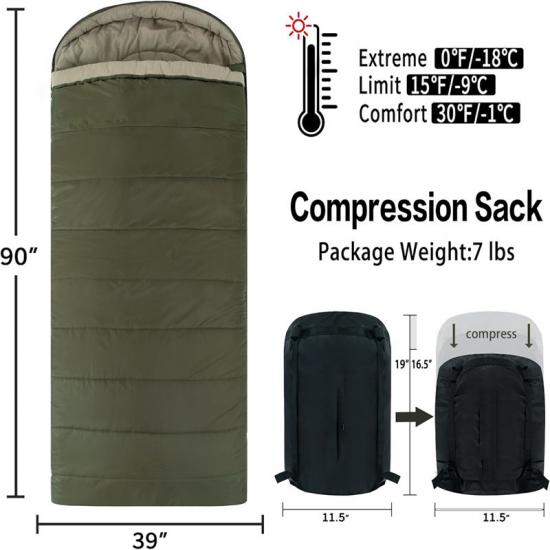
The internationally adopted temperature rating has three tiers: comfort temperature (the temperature at which a standard adult woman can sleep comfortably), limit temperature (the threshold at which an adult man can sleep in a curled position), and extreme temperature (the cold-injury risk threshold—not recommended as a standard for everyday distribution). Procurement documents should explicitly reference either "comfort temperature" or "limit temperature" to establish a common understanding with suppliers and reduce disputes during acceptance.
Two-Level Configuration Framework
Basic configuration (suitable for temperate and subtropical zones, short- to medium-term resettlement scenarios): 190T–210T polyester shell, hollow-fiber fill, comfort temperature +5°C to -5°C, packaging dimensions suited for full-pallet storage—covers standard distribution needs for the adult population.
Enhanced configuration (suitable for high-altitude or cold-climate disaster resettlement, winter emergency scenarios, and military field training): 210T or higher density shell fabric, down or high-performance composite fiber fill, comfort temperature -10°C to -20°C, with a moisture-proof inner lining bag supplied simultaneously. Enhanced versions should be prioritized for the elderly, children, injured persons, and frontline personnel stationed in extreme-cold regions.
Specific Requirements for Children's Versions
Children's sleeping bags (approximately 160×60cm) are not simply a matter of dimensions. Safety design must meet the following requirements: no detachable small components to prevent accidental ingestion; zipper anti-pinch and anti-jam design; fill material passing formaldehyde-free testing (OEKO-TEX STANDARD 100 certification can serve as a material safety reference, but note this certification only proves the material is free of harmful substances and cannot substitute for overall performance compliance documents); fabric suitable for direct contact with children's skin. These safety requirements must be listed separately in the technical specification document.
Size and Color Standards for Military and Police Versions
Military field support sleeping bags must be customized to regulation colors (green, tan, or camouflage), with compressed storage volume compatible with existing equipment systems and rucksack dimensions. Police versions emphasize lightweight quick-access design, with colors conforming to departmental unified standards. Procurement parties must specify regulation requirements and marking standards in the specification document in advance—not request modifications after production has begun.
The same batch of emergency relief sleeping bags plays entirely different roles in the pre-disaster stockpiling, mid-disaster response, and post-disaster recovery stages, with different configuration priorities at each point. Treating these three stages as interchangeable is one of the direct causes of configuration waste or protection failures.
Pre-Disaster (Prevention and Stockpiling Stage)
The core objective at this stage is to buy right, store well, and rotate efficiently. Selection must prioritize storage stability—fabric that does not age easily, fill that retains resilience after long-term compression, and packaging that is moisture-proof and pest-resistant. Each sleeping bag should carry an individual batch label (batch number, production date, warehousing date) to support a complete materials ledger for rotation management and audit traceability. Government-stockpile emergency sleeping bags projects should also verify the humidity control capacity of the storage facility in advance: warehouses with relative humidity above 70% require moisture-proof pallets or sealed packaging, otherwise the risk of mold during long-term storage rises significantly.
Mid-Disaster (Emergency Response Stage)
At this stage, demands concentrate on two points: deployment speed and extreme-environment adaptability. Individual compression-bag packaging significantly improves on-site distribution efficiency, avoiding disorder during carton unpacking. The hydrostatic pressure rating of waterproof emergency relief sleeping bags is particularly critical here—post-flood or post-rainstorm resettlement environments are far more humid than normal, and PU2000mm or above is more prudent for such scenarios. Additional demand commonly arises mid-disaster; it is recommended to pre-negotiate an "incremental production activation mechanism" and an emergency-order upper production limit in the initial procurement contract—a key clause frequently overlooked during contract negotiation.
Post-Disaster (Recovery and Reconstruction Stage)
When the resettlement period extends from weeks to months, washability and reusability become core indicators. Key considerations include fabric wash-cycle durability (recommend specifying "all indicators meet contract requirements after XX standard wash cycles"), zipper smoothness after multiple open-close cycles, and whether fill clumps severely after hand or machine washing. Disinfection compatibility is equally important: if fabric discolors, becomes brittle, or retains odor after contact with common disinfectants, this creates cascading problems in large-scale resettlement projects requiring centralized disinfection by re-distribution. This point should be explicitly written into the technical specification document during the procurement stage.
High-Altitude and Cold Regions
Comfort temperature must be at least 5°C lower than the local minimum nighttime temperature to ensure basic safety. Some lower-quality shell fabrics become stiff and brittle below -20°C, affecting the ease of deployment. Extreme-cold emergency sleeping bags shells must pass low-temperature flex testing—this specification is especially important to verify in military procurement for cold-region deployment.
Tropical and Subtropical High-Humidity Regions
Breathability and anti-mold performance are equally important. Prioritize fabrics with anti-mold and antibacterial treatment. Natural down fill is not recommended—it loses insulation sharply when damp in humid environments and is difficult to dry. When stored for more than 30 days, desiccant or sealed moisture-proof bags are necessary to prevent long-term moisture absorption and mold development.
Coastal and Island Environments
Salt spray significantly corrodes zipper metal components. Military and police procurement documents should specify the salt-spray resistance rating for zippers and metal hardware, or designate brass or anti-corrosion-coated materials, to prevent metal component failure during long-term storage.
Projects Spanning Multiple Climate Zones
Using a single specification to force coverage of both tropical and extreme-cold destinations is not advisable. Splitting orders by climate zone, specifying temperature ratings and material requirements separately for each batch, and conducting acceptance inspection by batch is more rational in terms of both cost and protection effectiveness than settling on a compromised middle-ground specification.
Everyday Usage Guidelines
The zipper is a precision component; forcing it open or pulling it hard can damage the teeth. It is recommended to demonstrate the correct opening and closing method to frontline users during distribution—especially in cross-national aid scenarios where language barriers exist, illustrated guides are more effective than text-only instructions. Using a moisture-proof pad when sleeping on bare ground in outdoor or high-humidity environments can significantly extend the service life of the sleeping bag's bottom shell fabric.
Open Flame and Flame-Retardant Reminders
In resettlement environments where open-flame heating is used, the flame-retardant rating limits of the material must be clearly communicated to users. Non-flame-retardant materials carry an ignition risk when placed too close to open flames. It is recommended to include a "keep away from open flames" graphic warning on packaging, verbally communicate this during distribution, and specify in the technical specification document whether a flame-retardant treatment certification is required.
Special Populations Safety Reminders
Children must have adult assistance when opening and closing the sleeping bag, with confirmation that there is no risk of accidental ingestion or compression injury. Elderly individuals and those with limited mobility are recommended to receive large-size versions with wider zipper openings and more spacious interiors. For humanitarian aid sleeping bags projects distributing to vulnerable groups, organizing a brief usage demonstration before mass distribution is recommended to reduce losses and safety incidents caused by improper operation.
Using a flood disaster resettlement site as an example—approximately 1,000 persons requiring resettlement, estimated period 4–8 weeks, local minimum nighttime temperature approximately 5°C:
(1)Basic configuration plan: 1 sleeping bag per person, 1,000 units total; select comfort temperature +5°C version, hollow-fiber fill, shell with PU1500mm waterproof treatment; additionally reserve 10%–15% backup quantity (100–150 units) for attrition and special needs.
(2)Enhanced configuration for special populations: elderly, infants, and injured persons account for approximately 15%–20% of the total; upgrade these to comfort temperature 0°C to -5°C versions, managed in separate batches from the basic versions to facilitate distribution identification and quantity reconciliation.
(3)Budget structure recommendation: the three components—basic versions, enhanced versions, and backup quantity—collectively form the total budget range. The recommended approach is to first request itemized quotes for both configuration tiers from candidate suppliers, then adjust the proportion of each tier based on budget constraints, rather than reverse-engineering specifications from a fixed budget.
This estimation logic applies equally to cold-snap or earthquake resettlement scenarios: replace the climate and nighttime temperature parameters with the relevant values, adjust the population structure to reflect actual distribution, and the 10%–15% backup reserve principle applies to most project types.
Selecting the Right Procurement Approach
Large-volume emergency sleeping bag bulk procurement typically follows one of three paths: sourcing directly from origin factories (the preferred approach for mid-to-large projects with clearly defined specifications—cost transparency is higher); sourcing through a one-stop-shop integrated supplier (reduces the number of contact points when multi-category co-procurement needs exist); framework agreement utilization (the most efficient method for institutions with established qualified supplier pools to rapidly deploy during disaster events). For first-time cooperation with a cross-border supplier, starting with a small trial order is recommended to validate production consistency and delivery capability before scaling up.
Pre-Allocating Incremental Capacity by Emergency Level
Standard stockpiles should cover the basic needs of medium-scale disasters in the jurisdiction. Regional disaster emergency plans can incorporate a 20%–30% incremental trigger mechanism, with the "incremental order activation time limit" pre-agreed in the contract. National-level major disaster scenarios require simultaneously activating both local stockpiles and global procurement channels—the large-batch production response capability of emergency relief sleeping bag China suppliers is particularly critical at this stage.
Contract Key Clauses Checklist
(1)Technical specifications and acceptance criteria: temperature rating must reference the applicable standard (e.g., EN 13537 limit temperature or relevant clauses of GB/T 22761); fill weight tolerance is recommended at ±5%; stitch density and key reinforcement locations should be stated in the specification annex.
(2)Non-conforming product handling mechanism: must specify inspection sampling ratio (3%–5% recommended), non-conforming product determination criteria and handling methods (return, replacement, or price deduction) to avoid disputes over responsibility during acceptance.
(3)Delivery arrangements: the standard production cycle for mid-volume orders is typically approximately 3–4 weeks, depending on configuration complexity and current production capacity; the final timeline is subject to the formally signed contract. Emergency projects may include priority production scheduling clauses in the contract, but this must be determined after production capacity assessment—informal verbal rush-order requests are not recommended.
(4)Payment terms: the standard settlement method is a deposit paid first, with the full balance settled before goods are shipped; full payment must be received before shipment arrangements are made. Payment against copy of bill of lading or any form of deferred payment arrangement is not accepted.
(5)Batch traceability: each shipment must carry batch number, production date, and specification parameters, enabling the procurement party to establish a materials ledger and meet project audit requirements.
HS Code Reference
The general HS code for sleeping bag products is 9404.30. For cross-border procurement and import customs clearance, the specific tariff classification should be confirmed with the destination country's tariff schedule and fill material type (e.g., down content percentage). It is recommended to verify this with a freight forwarder in advance to avoid additional duties or delays during clearance.
Goods Arrival Inspection Checklist
Appearance and workmanship: inspect a sample of units for shell damage, staining, and significant color variation; check zipper smoothness; verify stitching has no skipped stitches or fraying.
Dimensions and weight: measure dimensions against contract specifications; total weight including fill must be within ±5% tolerance.
Waterproof and flame-retardant spot-testing: depending on project requirements, submit shell samples for third-party hydrostatic pressure and flame-retardant testing (where contractually required), or verify the corresponding report number and validity period.
Packaging and labeling: verify packaging integrity, batch labels, and language labeling match contract specifications; confirm each carton contains a quality certificate and test report copy.
Quantity verification: confirm actual delivered quantity matches the packing list and contractual quantity.
Non-conforming product handling: any non-conforming products identified during acceptance must be immediately marked and quarantined; a written handling request must be submitted to the supplier per contract terms to avoid mixing with conforming stock and complicating resolution.
If you are currently preparing procurement tender documents or an internal acceptance procedure, the checklist above can serve as a reference for drafting a technical clauses draft. If you need an anonymized technical clauses sample or acceptance checklist template for internal discussion, you may submit your project background through the contact form on this site; a general-use template will be provided for reference only, with all final terms subject to the formally signed contract.
For common questions and technical doubts in procurement, please refer to Emergency Relief Sleeping Bag Procurement: Top 10 FAQs | 2026 Essential Guide for Government & NGO to quickly check key details and avoid typical procurement mistakes.
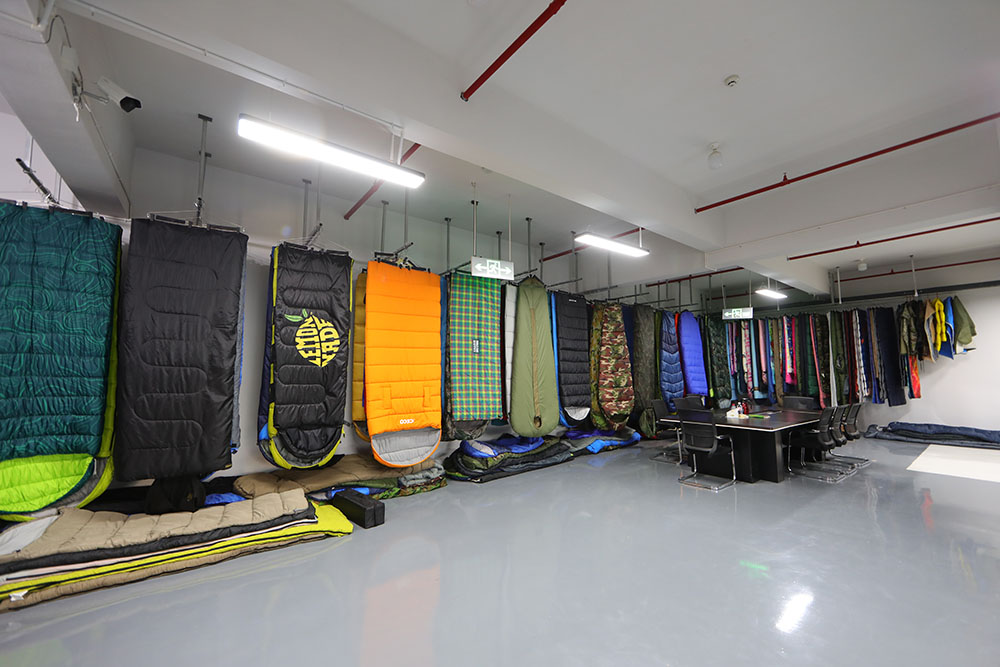
Warehouse Environment Requirements
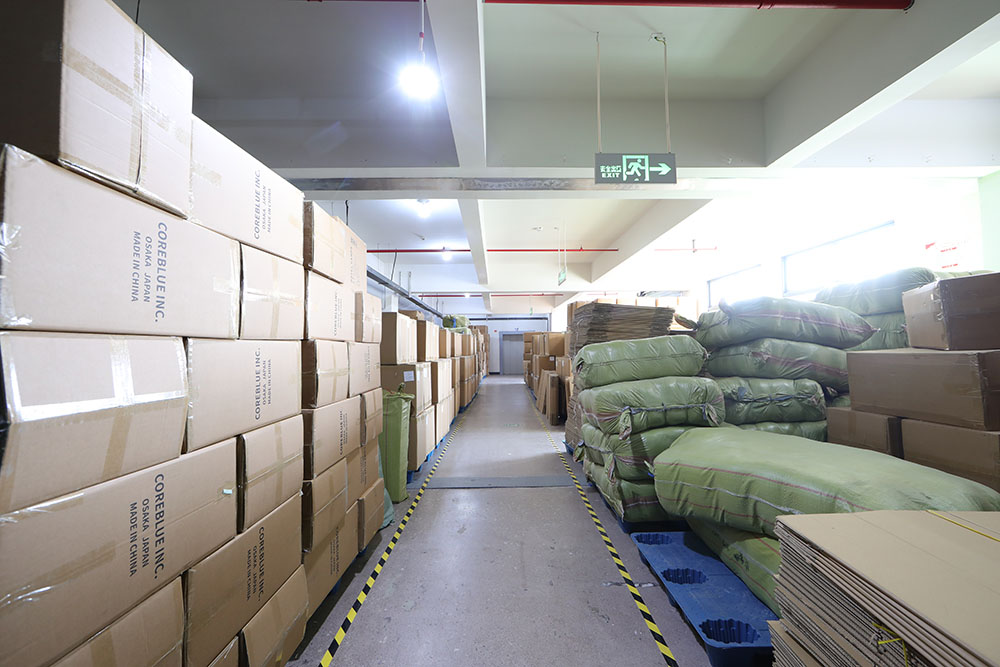
Recommended storage temperature range is 5°C to 30°C. -10°C is the lower storage temperature limit some products can tolerate, but this does not mean warehouses should be maintained at this temperature—the specific storage temperature tolerance varies by material and must be confirmed with the manufacturer for each product individually. Relative humidity should be maintained at 40%–70%; avoid direct sunlight exposure; the warehouse must maintain good ventilation; stacking height should not exceed 8–10 layers (depending on packaging load-bearing capacity), with aisles between stacks for periodic spot-checking.
Rotation Mechanism
Hollow-fiber fill versions are recommended for systematic rotation spot-checks every 3–5 years. High-performance down versions may have this interval extended based on spot-check results, but relying solely on factory-issued reports rather than physical sample testing is not advisable. Stockpile items approaching the rotation period but still performing to specification can be prioritized for use in internal drills or small-scale projects to be consumed first while new batches are simultaneously restocked—reducing waste while keeping inventory active. Emergency sleeping bag storage and rotation plans should ideally be established with suppliers at the contract stage through a rolling replenishment mechanism, avoiding the time cost of full re-tendering when periodic rotation falls due.
Ledger and Audit Support
Establish a dedicated materials ledger for each batch, recording batch number, specification, quantity, supplier information, warehousing date, inspection date, and rotation status, linked to the corresponding budget line item to facilitate internal audits in government or military systems and donor verification. This step should be established during the pre-disaster stockpiling stage—not retroactively compiled when an audit is triggered.
In actual projects, emergency relief sleeping bags rarely appear in isolation; they are typically deployed alongside the following items as part of a coordinated resettlement or support solution:
Emergency relief tents: provide shelter space. It should be noted that sleeping bags can also be used—and may indeed be required—in indoor settings such as schools, gymnasiums, and warehouses; they do not presuppose the presence of a tent, and both categories of supplies can be distributed independently.
Moisture-proof sleeping pads and folding cots: reduce direct contact between the sleeping bag's bottom and the ground, significantly improving insulation effectiveness and comfort. These are the most compatible basic resettlement supplies to use alongside sleeping bags.
Emergency blankets and rescue clothing: form a layered insulation system together with sleeping bags and can be used in combination in cold resettlement environments—a practical insulation-enhancement solution when resources are limited.
Emergency packs and basic hygiene supplies: together with bedding-type items, constitute the basic daily living support kit for a resettlement site, typically procured and shipped within the same batch order.
For military field support sleeping bags, these are typically required to form a complete field bedding kit together with regulation rucksacks, moisture-proof sleeping pads, and thermal management liners. The dimensional and weight compatibility of each component must be verified during the solution design phase to avoid coordination issues after equipment arrives on-site.
Prioritizing suppliers who can simultaneously supply the multiple categories listed above facilitates unified container loading and shipment, reduces the number of contact points, and lowers the probability of specification mismatches between different items.
This is a question that international procurement teams frequently raise when evaluating sourcing locations, and it deserves a systematic response across multiple dimensions.
Complete Supply Chain and Clustering Effect
China has a complete supply chain for textile bedding-type emergency supplies, from raw materials (polyester fiber, down, fabric coatings, hardware components) through to finished goods, with major industrial clusters concentrated in the Jiangsu-Zhejiang-Anhui region. Raw material procurement, production processes, and inspection services can be coordinated within a relatively compact geographic area, significantly reducing delivery fluctuations and cost increases caused by supply chain gaps. This advantage is particularly pronounced when natural disasters strike and global supply chains come under stress.
Large-Batch Production Capacity and Emergency Order Response
Major factories have monthly production capacities in the tens of thousands of units; multiple factories within the same industrial cluster can cooperate to scale up capacity, accommodating national-level stockpile requirements or simultaneous large-scale procurement by multiple countries. When post-disaster demand surges, pre-negotiating an "incremental capacity trigger clause" in the contract enables more efficient activation of emergency production scheduling—a flexible response capability that regional suppliers in many other locations struggle to match.
Mature Export Services and Customs Clearance Support
Emergency relief sleeping bag manufacturers in China generally hold export licenses, are familiar with the customs clearance requirements of major destination countries, and can cooperate in providing certificates of origin, commodity inspection certificates, third-party inspection reports, and other standard export documents. Experience with multi-language instruction manuals and neutral packaging customization is relatively mature, meeting the compliance documentation requirements of international aid projects.
One-Stop-Shop Configuration and Multi-Category Synergy
Many integrated factories or suppliers provide not only sleeping bags but also moisture-proof pads, emergency blankets, folding cots, and other associated supplies with unified container loading and shipment, reducing logistics coordination costs. For NGO projects and government stockpile projects with clearly defined emergency supply one-stop-shop needs, this capability can significantly reduce the procurement party's management investment.
Risk Control Recommendations
The quality level of Chinese suppliers varies considerably. It is recommended to complete qualification verification (production license, inspection reports, past project references), sample verification (physically testing key indicators against contract specifications), and necessary third-party factory audits before committing, and to use contract clauses to clearly stipulate handling of non-conforming products, delivery delays, and technical specification deviations.
From the perspective of this comprehensive guide, YRF's contribution focuses not on repeating production capacity figures, but on whether it can engage in the solution design phase early in a project to reduce trial-and-error costs for procurement parties—a point that deliberately differs from the production qualification emphasis in Series 1 and the selection verification emphasis in Series 2.
Product Line Coverage and Customization Capability
YRF's emergency relief sleeping bag product line covers basic, heavy-duty, and extreme-cold versions, with customization available for temperature rating tier, fill weight, shell fabric, and color marking according to climate zone and project requirements. YRF holds ISO quality management system certification and OEKO-TEX STANDARD 100 textile safety certification—the latter certifies that materials are free of harmful substances and serves as a baseline material compliance reference. Where projects have additional specific performance certifications or military qualification requirements, third-party inspection arrangements can be coordinated based on those needs.
Solution Design Support
For NGOs or small-to-medium government procurement units without dedicated technical materials teams, YRF can provide configuration recommendations, specification documentation, and sample comparison support during the project initiation stage, assisting in drafting tender technical clauses to reduce the time procurement parties spend on standard interpretation and supplier communication. This type of front-loaded support is particularly valuable in multi-category co-procurement projects and time-critical post-disaster response projects.
Supply Chain Integration and Export Cooperation
YRF can simultaneously supply emergency blankets, moisture-proof pads, rescue clothing, and basic protective equipment, supporting unified container shipment. On the export documentation side, YRF can cooperate in providing multi-language instruction manuals, batch traceability labels, and standard export documents, suitable for government projects and international aid organizations with strict document compliance requirements. For long-term stockpile or framework agreement cooperation, YRF can cooperate in establishing a rolling replenishment plan, providing rotation procurement support by batch and reducing the procurement party's coordination burden for periodic replenishment and ledger management.
For supplier comparison and vendor selection, refer to Top 10 China Emergency Relief Sleeping Bag Manufacturers | 2026 Authoritative Procurement Recommendations for professional supplier reference.
Three Core Conclusions
Selecting emergency relief sleeping bags is fundamentally a process of systematically balancing climate adaptability, performance compliance, stockpile efficiency, and total cost. There is no "universal version"—only the correct configuration combination suited to a particular project, climate zone, and user population.
Military and police procurement parties must additionally focus on regulation compliance, batch traceability capability, and full-lifecycle support mechanisms. NGO and government procurement parties must make thorough preparations for audit traceability, donor accountability, and cross-border customs documentation. International trading companies and distributors need to plan for the long term in terms of specification stability and continuous supply capability.
Sourcing from China can yield advantages in cost, production capacity, and solution configuration; however, this requires controlling risks within acceptable limits through upfront qualification screening, sample verification, and contractual agreements.
Three Things You Can Do Right Now
(1)Prepare a one-page project needs statement: specify target population size and composition (including the proportion of special populations), target climate and minimum nighttime temperature, resettlement or usage period, budget ceiling, and whether specific standards or certifications are required. This needs statement is the starting point for efficient communication with all candidate suppliers and the core input for subsequent tender technical annexes.
(2)Request samples from 2–3 candidate suppliers and test against the acceptance checklist: focus on verifying temperature rating versus actual warmth perception, shell waterproof rating (a simple water-spray test serves as a preliminary screen), whether fill weight deviation is within ±5%, zipper smoothness, and packaging label completeness. Document test results in writing as the basis for subsequent contract negotiations.
(3)Lock in technical specifications and non-conforming product handling clauses in the draft contract: before entering price negotiations, first incorporate the temperature rating reference standard, fill weight tolerance, inspection sampling ratio, and non-conforming product handling method into the contract draft to avoid responsibility disputes during the acceptance stage.
If you need a technical clauses reference template for tender documents or a goods arrival acceptance checklist sample for internal discussion, you may submit your project background through the contact form on this site; an anonymized general-use template will be provided for reference only, with all final terms subject to the formally signed contract.
Primary keyword: emergency relief sleeping bags
Long-tail keywords: disaster-relief bulk distribution sleeping bags、military field support sleeping bags、extreme-cold emergency sleeping bags、waterproof emergency relief sleeping bags、heavy-duty relief sleeping bags、government-stockpile emergency sleeping bags、emergency sleeping bag bulk procurement、emergency relief sleeping bag China suppliers、NGO relief sleeping bags、humanitarian aid sleeping bags、emergency sleeping bag storage and rotation、emergency relief sleeping bag manufacturers in China、military emergency sleeping bag configuration、emergency supply one-stop-shop
Liens amicaux :
droits dauteur © Custom Disaster - Relief Bedding: Tents, Sleeping Bags, Blankets Tous les droits sont réservés
léquipe professionnelle au service !