Catégories
dernier blog
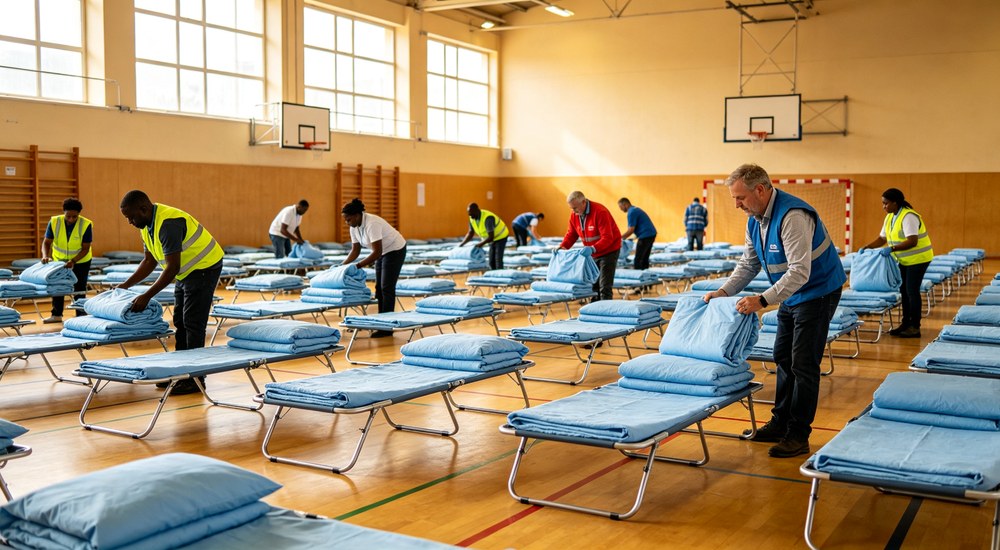
A temporary accommodation bedding set that works in a refugee camp may fail in a school dormitory, because bed format, laundry capacity, and user rotation are different. This guide covers exactly what to check before you order temporary accommodation bedding — from sheet format and fabric GSM to packaging and certification.
Short stays with mixed bed types usually need flexible flat sheets and simple construction. Longer stays with fixed beds can compare fitted sheets, heavier fabric, and durable openings. Humid or high-turnover sites must put drying time and rotation quantity first — not softness. Start by grouping your accommodation zones, then ask for sheet-by-sheet specifications for each group.
This approach applies to emergency relief projects, refugee camp operations, and displaced persons housing. The same temporary accommodation bedding set can also serve school dormitories and hospital overflow wards. It works for evacuation shelters too — as long as specifications match the actual site conditions.
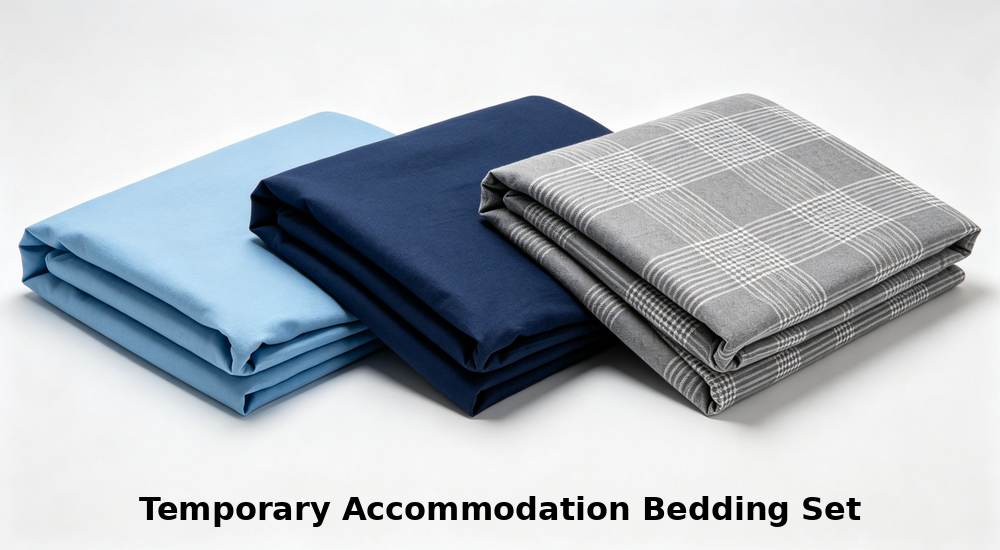
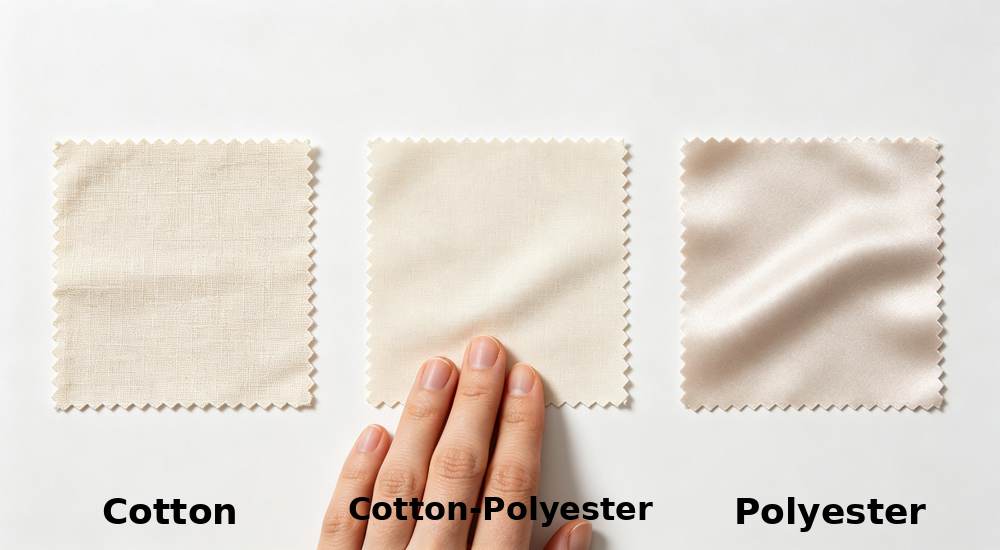
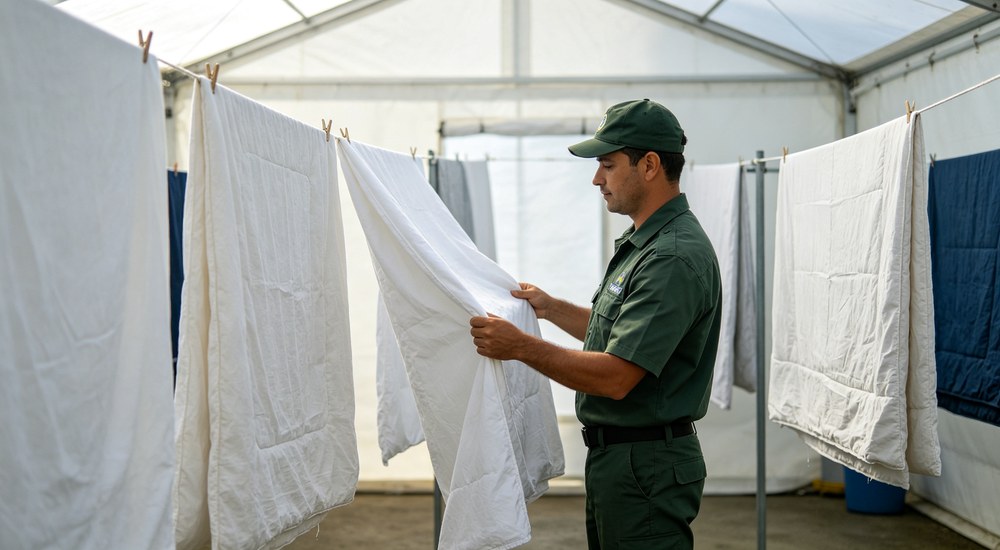
Many buyers default to cotton because it feels familiar. For temporary accommodation bedding, the right fabric depends on your laundry capacity and site humidity — not on what you use at home. A cotton set feels softer, but in a humid camp without mechanical drying it may take 24–48 hours to dry. Polyester often dries in 6–8 hours. That gap means you may need twice as many cotton sets in rotation.
The most costly error is ordering one "single size" for every bed. A folding bed, a thin gym mat, and a standard single bed all get called "single," but their depths and corner access are completely different. Measure each bed group before you commit to a temporary accommodation bedding set.
1. Five Conditions Before Ordering
6. Certification & Why Choose Us
Do not open a catalogue and pick the cheapest set. Answer these five questions first — they decide which temporary accommodation bedding set will actually work on your site:
1. How long will people stay? Days means quick replacement matters more. Months means comfort and durability matter more.
2. What beds are actually on site? Floor pads, folding beds, thin mattresses, standard singles, and bunks need different sheet formats.
3. How will the bedding be washed? Central laundry, outsourced, hand-washed, or no washing — each needs a different fabric and opening.
4. How humid is the site? If sets cannot dry within 24 hours, you need more rotation sets, not thicker fabric.
5. How often do occupants rotate? High turnover means fast insertion and removal. Stable occupancy means feel and wear resistance.
One site often needs two or three setups — not one temporary accommodation bedding set everywhere. Divide the site into zones. Write down the conditions for each zone. Then ask the supplier to return sheet format, fabric direction, duvet-cover opening, pillowcase opening, and sample status per zone. You may also want to compare this with emergency relief bedding specifications for rapid-deployment scenarios.

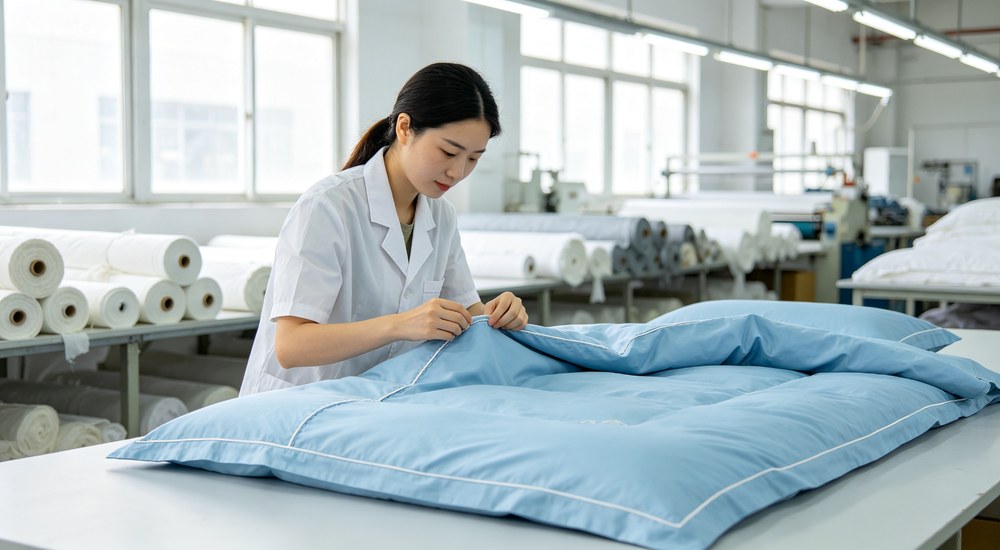
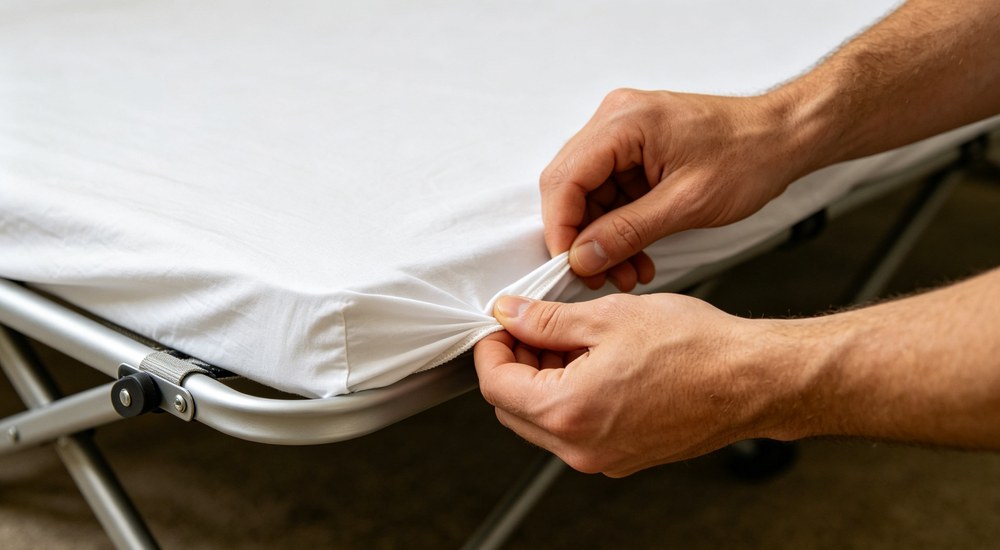
Measure the actual sleep surface, not just the frame. A folding bed labeled "single" may have a 75×190 cm sleep area while a standard single bed is 90×200 cm. QC inspectors verify stitching and seam strength before packing.
The sheet format is the first decision, because a sheet that does not fit makes everything else irrelevant. Here is the direct comparison for temporary accommodation bedding:
|
Factor |
Flat Sheet |
Fitted Sheet |
|
Ideal for |
Mixed bed types, folding beds, thin pads, unknown depth |
Fixed zones with consistent mattress length, width, depth |
|
Depth tolerance |
High — extra fabric tucks under |
Low — elastic corners must match depth range |
|
Corner access |
No corner access needed |
Needs all four corners reachable |
|
Common single size |
160×240 cm for 90×200 cm bed |
90×200 cm, pocket 15–25 cm |
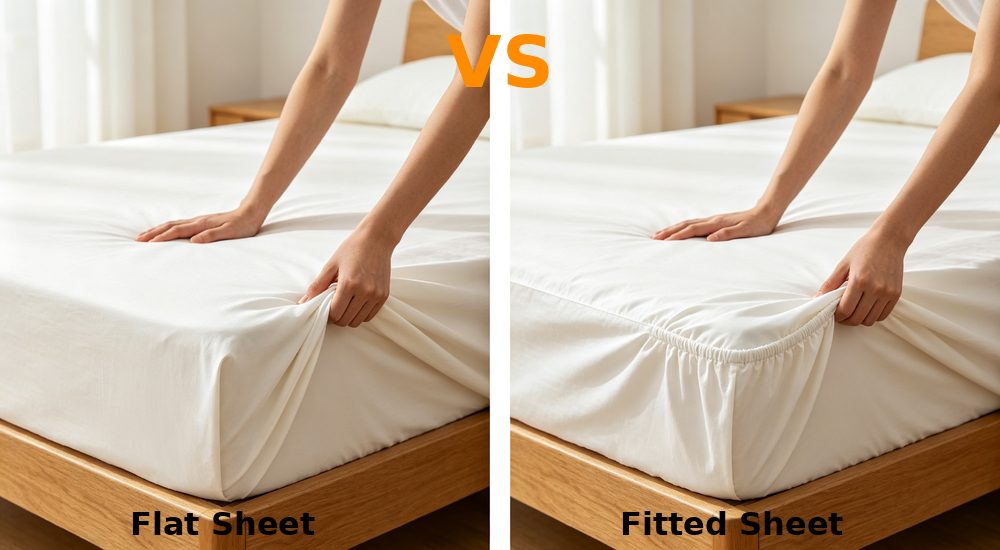
Flat sheets are the safer choice when bed types are mixed or mattress depth is unknown. A 160×240 cm flat sheet fits a 90×200 cm bed with about 35 cm of fabric to tuck on each side. Fitted sheets look neater but only work when every bed in the zone has the same dimensions. Pocket depth typically ranges 15–25 cm — confirm the actual mattress thickness before you commit.
|
Fabric |
Composition & GSM |
When to choose |
What to watch |
|
Cotton |
100% cotton, 120–200 gsm |
Longer stays, stable laundry, dry climate |
Slow drying in humidity; shrinkage 3–5% if not pre-shrunk |
|
Cotton-polyester |
65/35 or 50/50, 110–180 gsm |
Most institutional sites — balanced feel and drying |
Confirm exact ratio per sample |
|
Polyester |
100% microfibre, 90–150 gsm |
Humid sites, fast turnover, limited laundry |
Less breathable in heat; cheap grades pill |
For most temporary accommodation bedding projects, a cotton-polyester blend at 130–150 gsm is the practical starting point. It dries faster than cotton, holds its shape better than pure polyester, and costs less than high-grade cotton. Ask every supplier for GSM, composition percentage, weave type, shrinkage rate, and colourfastness on every quote. If a supplier cannot give these numbers, the quote is not comparable. For related products, see also hospital bedding sets for infection-control considerations.
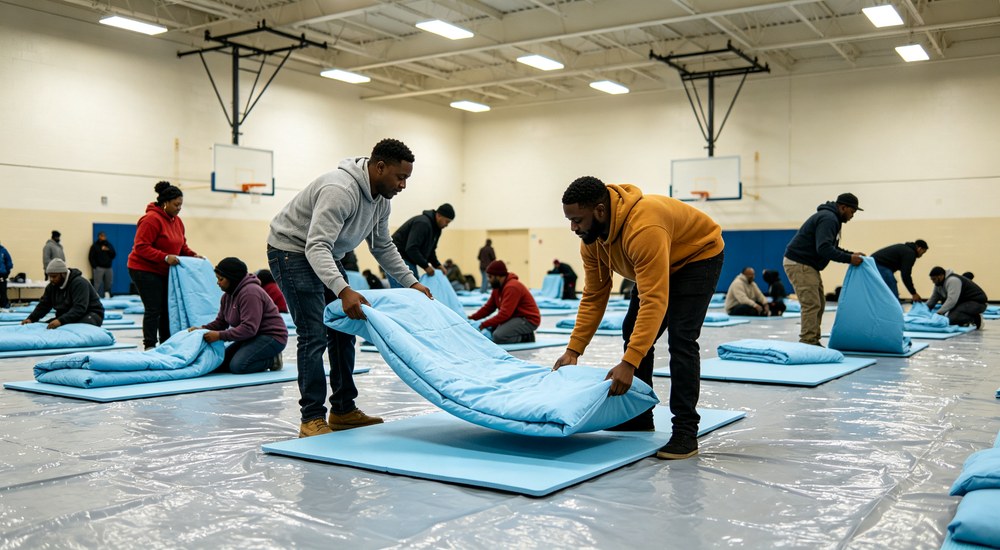
Thin pads, mixed sleeping lengths, limited space. People stay days to weeks.
What to order: flat sheets 140×220 cm for 70×190 cm pads, duvet covers 140×200 cm, pillowcases 50×70 cm. Fabric: 110–130 gsm cotton-polyester or polyester. Envelope openings.
Why: flat sheets tolerate pad variation. Light fabric dries fast. Envelope openings hold up under frequent changes. This setup is common in evacuation shelters and disaster response operations.
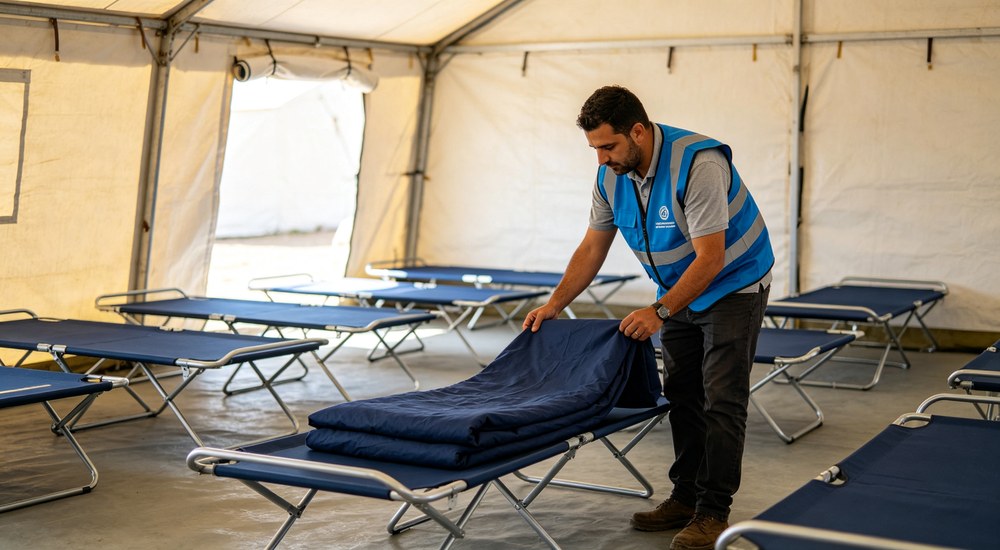
Folding beds in rows, staff change bedding weekly, humidity varies.
What to order: test both flat and fitted on the actual folding bed first. If depth is consistent, use fitted sheets 80×200 cm with 15 cm pocket. If depth varies, use flat sheets 160×230 cm. Fabric: 120–150 gsm cotton-polyester. Zipper or envelope duvet opening.
Why: durability and ease of care matter more than softness in refugee camp settings. Measure the actual sleeping surface first — folding beds often run 75×190 cm or 80×200 cm.
Fixed beds, stable occupancy, organized laundry.
What to order: fitted sheets 90×200 cm with 15–20 cm pocket. Fabric: 130–180 gsm cotton or cotton-polyester. Durable duvet-cover opening. Component-level replacement available.
Why: residents stay months, so feel and wear resistance justify a more durable fabric. In humid areas, still compare drying time. Keep a 1-in-use + 1-in-laundry + 1-in-storage rotation. Organizations such as UNHCR, Red Cross, and other NGOs may require specific documentation for humanitarian procurement — confirm tender requirements before finalizing.

School dormitories and transitional housing often use bunk beds with standard 90×200 cm mattresses, where fitted sheets work well. But across a full site, bed types rarely match — thin pads, folding cots, and fixed beds each need different sheet forms.
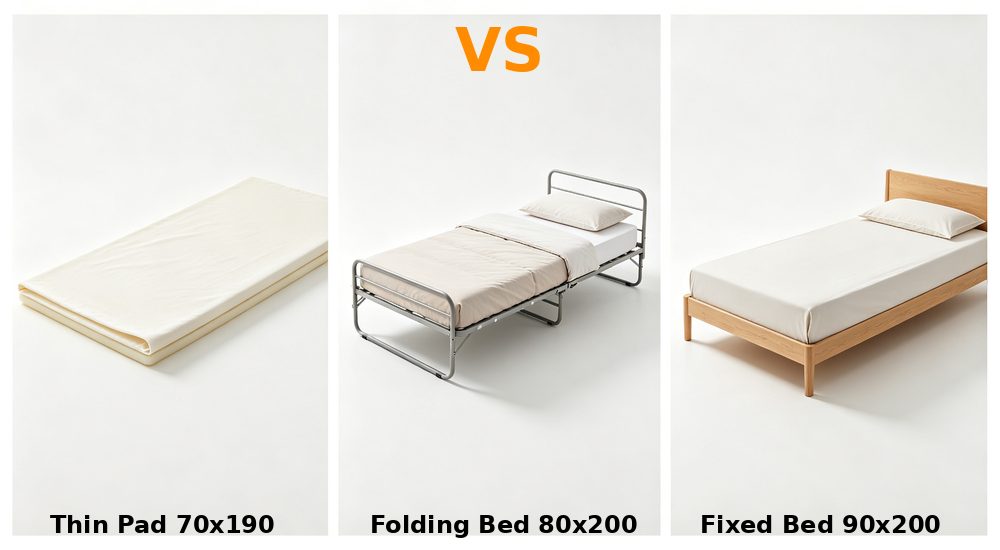
The table below gives common starting specifications. Always confirm actual bed dimensions on site before ordering a temporary accommodation bedding set.
|
Bed Type |
Flat Sheet |
Fitted Sheet |
Duvet Cover |
Pillowcase |
|
Thin pad (70×190 cm) |
140×220 cm |
Not recommended |
140×200 cm |
50×70 cm |
|
Folding bed (80×200 cm) |
160×230 cm |
80×200×15 cm pocket |
150×200 cm |
50×70 cm |
|
Fixed single (90×200 cm) |
160×240 cm |
90×200×15–20 cm pocket |
150×200 cm |
50×70 cm |
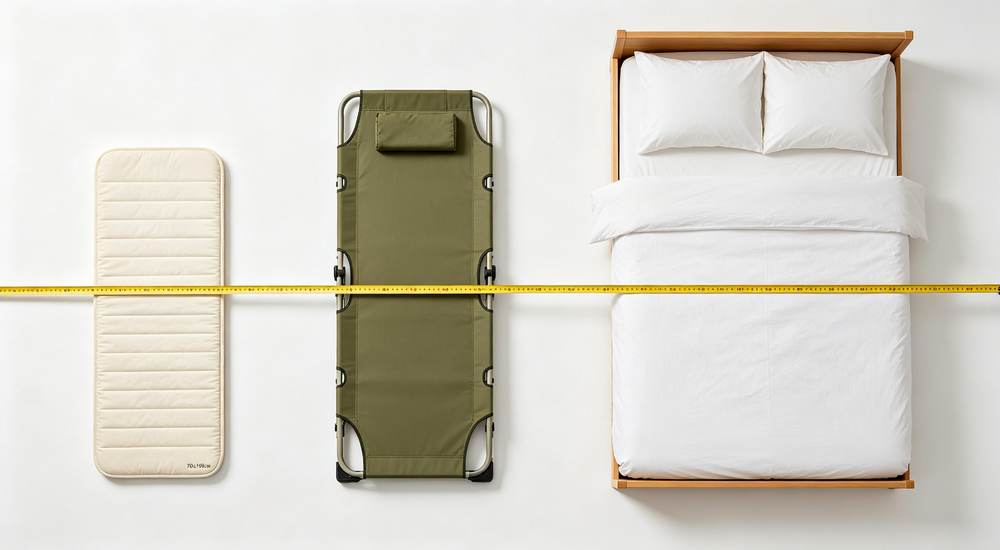
Always measure the actual bed on site before ordering. Sizes vary by region and supplier. Color choices also affect practicality — white shows dirt but may be required for infection control, while darker colors hide stains but absorb more heat.
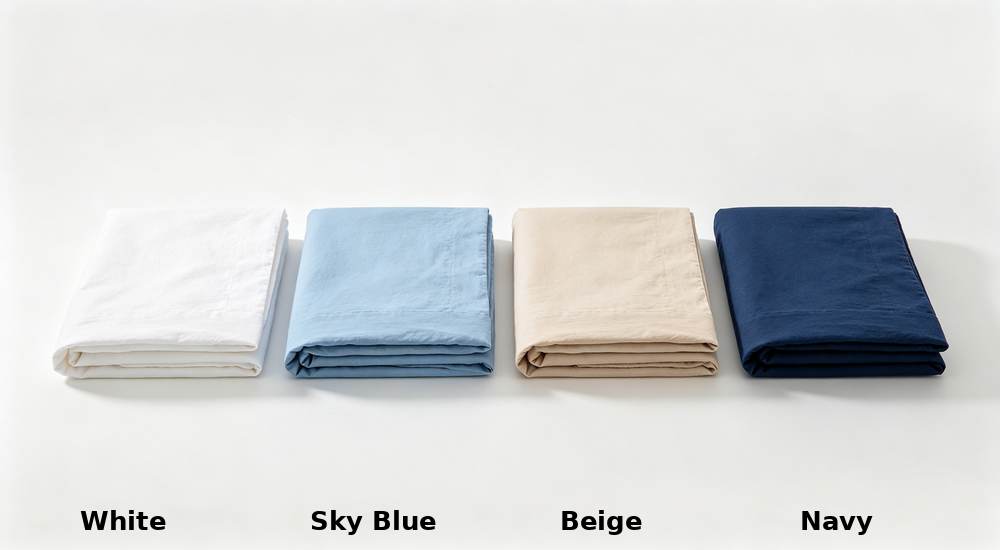
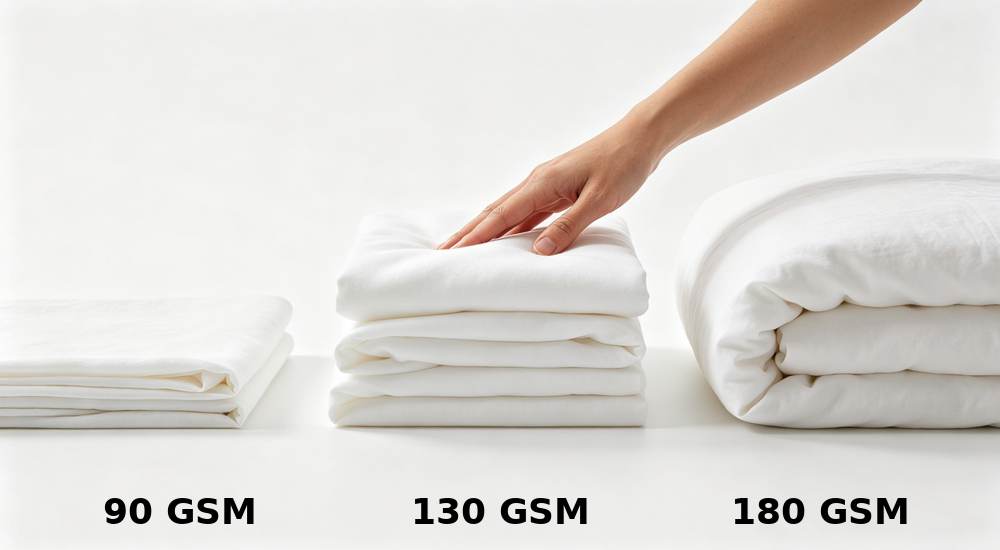
GSM selection by use case: 90–120 gsm for short-stay emergency and budget-sensitive projects; 120–150 gsm for most institutional and refugee camp use; 150–200 gsm for longer-term fixed accommodation where comfort and durability justify the extra weight. Colour options: white, light blue, beige, and navy are common for temporary accommodation bedding. White shows dirt clearly but may stain; darker colours hide stains but absorb more heat. Colour can also mark zones — but always pair colour with a printed label, because colour alone fails in low light.
Packaging affects shipping cost, storage space, and on-site distribution. A temporary accommodation bedding set is commonly packed in a polybag per set, then multiple sets per export carton. Vacuum compression can reduce carton volume by 30–50%, which lowers sea freight cost — but confirm the fabric can recover its loft after compression.
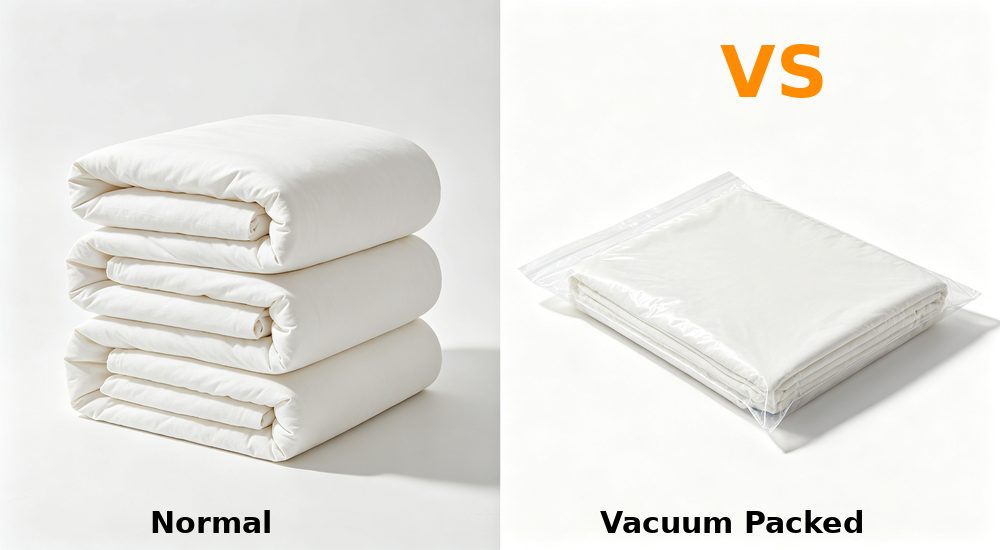
Key packaging fields to confirm: sets per carton, carton dimensions (L×W×H), gross weight per carton, net weight per set. Also confirm whether polybags are labelled with zone and size, and whether carton marks include the purchase order number. For humanitarian tenders, packaging may need specific labelling — confirm these before production.
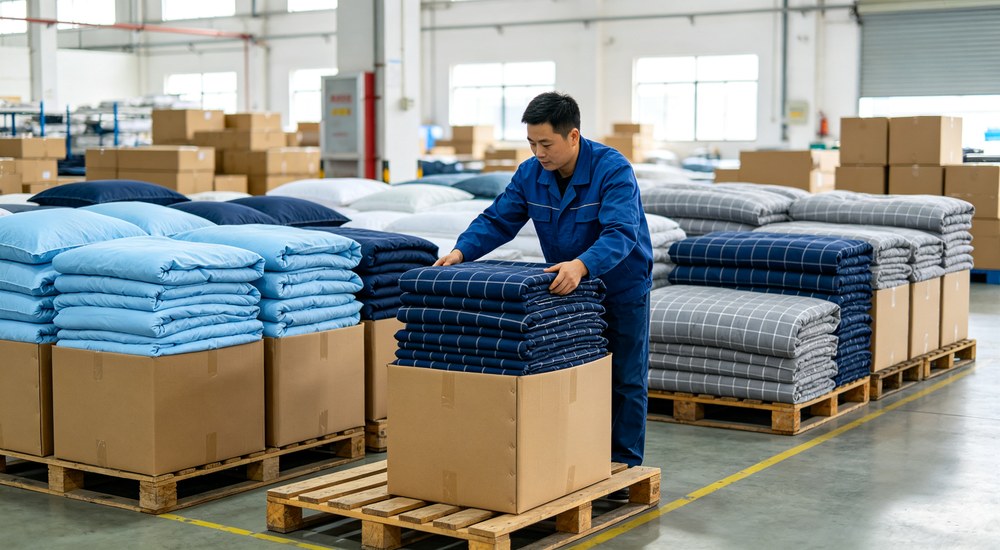
For large orders, ask whether the supplier can pack by zone (e.g., all Zone A sets in one carton series) to simplify on-site distribution. Mixed-size orders should be clearly separated by size on the carton label to avoid sorting errors at the destination.
Only if every zone has the same bed format, dimensions, stay length, and care method. In practice, that almost never happens.
Fixed beds, folding beds, and thin pads usually need different sheet formats. A humid zone and a dry zone need different fabric and rotation counts. Group the zones first, then ask for sheet format, fabric direction, and component dimensions per group. Two or three clearly defined setups are easier to manage than one temporary accommodation bedding set that does not fit anywhere.

No. Polyester dries fastest, but the choice also depends on feel, washing, ventilation, and the actual sample. Cotton and cotton-polyester can still work.
Take fabric samples, wash them, and time how long each takes to dry under your site conditions. In humid conditions without mechanical drying, cotton may take 24–48 hours. Polyester often dries in 6–8 hours. That gap can mean twice as many rotation sets — which could make cotton more expensive overall. A fibre name on a label does not prove drying performance; your own test does. You may also want to review disaster relief supplies for humidity-specific recommendations.
Only when the sleeping surface, length, width, and depth allow secure corner fitting. Many folding beds do not use a standard deep mattress, or their corners are hard to reach.
Flat sheets are usually the first option to test for these beds. If the folding bed has a standard mattress with consistent depth and the four corners are reachable, a fitted sheet can work. Check several beds from the same batch — frame and pad differences can change the result.
There is no single best GSM — it depends on stay length, laundry capacity, and climate.
For short stays and mixed bed types, 110–150 gsm cotton-polyester or polyester works well. For longer fixed accommodation, 130–180 gsm cotton or cotton-polyester is common. Higher GSM costs more and takes longer to dry, so balance durability against your rotation capacity. Always ask for the exact GSM on the quote, not just "cotton" or "polyester."
MOQ depends on material, size mix, colour count, custom marking, packing, and total order quantity. It must be returned under current commercial conditions.
A single-colour, single-size order has a lower MOQ than a mixed-size, multi-colour, custom-printed order. Submit your zone groups with component dimensions, quantities, destination, and customization. Ask whether the MOQ applies per component, per size, per colour, or to the total order. Do not reuse an MOQ from another project.

Bedding sets are commonly packed in polybags per set, then multiple sets per carton. Compressed packing can reduce volume.
Confirm carton dimensions, gross weight, and sets per carton with your supplier before ordering. For large projects, ask whether packing by zone is possible to simplify on-site distribution. Humanitarian tenders may have specific labelling requirements — confirm these before production starts.

Only when applicable testing covers the exact fabric, colour, opening, and care method you are ordering. A fibre name does not prove wash cycles.
Ask for the product identity, fabric, colour, opening, test method, and report scope. If the report does not match your setup, treat wash cycles as a sample-check item, not a guarantee. Define what counts as failure — poor fit, opening damage, or tearing — before testing.
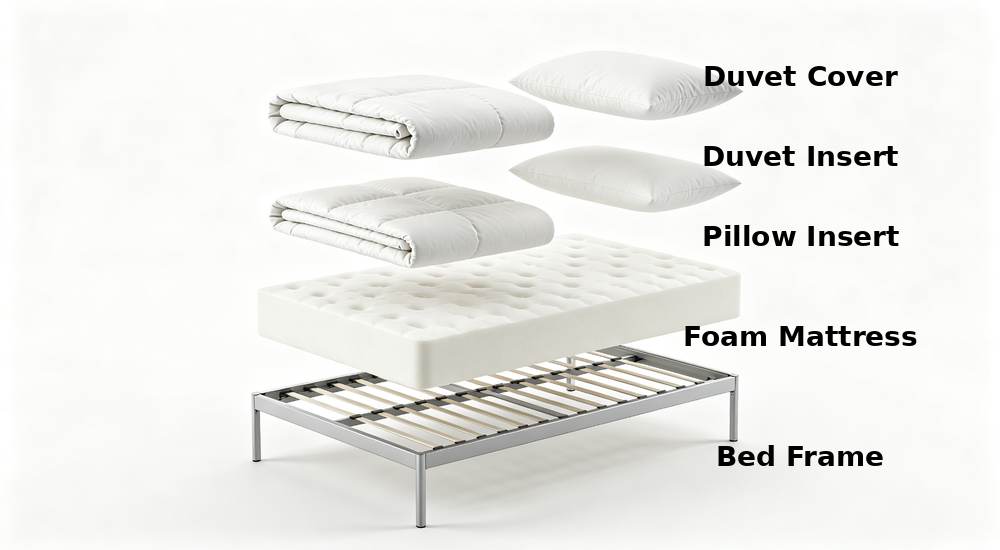
A three-piece temporary accommodation bedding set covers the outer layer only. Beds, mattresses, duvet inserts, pillow inserts, blankets, and sleeping bags are separate products.
Choose those based on climate, bed format, and stay length. Then check that dimensions match — a 140×200 cm duvet cover needs a 140×200 cm insert. For emergency relief and displaced persons projects, coordinate bedding with shelter supplies so the whole setup works together. The supplier can suggest combinations, but keep related product pages as text-level next steps until real URLs exist.
Product names like "emergency bedding" or "institutional bedding" on a catalogue page do not prove cotton percentage, shrinkage, colourfastness, antibacterial performance, flame resistance, certification, or wash cycles. Test reports must name the exact product and setup. When two sources give different numbers, do not pick the nicer one — ask which applies to your quoted sample.
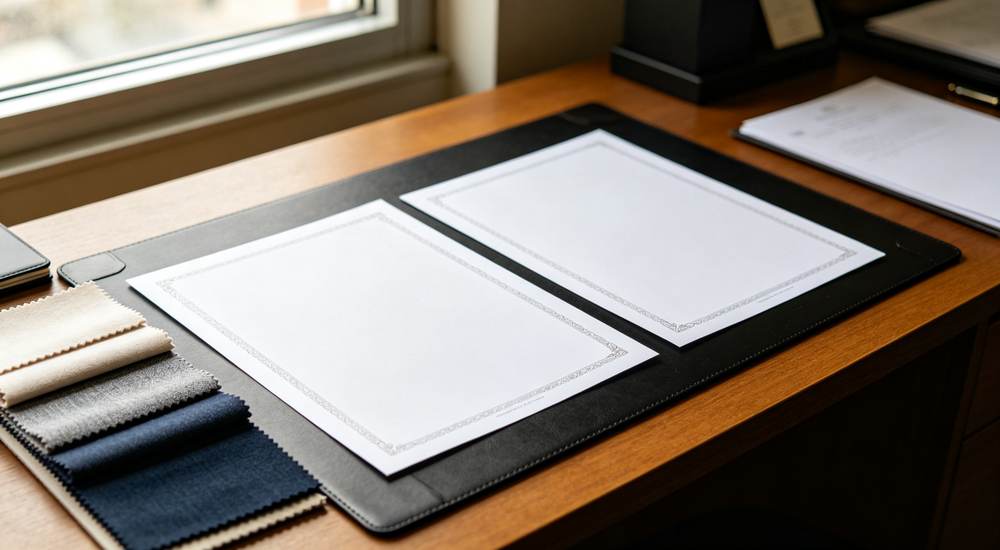
Certifications that may be relevant for temporary accommodation bedding include OEKO-TEX Standard 100 (textile safety) and ISO 9001 (quality management). Flame-retardant standards may also apply where required by local building codes or tender specifications. Always ask for the certificate number. Confirm it matches the product you are ordering — not a similar product from the same factory. Certifications available upon request, subject to contract.
Taking the time to specify each component — sheet format, GSM, dimensions, openings, packaging — is what separates a successful procurement from a shipment that does not fit. A valid sample tested on the actual bed, washed and re-tested, is the final confirmation before a bulk order.

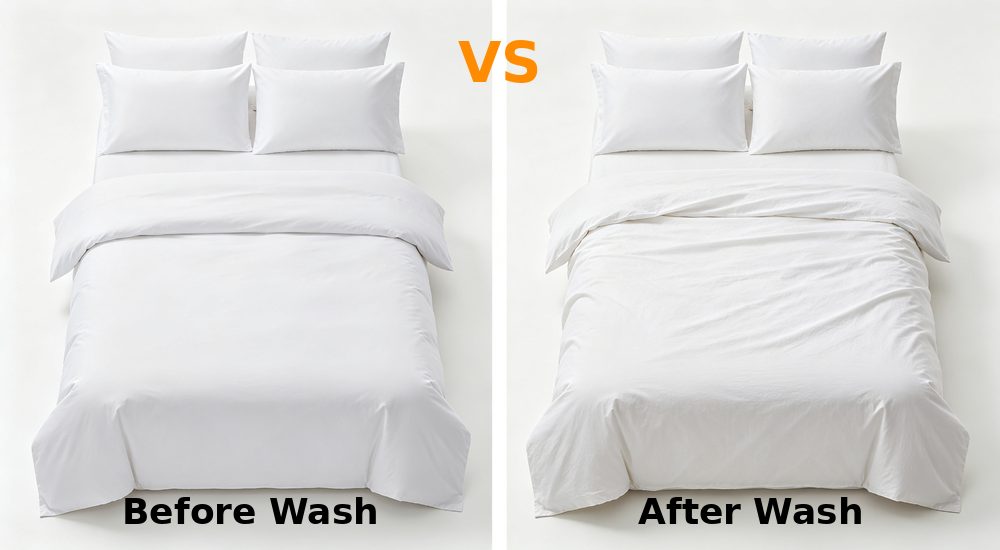
Color fastness testing confirms that bedding will not bleed onto other laundry or stain mattresses after repeated washing. A well-specified temporary accommodation bedding set makes the difference between a functional shelter and a site where nothing fits, nothing dries, and budgets overrun.
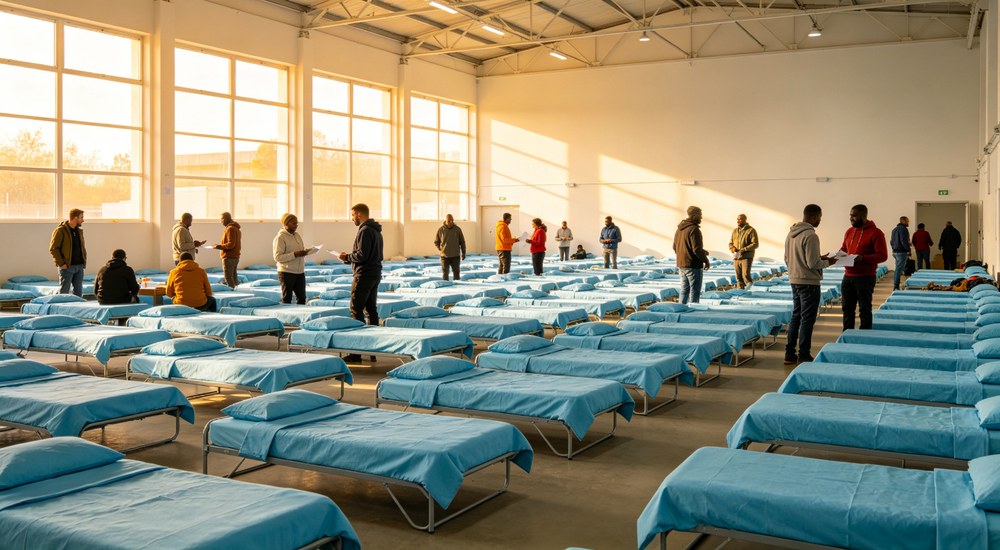
Ready to finalize bedding specifications for your temporary accommodation project?
Send site layouts, bed types, length of stay, laundry method, and quantities by zone. You will receive component-level specifications, sample validation methods, and comparable quotation inputs.
Liens amicaux :
droits dauteur © Custom Disaster - Relief Bedding: Tents, Sleeping Bags, Blankets Tous les droits sont réservés
léquipe professionnelle au service !